COMMENTARY / OPINION

Leftist Narratives of Global Warming and Other Fear Porn Are Evaporating JEROME R. CORSI, PH.D.
“Trust the Science” is Actually a Unicorn hunt.
SEP 01, 2025
The world economy continues to spiral downward. Fiat currency is dissolving as precious metals increase in value. Go to corsination.com and click on the Swiss America link for a free eBook, personal consultation, and precious metals purchases.
The last four months of 2025 are going to be dramatic. President Trump will continue to put pressure on both Russia and Ukraine to end their war and stop the bloodshed. Israel is on the cusp of taking complete control of Gaza.
2026 will begin with an entirely new and MAGA approach to the United States.
Stay tuned, in the end, God always wins!
“Liquidate the Galuth or the Galuth will liquidate you. Dr. Alex Grobman
What is a major signs to be aware of in ascertaining the present danger of antisemitism? German Jews did not want to overreact…Op-ed.
Mar 31, 2022, 3:00 PM (GMT+3) Israel National News
The precipitous increase of antisemitism in the US has alarmed American Jews. Their reaction to this rise of assaults, vandalism and harassment, which “remain at near-historic levels in the U.S,” according to the ADL, has been instructive. Some of these incidents remind Jews of Germany of 1933- 1934 or even Kristallnacht. In response, some Jews intend to move to Florida, increase their involvement in Jewish defense organizations and lobbying groups like NORPAC and AIPAC or simply wait for the Messiah to come toand rescue them. Still others, are obtaining Israeli citizenship as an insurance policy— as a hedge in case the situation in the US deteriorates significantly.
In making their decision to move to Israel, some cite their fear of another Holocaust or just the desire to live in a Jewish state. A number quote Ze’ev Jabotinsky, founder of the Zionist Revisionist movement, who, in the late 30s, urged his followers to leave Europe: “Liquidate the Galuth or the Galuth will liquidate you.”
In hindsight, Jabotinsky’s admonition before World War II sounds prophetic, as if he foresaw the Holocaust, but did he? The context in which Jabotinsky conveyed this warning is missing, the late Hebrew University historian Jacob Katz declared. Jabotinsky’s remarks were made, Katz asserts, “to prod his people to a more active Zionism than the leadership in charge thought possible or even contemplated.” He advocated the “evacuation” of Polish Jewry , and would “not have hesitated to enlist the assistance of the Polish government, regardless of its antisemitic motivations, to implement his plan.”
He attempted to persuade Polish Jews of the exigency of emigrating from Poland because of the worsening economic, social and political measures enacted against Polish Jews. Katz said Jabotinsky used the plight of German Jewry as an example of what Polish Jews should be doing. Jews were , since they were fleeing Germany as a result of the anti-Jewish legislation and persecution. It was in this context, that Jabotinsky used the expressions that appear to reflect the dire associations with the Shoah.
Jabotinsky “had no apprehension of a possible conquest of other countries by the Nazis.” Yet, like many Jewish intellectuals, Hhe shared with many Jewish intellectuals their “illusion about the fragility of Nazi rule,” convinced that it would collapse, either through “internal difficulties” or during Germany’s first hostile encounter with a foreign power.
How unaware Jabotinsky about was to what awaited the Jews of Poland is plainly demonstrated by his timetable for evacuating Jews from Poland. He wanted to transfer one and a half million Jews to Palestine during the next ten years beginning in the late 30s. In other words Katz concluded, “Neither the scope nor the imminence of the tragedy was foreseen in this suggestion.” His “vision, inspired though it was by a deep passion for the welfare of his people, was as limited by the impenetrability of the future as the vision of anybody else.”
Jabotinsky’s prediction about the future of Polish Jewry seemed prescient, but, with hindsigiht, we know it was greatly flawed. This illustrates the danger, Katz points out, of the futility of predicting the future. Those who attempt to warn us of the possibility of another Holocaust, “simply project the past into the future—a way of prognostication that has always turned out to be false.” What we can learn from the past, is to ask the “right question to be put in the diagnosis of the present.”
A Final Note
What is one of the major signs we need to be aware of in ascertaining the danger of antisemitism? The late George L. Mosse, one of the world’s leading historians of European intellectual and cultural history, said it is when we should determine whether antisemitism has becomes a mass movement. In other words, we need to ask whether antisemitism and the myth about Jewish power have become mainstream and acceptable to all segments of society, especially polite society.
In The Crisis of German Ideology: Intellectual Origins of The Third Reich, Mosse noted historians and laypersons questioned whether “men of intelligence and education could really have believed the ideas” espoused by the Nazis. Many, he said, thought the “ideological bases of National Socialism were the product of a handful of unbalanced minds.” Others were convinced the leaders did not share these views or that the ideas were “so nebulous and incomprehensible,” they were rejected as being insignificant. Yet, as Mosse asserted, these ideas “were embraced by many normal men… the Nazis found their greatest support among respectable, educated people.”
The late journalist and author Amos Elon observed in The Pity of It All: A Portrait of Jews In Germany, 1743–1933, how many German Jews did not want to “overreact” by uprooting their lives and families even when it became clear German oppression would continue to escalate. Once the severity of the situation became undeniable, for all too many it was too late, and they were unable to leave.
Today, antisemitism, is expressed in baseless attacks against Israel. Portraying Israel’s relationship with the Palestinian Arabs as a combination of “military occupation, colonization, ethnic cleansing and apartheid,” means that “justice and freedom for the Palestinian Arabs are incompatible with the existence of the state of Israel,” according to political scientist As’ad AbuKhalil. In other words, Israel is an illicit and immoral state that should never have been established. To counter the “Zionist entity,” the goal is to delegitimize, marginalize, and dehumanize Jews and undermine Israel’s economy. The BDS movement (Boycott, Divestment and Sanctions) was designed to promote these objectives.
Antisemitism under the guise of vilifying anti-Israel, permeates all sections of American society-from the halls of Congress, the academy to the members of the Right and Left groups. In assessing the danger American Jews face today, it is prudent and useful to heed the words of Bret Stephens. “American Jews, he said, “find ourselves at perhaps the most successful period in our history, at a moment when much of the progressive left has decreed that privilege is a sin and that those who hold power should be stripped of it. Anyone with a long view of Jewish history should know how quickly economic and social privilege can turn to political and personal ruin, even — or especially — in countries where it might seem unthinkable.” We have been fortunate thus far, but we must understand that some someday “our luck in America may run out.”
Dr. Alex Grobman is the senior resident scholar at the John C. Danforth Society and a member of the Council of Scholars for Peace in the Middle East. He has an MA and PhD in contemporary Jewish history from The Hebrew University of Jerusalem and heeding his own words, lives in Jerusalem.
US Foreign Aid to Israel: a Mega Billion Dollar Bonanza for the US Ambassador (ret.) Yoram Ettinger
“Second Thought: a US-Israel Initiative”
September 1, 2025
Some influential US public opinion molders claim that foreign aid to Israel has been extended at the expense of the US taxpayer and US national security.
Really?
*Israel was compared by Admiral Elmo Zumwalt (a former US’ Chief of Naval Operations) and General Alexander Haig (a former NATO Supreme Commander and US Secretary of State) to the largest US aircraft carrier, which does not require US soldiers on board, and is deployed in a most critical area between Europe-Asia-Africa and between the Mediterranean-Red Sea-Indian Ocean-Persian Gulf. This area is the hotbed of 1,400-year-old intra-Muslim and intra-Arab terrorism and wars, the epicenter of global anti-US Islamic terrorism, the platform of 48% of global oil reserves, and a crucial intersection of Far East-Europe sea lanes.
*Comparing Israel to the largest US aircraft carrier has been a derivative of Israel’s key pro-US geo-strategic features in the face of mutual threats, such as the Ayatollah regime and The Muslim Brotherhood. These features are not typical of other allies:
<Israel’s geo-strategic location;
<Israel’s posture of deterrence, which is critical for the survival of Jordan’s pro-US Hashemite regime and other pro-US Arab regimes;
<Israel’s proven defense and commercial technological capabilities;
<Israel’s contributions to the research & development, exports, employment and superiority of the US defense industries and high tech sector;
<Israel’s rapid and massive self-manned troop mobilization;
<Israel’s game—changing, pro-active military track record has advanced US interests.
<General George Keegan, a former Chief of US Air Force Intelligence assessed that the intelligence shared by Israel with the US equals to 5 CIAs. The annual budget of one CIA is around $15bn;
<Israel’s unconditional identification with the US by the vast majority of Israel’s public and political establishment (L and R, secular and religious).
*According to General Haig, if there were not Israel in the Middle East, then the US would have to invest $15bn-$20bn annually (instead of$3.8bn annual investment in Israel) for the manufacturing of a few real aircraft carriers. These carriers would be deployed to the Indian Ocean and the Mediterranean, accompanied by a few ground divisions, in order to shield US soil from the wrath of Islamic terrorism, secure US’ economic interests, sustain the survival of the US’ Arab allies, and constrain China and Russia.
*Israel’s role as a strategic asset is underscored, when comparing the $3.8bn annual US investment in Israel to the cost of manufacturing new aircraft carriers: $10bn-$13bn for one supercarrier, while smaller carriers may cost $2.5bn-$9bn each. Moreover, deploying and operating a carrier, including a full carrier strike group of destroyers, frigates, submarines, and support vessels, incurs annual costs of $900mn-1.2bn. In addition, the annual cost of deploying a single US ground division to the Middle East is $2bn, excluding the cost of munition and missiles, with higher costs in combat-intense or logistically complex environments.
The bottom line
*The US annual investment in – not foreign aid to – Israel yields a uniquely high Return-on-Investment (R-o-I) by Israel, which is acting as a force and dollar multiplier for the US economy and defense. Israel is also performing as the most productive battle-tested research and development center, as well as the showroom of the US defense and aerospace industries, and an innovation center, sharing ground-breaking battle tactics with the US Armed Forces.
*Israel’s military and intelligence capabilities have reduced the need for US military deployments in the region, enhancing the safety of US soldiers.
*Israel’s military, intelligence and technological capabilities – unmatched by any other ally of the US – have significantly lessened the burden on the US military in the Middle East, saving substantial US resources and lives, and facilitating the diversion of US resources to other regions.
*The intense collaboration between Israel and the US military has dramatically expanded since January 2021, when Israel joined CENTCOM (which oversees US military interests in the Middle East, Central Asia and parts of South Asia), upgrading the performance of both the US and Israel.
[Ed.:

OPERATION WARP SPEED WAS A DISASTER JAMES ROGUSKI
Please forward this article to President Donald J. Trump and share it widely across social media.
SEP 01, 2025

Most people still don’t understand Hamas’ strategy. ANDREW FOX
Ultimately, the terror group’s most significant weapon is not rockets or fighters, but its capacity to endure and adapt.
AUG 31, 2025
When conducting military tactical planning, the first question for most armies is a variation of “What is the enemy doing, and why?” to determine the enemy’s likely course of action.
The IDF is preparing to strike at the heart of Hamas’ stronghold in Gaza City. To anticipate what lies ahead, it is necessary to think like Hamas’ commanders: to ask what they value most, what options they perceive, and what actions they are likely undertaking now to ensure their movement survives.
Hamas’ aim, most generally, is survival. Hamas does not expect to win on the battlefield against a much stronger enemy. Instead, its strategy will focus on surviving as a movement, manipulating the battlefield to increase Israeli costs, and preparing to continue as an underground insurgency even if it is pushed out of open control of Gaza. Understanding this viewpoint helps explain why Hamas acts as it does, why Gaza City has become a fortress, and why the eventual fall of the city may not bring about the end of the conflict.
Hamas’ primary goal is to ensure its organisational survival. In conventional warfare, armies fight to hold territory or achieve decisive military victories. Hamas’ priorities differ. Its objectives in the current phase can be broken down into six key elements.
- Preserve leadership and organisational continuity. As long as some senior leaders and cadres remain intact, the movement can reconstitute itself, even in exile. Hamas is not confined to Gaza. They have cells in Syria, Lebanon, and the West Bank (where they poll a 70-percent approval rating). Their leadership sits in Qatar. Killing every Hamas member in Gaza does not destroy Hamas.
- Maximise the civilian death toll. Hamas sees civilian casualties as leverage. Hamas hopes it can generate international pressure on Israel to halt operations, or, just as good, delegitimise Israel, and cement its pariah status on the world stage.
- Delay Israeli advances. Every day bought through negotiation or tactical defence gives Hamas time to consolidate and increases the chance of diplomatic intervention.
- Embed for insurgency. If it loses its governing role in Gaza, Hamas intends to remain present as a shadow network and resistance movement.
- Eliminate rivals. Hamas has a long record of suppressing dissent through intimidation and assassination. As pressure mounts, it is likely tightening its grip by removing those who might collaborate with Israel or challenge its legitimacy.
- Exploit hostages. Captured Israelis remain Hamas’s most valuable bargaining chips. Beyond negotiation, hostages can be executed if Israel pushes too hard, serving both as a deterrent and as psychological warfare.
This ruthless approach indicates that Hamas’ survival strategy targets not only Israel outwardly, but also its rivals internally, and even the hostages.
Israel has spent years hunting Hamas’ senior leaders, and in this war, it has devoted enormous resources to successful “decapitation” strikes, yet Hamas has prepared for this. Its leadership is decentralised. Command and control is deliberately redundant, with communication nodes dispersed and authority shared across multiple figures. Hamas is likely no longer a centralised authority, but multiple smaller groups across the Strip, acting to a shared intent.
Hamas’ government departments are still in operation. The apparatchiks at its Ministry of Health have been Hamas’ single greatest weapon during this war and still push out their lies to a gullible world. These are not neutral civil servants who will flex to follow whoever is the next administration in Gaza. Hamas spent years ruthlessly purging government systems within Gaza. These administrators might make all the right noises, but be in no doubt: They are Hamas loyalists to the core, and they will ensure that Hamas’ influence continues to pervade Gaza’s governance systems.
The kicker: Remove them, and every governance system in Gaza collapses. The next administration will have no choice but to retain them.
Hamas has examined Hezbollah’s example in Lebanon, which has survived multiple Israeli campaigns due to a similar organisational structure. The principle is the same: Absorb the attrition, survive, and hope to regrow in the long term (even if it takes decades). From Hamas’ perspective, the risk of destruction is reduced when command is decentralised. Consequently, even if Gaza City is overrun, parts of the leadership are almost certain to remain capable of hiding and waiting things out, or regrouping elsewhere.
No aspect of Hamas’ strategy in Gaza has been more murderous than its use of civilians. From the earliest days of the conflict, Israel urged civilians in Gaza City to evacuate southwards. Hamas responded by encouraging residents to stay in their homes. Mosque loudspeakers and official spokesmen portrayed evacuation as a trick aimed at permanently displacing Palestinians, echoing memories of the 1948 “Nakba.”
This tactic serves Hamas in multiple ways. The presence of civilians complicates Israeli operations, constraining the IDF’s use of firepower. High casualties attract international attention, feeding global campaigns to halt Israel’s offensive. By tying civilians to the terrain, Hamas ensures that any advance through Gaza City is slow, bloody, and politically costly for Israel.
So far, reports indicate that out of 1.3 million people, between 10,000 and 40,000 Gazans have left Gaza City. If these figures do not increase, attacking Gaza City could result in the highest civilian death rate since the war began. I would even suggest that a major assault might not be feasible unless more civilians evacuate. The cost would be too great to justify militarily.
From Hamas’ perspective, the civilian population is not just a shield but also a weapon in the information war. The more the conflict is portrayed worldwide as a humanitarian disaster, the more Hamas hopes Israel will face pressure to cease. In this context, Hamas’ fighters are not isolated; they are surrounded by strategically valuable human terrain.
Hamas has consistently sought to draw out the conflict through negotiation. Temporary ceasefires, typically tied to hostage exchanges or humanitarian access, serve not only humanitarian purposes but also military ones. Each pause allows Hamas to regroup, resupply, and reposition. Each day of delay increases the chance of external pressure on Israel. I would not be surprised to see a ceasefire-for-hostage-release agreement in the near future. Hamas will want to buy time wherever possible.
Hostages are central to this strategy. They are bargaining chips to trade for Palestinian prisoners and political concessions, and they are also a deterrent. Hamas has openly threatened to kill captives if Israel advances too far or too quickly. From the group’s perspective, hostage execution serves two purposes: punishing Israel for its actions and shaping Israeli public opinion by turning each advance into a potential death sentence for compatriots held underground.
For Hamas, negotiation and hostages are two sides of the same coin. Both are means to buy time and to exert psychological leverage. From the enemy’s perspective, they are not humanitarian matters but tactical weapons.
Perhaps the most crucial element of Hamas’ planning is its acceptance that it may lose Gaza City. If it cannot hold the terrain, Hamas will intend to survive underground as an insurgency. Fighters can drop their weapons, melt into the civilian population, even evacuate to humanitarian areas, and re-emerge once Israeli forces withdraw (or conduct insurgent attacks on occupying troops).
At the same time, Hamas will take steps to ensure that if its political rule collapses, no rival faction can take its place. This has historically meant intimidation, arrests, and targeted killings of suspected collaborators or members of rival groups. Assassination is a tool of internal dominance. In the chaos of battle, such actions are likely accelerating, as Hamas closes ranks and eliminates figures or groups who might threaten its underground continuity.
In parallel, Hamas will maintain shadow governance structures. Hamas infests every element of life in Gaza. Its police, charities, and administrators can operate quietly, ensuring that even if overt authority collapses, its influence in daily life persists.
In the longer term, Hamas may rebrand itself, as other militant organisations have done, to escape international pressure. What matters is not the name but the continuity of networks, ideology, and capability. From Hamas’ point of view, insurgency is not failure but adaptation — a way to ensure that it remains relevant and that no post-war order in Gaza can ignore it.
Drawing these elements together, Hamas’ probable course of action in Gaza City is clear. It will not seek decisive battle, but will aim to:
- Survive as a movement by dispersing leadership and cadres.
- Impose maximum civilian and military costs on Israel to shape global opinion.
- Delay operations through negotiations.
- Exploit hostages for leverage, including execution if pressed.
- Suppress rivals internally to prevent any alternative Palestinian leadership from emerging.
- Transition to insurgency.
From Hamas’ perspective, this course of action offers the best chance of ensuring that it outlasts the Israeli campaign. Even if Gaza City falls, Hamas can still claim victory if it survives and undermines or subverts any replacement authority.
For Israel, this presents a sobering reality. The fall of Gaza City will not necessarily mean the defeat of Hamas. The group has structured itself to endure precisely this scenario. Its leaders expect to outlast Israel’s offensive and to re-emerge, whether in Gaza’s ruins or abroad, as the core of continued resistance.
The broader implication is that military success alone may not achieve Israel’s strategic objective of eliminating Hamas. Unless a credible political and governance alternative emerges, Hamas will likely persist, whether openly or underground, as a central actor in Palestinian politics and armed resistance.
From the enemy’s perspective, survival equals victory. Hamas knows it cannot succeed in conventional terms, but believes it can prevent Israel from achieving a decisive result. This belief underpins all its current actions in Gaza City: from urging civilians to stay in place, to negotiating, to assassinating rivals.
Ultimately, Hamas’ most significant weapon is not rockets or fighters, but its capacity to endure, adapt, and rebuild.
The Trump “GREAT Trust” Gaza Plan Avi Abelow
August 31, 2025 Israel Video Network – Pulse of Israel
Let’s talk about the Trump “GREAT Trust” Gaza plan and why it’s not just a mistake. It’s a moral disaster that sets the world on fire.
We don’t know if this is Trump’s actual plan, a trial balloon, or deliberate misinformation — but either way, it’s worth breaking down to expose just how dangerous and misguided it really is.
The plan says: let’s “help” Gaza by offering Gazans $5,000 in cash, four years of rent, food aid, and “digital tokens” to relocate peacefully, while rebuilding Gaza as a tourist and tech hub , the “Riviera of the Middle East.”
Sounds good on paper, right?
But here’s the problem — and I’m going to say it plainly:
You do not reward a population that cheered the worst massacre of Jews since the Holocaust!
On October 7th, Hamas terrorists brutally murdered 1,200 Israelis, mass raping women, burning families alive, beheading babies, and taking over 250 hostages.
And how did Arab Muslims in Gaza, Judea & Samaria respond, together with Arab Muslims all over the world respond?
They celebrated.
They danced in the streets. Handed out sweets. Hung signs praising the “martyrs.” This wasn’t just a fringe group. This is the mainstream Gazan.
Israel offered $5 million for any piece of information to help rescue even one hostage.
And guess how many Gazan civilians came forward?
Zero. Not one.
So now this U.S. plan is proposing to give this same population money, housing, and food, to “relocate them safely” while new homes are rebuilt?
Let me be crystal clear:
This is the first time in history the world is proposing to reward an enemy population, one that raised its children to murder, with cash and beachfront property.
That’s not justice.
That’s not peace.
That’s rewarding terror.
And for the West, especially Americans and Europeans watching growing jihadist movements in your own cities, this sets the worst possible precedent.
What message are you sending?
Terror works.
Massacres get results.
Hate Jews long enough, and you’ll get your own development fund and better housing.
This isn’t about “helping civilians.” It’s about ignoring decades of indoctrination, funded by the UN, by Qatar, and by Western aid, all of which raised generations of Gazans to glorify martyrdom, hate Jews, and seek Israel’s destruction.
And let’s not forget:
The Palestinian national identity itself was invented by the Soviet Union in the 1960s, not to build peace, but to destroy the Jewish state.
Before then, no Arab called themselves “Palestinian.” It was always a weapon, never a nation.
So what do we do with Gaza?
We Make Gaza Jewish again!
It’s our ancestral land. Jews lived there long before 1948, until they were expelled by the British in 1929 due to the Arab Muslim violence.
And as for the Gazans who supported Hamas and October 7th?
Let Qatar, Syria, Turkey, or Iran, the same countries that funded their terror, take them in.
We don’t need to ask. We don’t need to apologize.
You don’t bribe evil.
You don’t pay off genocidal ideology.
You confront it, uproot it, and build something moral and just in its place.
The West is standing at a crossroads.
Reward evil, and you guarantee more October 7ths. Not just in Israel. In Paris. In London. In New York.
Or take a stand.
Stand with truth. Stand with morality. Stand with the victims, not the murderers.
The world must wake up.
Because what starts with the Jews… never ends with the Jews.
And, yes, I know, Netanyahu is part of the problem. He will go along with whatever crazy and immoral plan Trump supports. But it is futile. No plan will succeed, especially if it involves Qatar, the mothership of the Muslim Brotherhood…except the one plan that accepts reality.
Eventually, we will make Gaza Jewish again! Because our enemies will never give up trying to use Gaza to destroy us.
Am Yisrael Chai!!!
To join the Israel Video Network – Pulse of Israel Group Click Here:
Telegram ➡️ https://t.me/aviabelowpulse
Whatsapp ➡️ https://chat.whatsapp.com/GkavRznXy731nxxRyptCMv
Zionism & Nazism MICHOEL GREEN
Two sides of the same coin?
AUG 31, 2025
The current era has seen the emergence of a new compound word, “ZioNazi.”
Some people object to this term, while others are puzzled by it.
Objectors misinterpret it as anti-Jewish hate speech, while others confuse it as absurd Godwin-law hyperbole. It is neither.
In fact, it’s a reasonable descriptor for Zionism for several reasons.
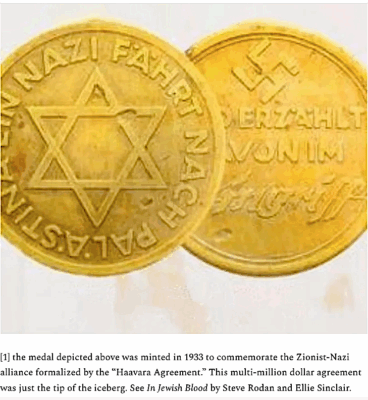
For starters, Zionists and Nazis were close allies in the years preceding World War II, during the war itself, and in certain respects, even after the war. This alliance is well-documented [1].
The highest-level Zionists collaborated with the Nazi regime in the mass murder of an unfathomable number of Jews. The slaughter of millions was made possible only due to well-coordinated Zionist collaboration.
Following the war, Zionists absorbed their erstwhile allies, Nazi war criminals, and helped them evade justice. And in subsequent decades, the slaughter of Jews continued unabated by the Zionist regime and their Islamist proxies, and does so till today.
It’s reasonable to conclude that Nazism and Zionism are two tentacles of the same depopulationist beast. This is not hyperbole but a tragic observation of reality.
Moreover, the corporatist system of governance that the Zionists imposed is remarkably similar to the Nazis’ Fascism in many respects. Repression, censorship, propaganda, indoctrination, forced medical experimentation, are all mainstays of the Zionist state.
While Nazis herded Jews into ghettos and concentration camps, their Zionist protégé seeks to herd Jews into fifteen-minute cities. Nazis sprayed Jews with deadly chemicals in gas chambers. Zionists spray slower-working poisons onto its Jewish population in open-air gas chambers.
Furthermore, the term Zionism itself is objectionable. It’s an affront to Jews and authentic Jewish faith since it misappropriates the word Zion. Historically, Zion referred to Mount Zion, site of scripture’s holiest shrine, the Holy Temple in the ancient Jewish capital, Jerusalem. As such, the Jews’ yearning to return to Zion had exclusively religious connotation.
Zionist revisionism subverted and undermined this hallowed aspiration, replacing it with a new-age fetish of hollow nationalist collectivism, the main objective of which was to subject Jews to the same authoritarian statism that the rest of the world’s population was getting subjugated to in the modern era.
Zionism, then, has nothing to do with Zion.
However, the mere mention of this odious ism falsely attributes it to Zion. Why should we bring ignominy upon G-d’s holy mountain by nominally associating it with something so unholy and ugly? Better attribute it to Nazism, its ideological twin.
The capitalized “N” of “ZioNazi” aptly separates “Zio” from its “n,” thereby disassociating it from Zion and exposing its true profane intent. It also highlights the curious fact that both repugnant isms share the same radicals (i.e. N, Z, I) in English, which in fact is the case in modern Hebrew (נ, צ, י) as well. Surely this too was by dark design.
Hence the preference for this new term and its spelling.
If the invoking of Nazism disturbs you, perhaps you can substitute it with another fitting N word, like “ZioNefarious” or “ZioNoxious.”
Either way, please understand that Zionism is cut from the same cloth as Nazism, authoritarian statism, and has absolutely nothing to do with the actual Zion.
Contrary to their misleading names, “Zionists,” “Poalei Tzion,” “Chovevei Tzion,” etc., were never lovers of Zion. They were haters of Zion, and their successors in power remain sworn enemies to everything Zion represents, especially the Sons and Daughters of Zion, biblical epithets for the Jewish people.
Tragically, the Jews have no bigger enemy than the predatory regime of the “Jewish State.” No one is guiltier of crimes against Jews in the past eighty years than the Zionist foe, continuing the genocidal work of its Nazi forbears. ZioNazism indeed.
A true lover of Zion rejects the ism that hijacked its name and seeks to depopulate its children.
May God Almighty liberate Zion from its ZioNazi captors.
Let’s return to Zion for real and ignore the ‘ists and their lethal isms.
Notes:
Challenging the IPC Gaza Famine Report: Examining Claims of Bias and Methodological Failures [VIDEOS] ADAM ELIYAHU BERKOWITZ
AUGUST 31, 2025
The recent declaration by the UN-backed Integrated Food Security Phase Classification (IPC) that famine exists in Gaza has sparked intense international debate and legal ramifications. However, a growing body of analysis suggests that this determination may be fundamentally flawed, riddled with methodological problems, and influenced by anti-Israel bias among its authors. This examination reveals concerning patterns in how the UN and affiliated bodies have reported on Gaza’s humanitarian situation, raising serious questions about the reliability of their conclusions.
The IPC’s Controversial Famine Declaration
On August 22, the IPC’s Famine Review Committee officially declared that famine was unfolding in the Gaza Governorate, encompassing Gaza City and its surrounding areas. The report warned that this famine could potentially spread to Khan Younis and Deir al-Balah in the coming weeks. International media outlets immediately amplified these findings, with major publications treating the declaration as established fact from a credible, neutral international body.
The IPC’s conclusions were stark and unequivocal. The report classified the Gaza Governorate as experiencing Phase 5 famine conditions, claiming that over half a million people in parts of the Gaza Strip face “catastrophic conditions characterized by starvation, destitution and death.” The assessment projected that 132,000 children under five would suffer from acute malnutrition through June 2026, including 41,000 severe cases described as being “at heightened risk of death.” These findings formed the basis for renewed international condemnation of Israel and fresh calls for immediate intervention to prevent what the IPC characterized as a man-made humanitarian catastrophe of unprecedented scale.
However, this latest report represents just one chapter in a troubled history of questionable UN reporting on Gaza’s humanitarian situation. The pattern of problematic assessments began early in the conflict and has continued despite repeated corrections and contradictory evidence.
A History of Inaccurate Predictions
The IPC’s track record on Gaza famine predictions has been notably poor. In March 2024, the organization predicted that famine would occur in northern Gaza between March and May 2024, subsequently spreading to the rest of the Strip by July. The report classified 50% of Gaza’s population (1.11 million people) as facing “catastrophic conditions” or Phase 5 food insecurity.
These dire predictions proved incorrect. By June 2024, the IPC’s own Famine Review Committee acknowledged that “the evidence on acute malnutrition and mortality does not indicate that famine thresholds have been passed” for both northern and southern Gaza. The committee found that “the available evidence does not indicate that famine is currently occurring,” forcing the IPC to revise its assessment dramatically downward.
The June revision reduced the classification of people in “catastrophic situations” from 1.11 million (50% of the population) to 495,000 (22% of the population) – a reduction of more than half. Despite this significant correction, the UN continued to use inflammatory language, with some officials declaring that “famine has spread throughout the Gaza strip” even after their own reports contradicted this claim.
Methodological Flaws in the August 2025 Report
Critics have identified numerous methodological problems with the latest IPC famine declaration that appear to violate the organization’s own established standards:
Inappropriate Use of MUAC Measurements
The IPC relied on Mid-Upper Arm Circumference (MUAC) measurements rather than the more reliable weight-for-height scores to determine acute malnutrition among children. While MUAC can be used in emergency situations, it is specifically “limited to classifying Phase 4 (Emergency), not Phase 5 (Famine).” The use of MUAC measurements to justify a Phase 5 classification directly contradicts established IPC protocols.
Additionally, pre-war Gaza had significantly higher MUAC prevalence rates compared to weight-for-height rates – an anomaly that should have led to adjusted thresholds. The IPC failed to account for this baseline difference, potentially inflating malnutrition assessments.
The IPC’s claim of a 16% malnutrition rate among children under five was based on only a partial sample of July’s data. When complete data for July became available on August 6, showing a malnutrition rate of 12.2%, the IPC chose not to incorporate this updated information into its findings – a decision that raises serious questions about selective data usage.
Furthermore, the report relied heavily on hospital records rather than community-based surveys, which skews results toward sicker children and excludes healthy populations. This approach directly contradicts IPC guidelines that typically prohibit using hospital-based data for population-wide assessments.
Perhaps most problematically, the IPC made extraordinary assumptions about unreported deaths to meet famine thresholds. While official sources reported an average of six malnutrition-related deaths per day, the IPC assumed that the actual number was significantly higher – despite lacking evidence for this claim. To meet the famine threshold of two deaths per 10,000 people daily, approximately 130 malnutrition-related deaths would need to occur daily in the Gaza Governorate. The assumption that over 20 times more deaths are occurring than reported lacks credible justification.
The foundation of the IPC’s assessments rests on data provided by UN Office for the Coordination of Humanitarian Affairs (OCHA), which has been collecting information through UNRWA since October 7, 2023. However, analysis reveals systematic problems with this data collection process.
UNRWA’s data collection method captures only aid observed at specific southern crossings (Kerem Shalom and Rafah) while representatives are present. This approach systematically excludes:
- Aid delivered through air drops
- Supplies arriving via the US floating pier
- Aid received through the northern Erez crossing
- Deliveries when UNRWA representatives are absent
- Private sector goods and fuel shipments
- Flour deliveries to northern Gaza bakeries
The result is a dramatic undercount of aid entering Gaza. For example, in May 2024, OCHA initially reported approximately 2,790 trucks entering Gaza, while Israel’s Coordination of Government Activities in the Territories (COGAT) documented 6,359 trucks – a discrepancy of nearly 4,000 trucks. Over the entire period from the war’s beginning through June 2024, OCHA counted 28,818 trucks while COGAT recorded 38,212 trucks, representing a gap of almost 10,000 trucks.
Lack of Transparency and Verification
The UN consistently presented incomplete data without acknowledging its limitations. It wasn’t until late April 2024 that OCHA first added a disclaimer noting that figures only included “supplies observed or registered by the UN” at specific crossings. This critical limitation should have been disclosed from the beginning, especially given the serious accusations being leveled against Israel based on this data.
The UN also failed to verify figures from Gaza-based sources, many of which are controlled by or closely aligned with Hamas. Meanwhile, Israeli data was consistently dismissed without explanation, despite Israel being a democratic state with independent media, civil society oversight, and judicial review.
Anti-Israel Bias Among Report Authors
Beyond methodological concerns, the credibility of the IPC report is further undermined by the inclusion of authors with documented anti-Israel bias and activism.
Andrew Seal, an associate professor at University College London, has demonstrated clear anti-Israel bias through his social media activity and public statements. He accused Israel of genocide as early as October 28, 2023, just weeks after the Hamas attack and before Israel’s ground operation had fully commenced. His social media presence includes:
- Defending Houthi attacks against international shipping
- Accusing Israel of apartheid
- Drawing moral equivalencies between Israel and Hamas
- Spreading Iranian regime propaganda
- Dismissing the threat posed by Hamas despite their explicit calls for repeated October 7-style massacres
Zeina Jamaluddine, an assistant professor at the London School of Hygiene & Tropical Medicine, co-authored a controversial study on Gaza death tolls published in The Lancet that was criticized for faulty methodology and political bias. Notably, she and her team were granted exclusive access to data by the Hamas-run Ministry of Health, raising questions about potential manipulation of information.
Jamaluddine has also:
- Described Israeli defensive actions against Hezbollah as “terror”
- Called for an end to the war as early as October 16, 2023 – just nine days after the Hamas massacre
- Advocated for “decolonization” in the context of Israel and Gaza
Another key figure, Alex de Waal, heads an organization that has been described as “a leader of the ‘starvation as a weapon’ narrative against Israel” since the beginning of the war. Prior to the IPC report’s publication, de Waal used Qatar-funded media platforms to accuse Israel of “precisely engineered starvation” and “genocidal starvation” – predetermined conclusions that he later incorporated into supposedly objective scientific analysis.
The Real Humanitarian Picture
While no one disputes that Gaza’s population faces genuine hardships due to ongoing conflict, the evidence suggests a more complex reality than portrayed in UN reports.
According to COGAT data, humanitarian aid entering Gaza has actually exceeded minimum requirements. The organization tracks all aid entering through all crossings and routes, including supplies from international organizations, private sector goods, and deliveries via air, sea, and land. Monthly totals show significant increases in aid flows, with the number of trucks nearly doubling between February and April 2024.
At times, aid has accumulated faster than it could be distributed, with COGAT reporting 1,500 trucks waiting for collection from Kerem Shalom and the floating pier in June 2024. This backlog contradicts claims of deliberate aid restriction.
Reports from Gaza itself suggest food availability that contradicts famine conditions. Images of functioning markets, decreasing food prices, and testimonies about food accessibility paint a different picture than the one presented in UN assessments. The World Health Organization, as of June 2024, reported only 32 deaths from acute malnutrition and starvation – far below the thousands that would be expected under true famine conditions as predicted by the IPC.
Hamas’s Role in Aid Obstruction
UN reports consistently downplay or ignore Hamas’s role in obstructing aid distribution. The organization has:
- Attacked border crossings with rocket fire, forcing temporary closures
- Controlled convoy routes and distribution points
- Looted aid trucks and storage facilities
- Used civilian infrastructure for military purposes
- Attacked humanitarian installations, including the US floating pier
The UN’s own acknowledgment that close to 90% of its aid is looted by “armed actors” or others further undermines claims that Israel is systematically preventing aid delivery.
International Legal Implications
The flawed UN and IPC reports have had far-reaching consequences beyond public opinion. International legal proceedings have heavily relied on these assessments:
In three separate instances where the ICJ issued provisional measures against Israel in the genocide case filed by South Africa, the majority of judges based their decisions on UN reports and IPC famine predictions. The court quoted statements by UN officials that characterized Gaza’s situation as “catastrophic” based on these problematic assessments.
ICC Prosecutor Karim Khan referenced IPC findings when requesting arrest warrants against Israeli officials, specifically citing claims about 1.1 million people facing “catastrophic hunger.” These legal proceedings are thus built upon a foundation of questionable data and biased analysis.
UN Opposition to Alternative Aid Mechanisms
The UN’s objections to the Gaza Humanitarian Foundation (GHF) provide perhaps the most revealing evidence of institutional bias prioritizing political control over genuine humanitarian relief. The humanitarian community, led by UNRWA, has called for an end to the GHF, describing it as providing “nothing but starvation and gunfire to the people of Gaza”. UN experts have demanded the “immediate dismantling” of the GHF, calling it “an utterly disturbing example of how humanitarian relief can be exploited for covert military and geopolitical agendas”.
This opposition is particularly striking given the UN’s simultaneous claims of dire humanitarian conditions in Gaza. If the situation were truly as catastrophic as portrayed in IPC reports, one would expect international organizations to welcome any additional aid delivery mechanism, regardless of its sponsor. Instead, UNRWA has demanded “urgent clarification” from UN leadership over any meetings with the GHF, warning that failing to criticize the initiative risks being seen as complicity in war crimes.
The institutional resistance to alternative aid delivery suggests that maintaining control over humanitarian operations – and by extension, allowing Hamas to continue hijacking aid – may be more important to these organizations than actually alleviating suffering. This pattern reinforces concerns that UNRWA and other UN agencies may be inadvertently or deliberately helping Hamas maintain its grip on power by preserving aid distribution systems that the terrorist organization can manipulate and exploit.
Misleading Imagery and Propaganda Campaigns
The humanitarian narrative has been further undermined by revelations about staged and manipulated imagery designed to amplify claims of famine and starvation. German newspaper Bild revealed photos of Gazans holding empty pots posing in front of photographers, rather than actually waiting in line for food aid. These photographers often have documented ties to Hamas, and some were actively embedded with terrorists during the October 7 massacre.
WATCH [2:30]
The Israeli Ministry of Foreign Affairs has documented “a concerning surge of misleading information, manipulative narratives and fabricated or AI-generated images” targeting Israel and misrepresenting Gaza’s humanitarian situation. Examples include Hamas propaganda exploiting images of seriously ill children, with some Western media outlets publishing them, including a widely shared image of a child that was actually a recycled photo of a Yazidi girl from 2014.
WATCH [17:04]
Israeli military officials have stated that “no real hunger crisis exists in Gaza” and accused Hamas of using “fake images of malnourished children from Yemen” to manufacture evidence of famine conditions. Israeli military spokesperson Brigadier General Effie Defrin told reporters that “the claims of starvation are fake, and it’s an organized campaign by Hamas in order to fight us”.
WATCH [26:25]
These revelations about staged photography and recycled imagery call into question the visual evidence that has been central to international perceptions of Gaza’s humanitarian crisis. The systematic nature of these deceptions suggests a coordinated propaganda effort designed to shape international opinion and legal proceedings against Israel.
The Broader Pattern of UN Bias
The problems with Gaza reporting reflect a broader pattern of UN bias against Israel. This bias manifests in several ways:
UN reports consistently emphasize negative aspects of Israeli actions while ignoring or minimizing:
- Israel’s opening of additional aid corridors
- Humanitarian pauses in fighting to facilitate aid delivery
- Infrastructure improvements to aid routes
- Coordination with international relief efforts
- Steps taken to prioritize humanitarian trucks over commercial vehicles
The UN dismisses Israeli government data without explanation while accepting information from Hamas-controlled sources at face value. This represents a troubling preference for information from a designated terrorist organization over a democratic government with transparent institutions and independent oversight.
UN officials have used inflammatory language to describe Israel’s actions, often timing statements to coincide with international legal proceedings or diplomatic pressure campaigns. The consistency of this pattern suggests coordinated messaging rather than objective assessment.
Recommendations for Media and Policymakers
Given these documented problems, several recommendations emerge:
For Media Organizations
- Critically examine UN and IPC reports rather than treating them as unquestionable authority
- Investigate the backgrounds and potential biases of report authors
- Compare multiple data sources and highlight discrepancies
- Provide context about the complexity of humanitarian operations in active war zones
- Acknowledge when organizations have been forced to revise previous assessments
For Policymakers
- Demand transparency in data collection methodologies
- Require verification of information from conflict zones
- Consider multiple sources when making policy decisions
- Investigate potential bias in international monitoring organizations
- Ensure that legal proceedings are based on verified, complete information
For International Organizations
- Implement stricter standards for author selection to ensure objectivity
- Require full disclosure of data limitations and sources
- Establish independent verification mechanisms
- Address documented cases of bias and methodological failures
- Separate humanitarian assessment from political advocacy
The Israeli goverenment responded to the reporting with heavy criticism:
“Unbelievably, the IPC twisted its own rules and ignored its own criteria just to produce false accusations against Israel: the IPC changed its own global standard, cutting the 30% threshold to 15% for this report only, and totally ignoring its second criterion of death rate, solely to serve Hamas’s fake campaign,” the Ministry of Foreign Affairs stated.
“The entire IPC document is based on Hamas lies laundered through organizations with vested interests.”
There is no famine in Gaza. Over 100,000 trucks of aid have entered Gaza since the start of the war, and in recent weeks a massive influx of aid has flooded the Strip with staple foods and caused a sharp decline in food prices, which have plummeted in the markets.
The laws of supply and demand don’t lie – the IPC does. Every forecast the IPC has made regarding Gaza during the war has proven baseless and completely false.
This assessment too will be thrown into the despicable trash bin of political documents.
Conclusion
The evidence presented by multiple Israeli institutions, independent analysts, and even the IPC’s own subsequent revisions suggests that the famine declaration in Gaza is built on a foundation of flawed methodology, incomplete data, and biased analysis. The inclusion of demonstrably anti-Israel activists as report authors further undermines the credibility of these assessments.
What a dictator! TIERNEY’S REAL NEWS
AUG 30, 2025
Carjackings are already down 87% in Washington, DC since President Trump brought in the National Guard and started DEFENDING innocent Americans in our Nation’s Capitol from criminals, gangs and aliens. What a dictator!
This has been confirmed by DC Mayor Bowser.
BOWSER: “The difference between this 20-day period of this federal surge and last year represents a 87% reduction in carjackings.”
Fox News reported that DC homicides are down 71%, robberies down 60%, property crime down 20% and assault with dangerous weapons is down 10% as well.
I remember, when I lived in Minneapolis, that there were signs in the health club locker room warning us that the juvenile Somali gangs were carjacking people in the round-a-bouts, so they told us not to slow down (because they jump on your car) and to keep our car doors locked and our windows rolled up. There were at least 5 round-a-bouts that I had to navigate every day, just to leave my house to run errands, so it was a constant worry.
BREAKING: Israel WIPES Out ENTIRE Houthi Islamist Leadership Cabinet [37:22] Mahyar Tousi
August 30, 2025 Tousi TV
POST SHABBAT WAR UPDATE Avi Abelow
August 30, 2025 Israel Video Network – Pulse of Israel
Israel is currently engaged in a war like no other, a multi-front battle across the Middle East, coordinated by Iran and fought through its vast network of terror proxies. But what our enemies envisioned as Israel’s moment of collapse is fast becoming their strategic disaster.
From Gaza to Yemen, from Lebanon to Tehran, Israel is not just surviving, we’re dismantling an empire of terror, over two years. And in doing so, we are exposing the deeper battle for the future of the Middle East.
GAZA
This week, the IDF officially ended its daily tactical pause, signaling the beginning of a relentless new phase to destroy Hamas once and for all and take full control over Gaza.
In a targeted strike, Israel also eliminated Hamas’ spokesperson, a central figure in the terror group’s propaganda campaign. And in a tragic but crucial operation, our soldiers retrieved the bodies of two hostages murdered by Hamas on October 7th. Their return gives their families the dignity of closure.
Forty-eight hostages now remain in Gaza. Israel will not rest until every one of them is brought home.
YEMEN
Let’s be crystal clear:
Israel did not attack Yemen. Yemen, as a fully integrated Iranian proxy, chose war with Israel, continuously launching ballistic missiles at our population centers, all with the singular goal of mass civilian death.
This Houthi threat in Yemen is no joke, as they have an army of hundreds of thousands, in addition to their ballistic missiles.
Israel’s response over the weekend was surgical.
In a devastatingly precise strike, Israel eliminated the upper leadership of the Houthis:
– Prime Minister
– Head of the Political Bureau
– Ministers of Welfare, Agriculture, Economy, Justice, Information, and Foreign Affairs
– Government Secretary
– Government Chief of Staff
With their Minister of Defense and Chief of Staff potentially seriously wounded.
This is what happens when a terror state behaves like a terror organization.
LEBANON
Hezbollah is threatening violence if the Lebanese government proceeds to take away their weapons, as Lebanon agreed to do in talks with the Trump administration. And as a senior commander of the Lebanese army recently said, ‘do not expect our Shia soldiers to shoot at their Hezbollah brothers’.
With diplomatic channels now shut and Hezbollah increasing its provocations, the northern front is nearing escalation.
If Hezbollah remains armed on our Northern border, expect Israel to finally militarily destroy Hezbollah and push them out of Southern Lebanon, to provide the necessary security to our Northern border communities. Hopefully, we will go all the way to the Litani River and remain there, as we should have done initially.
IRAN
The international community has reactivated the snapback sanctions mechanism, a long-overdue diplomatic victory for Israel and a crippling blow to Iran.
Even Iran’s foreign minister publicly admitted that another direct confrontation with Israel is inevitable.
Expect the direct confrontation with Iran to continue someday in the near future.
JUDEA & SAMARIA
As I posted on Friday, the Trump administration has officially barred Mahmoud Abbas’ Palestinian Authority team from entering the U.S. to attend the upcoming United Nations General Assembly. The reason? The PA’s continued financial and political support for terrorism.
This could mark more than a symbolic shift. It may well be the beginning of a broader policy realignment laying the groundwork for U.S. support for Israel to formally apply sovereignty over Judea and Samaria. After years of international appeasement, reality is setting in: the Palestinian Authority will finally be punished for supporting terror and the destruction of Israel.
That’s all the good news on the current war front.
Now, for the update about the war that nobody is talking about.
The Axis Is Shifting.
As Israel continues to successfully destroy the Iranian Shiite axis, Iran’s partner, Qatar, is busy establishing a new and equally dangerous Islamic axis of evil threat to Israel and the freedom-loving world.
In a recent statement, Israeli Minister Amichai Chikli identified the emerging Sunni Axis of Evil, comprising two dangerous imperial visions:
– Qatar ( Muslim Brotherhood)
– Turkey (Erdogan is also Muslim Brotherhood, interested in re-establishing Ottoman caliphate)
– Syria under the caliphate vision championed by Jolani’s al-Qaeda leadership
These are not isolated actors. With their greatest rival, the Iranian-led Shiite axis of evil, now in ruins thanks to Israel, they are increasingly aligning ideologically and politically around a common goal: to reassert Sunni Islamist dominance across the region and to eliminate Israel as a free, democratic, Jewish state.
Anyone who fails to see this, fails to understand both fundamentalist Islam and the true nature of the Middle East.
CONCLUSION: ISRAEL IS WINNING
While headlines and Jewish pundits scream about Israel potentially taking over Gaza, ultimately, we are not fighting for land. We are fighting for our right to exist, to live in peace, and to protect our people from those who glorify death, and that necessitates taking our land back.
This war is exposing the hypocrisy of our enemies, the strength of our people, and the collapse of an axis that thought we were weak.
As we face this shifting reality, Israel remains the front line of the freedom loving world’s defense.
We will not apologize for doing what we have to do. We will not retreat. We will lead.
And to all those worried about the reporting of this war and the number of Jewish voices, including Rabbis, throwing Israel and the Jewish people under the bus, calling for Israel to end this war, just ignore them.
They lack any real understanding of the evil we’re facing or the military and diplomatic precision required to ensure we never experience another October 7th, while Israel continues to achieve extraordinary things to protect not just itself, but the entire freedom-loving world. So stop believing the mainstream narrative and strengthen your faith in Hashem above.
We are winning this multifront war, and we will win. That victory will necessarily include maintaining a permanent presence in Gaza, southern Lebanon, and southern Syria, not simply because these are our biblical lands, but because reality has made one thing clear: despite every diplomatic effort to avoid it, true security will only be achieved when Israel is sovereign in its God-given homeland.
Things still might take some time, but the process is in full swing.
Be proud of that and share this message.
Am Yisrael Chai.
To join the Israel Video Network – Pulse of Israel Group Click Here:
Telegram ➡️ https://t.me/aviabelowpulse
Whatsapp ➡️ https://chat.whatsapp.com/GkavRznXy731nxxRyptCMv
WOKE up! TIERNEY’S REAL NEWS
AUG 30, 2025
Many people wonder how in the world the planet got so crazy and woke, so fast, including me. I know there are lots of historical precedents to woke concepts like transgenderism, DEI, ESG and climate change, but, as usual, we can follow the money to see how it all exploded so quickly in just the past few years. And when we do that, we can pretty much pin much of the blame on this guy: Larry Fink, the CEO of BlackRock – and I can prove it to you by using his OWN words against him.
This article is less than 10 minutes long, but takes a complex topic and makes it easy to understand. It’s a must-read if you want to understand the financial future of America and her citizens. I learned a lot writing it.
Larry Fink, who also serves on the board of the WEF, has almost single-handedly blackmailed the entire corporate world to turn WOKE – or BlackRock would defund them and destroy them.
BlackRock controls more than $12.5 trillion in assets worldwide, as of the second quarter of 2025, making it the world’s largest asset manager by far. This figure exceeds the GDP of most countries, except the United States and China. BlackRock and their partners also invest and direct the money for many of the world’s Puppet Masters and the so-called New World Order – and their plans for a One World Currency that they control.
BlackRock holds significant shares in thousands of companies globally (including most of the fake news) and is the largest shareholder in dozens of major multi-national firms. BlackRock represents roughly a quarter of the world’s total financial assets considered “in circulation” by some estimates.
Every year, Larry Fink and BlackRock issue letters to CEOs and global investors and basically TELL THEM WHAT TO DO with their corporations, their countries and their money – OR ELSE.
On March 26, 2025, as usual, BlackRock CEO Larry Fink released his annual Chairman’s Letter to Investors. Compared to previous letters in 2018 and 2022, BlackRock has completely omitted demands in the 2025 letter that countries and corporations succumb to BlackRock’s WOKE ESG policies if they want to survive. BlackRock’s 2025 letter was a major pivot in strategy that the fake news has NOT reported on. I’ve written much about this in the past (and include links to those articles in red in this post) but BlackRock’s 2025 letter is a clear sign they have admitted defeat over WOKE and are moving on to their next scam.
To remind you, ESG is a type of investing where non-financial factors are considered when making investment choices. ESG has grown significantly over the past few years following a push from the United Nations. In a very short time, ESG became an unregulated staple of corporate financial reporting. BlackRock was an early acceptor and advocate for ESG, with Fink leading the charge. As conservatives began pushing back on ESG, criticism of BlackRock and Fink quickly escalated.
In his latest Chairman’s Letter to Investors, Fink avoided the phrase ESG – as it had become too political. Instead of ESG and DEI – he is now opting instead for terms like stakeholder capitalism, sustainable investing, energy pragmatism, energy security, democratization of private markets and climate investing.
Fink said that there is a need for “energy security” spurred by Russia’s invasion of Ukraine. In other words – BlackRock wants war in Ukraine (and everywhere else) – because they can use it to justify the need for “energy security” and private investment for “infrastructure” and AI projects all over the world.
BlackRock claims that wars and instability create the narrative for why trillions need to be spent THROUGH BlackRock. BlackRock benefits no matter which side wins — they sell the investment products that “solve” the problem.
Larry Fink’s 2025 investor letter also pushes the democratization of private markets, arguing that access to assets like data centers, private credit, power grids, and infrastructure should expand beyond institutions to include retail investors, particularly within 401(k)s. Fink is calling his new guidance the “democratization of investing” using globalization and capital markets. Fink says that the need for new infrastructure investment around the world will be HUGE and he wants private investors, like you and me, to be a part of it. Fink says that by 2040, the global demand for new infrastructure investment is $68 trillion.
Larry Fink is saying BlackRock wants to move away from the term ESG but still push big themes like sustainability and energy security. He sees wars and global instability as justification for more reliable energy and infrastructure. Fink said that means trillions in spending worldwide—the biggest investment opportunity of the next 15 years. And instead of keeping it just for big Wall Street players, he wants to let everyday investors (through their 401(k)s, for example) buy into these large-scale projects. Isn’t that special? Fink is so kind – always thinking of us! NOT.
This isn’t about values; it’s about de-risking BlackRock’s brand while keeping the same investment agenda.
- The pitch: let everyday investors (through 401(k)s or retirement accounts) buy into private assets (infrastructure, private credit, etc.) that used to be for the wealthy only.
- Reality: private assets are harder to value, less liquid, and more opaque than public stocks. That means more risk for retail investors, less accountability for big firms.
Democratization here really means “shifting risk from big institutions onto ordinary people’s retirement savings” while BlackRock collects management fees either way. Calling it a “need” is a sales tactic. The real goal: persuade governments and individuals to funnel money into BlackRock-managed assets under the guise of progress. It’s Wall Street’s classic playbook — turn global instability and genuine human needs (energy, infrastructure) into investment narratives, then channel both government money and individuals’ savings into products that enrich asset managers.
Citizens are locked in on both sides — through taxation (public subsidies) and retirement savings (private contributions). BlackRock positions itself as the trusted “neutral allocator,” but in reality, it becomes the power broker directing global capital flows.
What most people don’t realize is that Trump’s tariffs (and his entire plan based on economic protectionism for We the People) can, in theory, protect us from predators like BlackRock and act as a buffer between ordinary people and the risks of globalization-driven finance.
Without tariffs: people’s retirement savings (401ks, pensions) are tied to globally exposed private investments (ports in Africa, pipelines in Europe, Asian data centers). If instability hits, citizens bear that risk.
This is the real reason that BlackRock, the Communists, the open-border Koch Libertarians and the globalists hate tariffs – because it limits their ability to STEAL MORE OF OUR MONEY.
For proof, compare that to what Fink and BlackRock said in 2018 and 2022. It’s a complete pivot away from DEI, transgenderism and climate change – but the end result is the same. More money for BlackRock – less money and MORE RISK for you and me.
BLACKROCK 2018: Society is demanding that companies, both public and private, serve a social purpose. To prosper over time, every company must not only deliver financial performance, but also show how it makes a positive contribution to society. Companies must benefit all of their stakeholders, including shareholders, employees, customers, and the communities in which they operate.
In the $1.7 trillion in active funds we manage, BlackRock can choose to sell the securities of a company if we are doubtful about its strategic direction or long-term growth. To sustain financial performance, however, you must also understand the societal impact of your business.
We also will continue to emphasize the importance of a diverse board. Boards with a diverse mix of genders, ethnicities, career experiences, and ways of thinking have, as a result, a more diverse and aware mindset. A company’s ability to manage environmental, social, and governance matters demonstrates the leadership and good governance that is so essential to sustainable growth.
Companies must ask themselves: What role do we play in the community? How are we managing our impact on the environment? Are we working to create a diverse workforce? Are we adapting to technological change?
BLACKROCK 2022: Stakeholder capitalism is not about politics. It is not a social or ideological agenda. It is not “woke.” It is capitalism, driven by mutually beneficial relationships between you and the employees, customers, suppliers, and communities your company relies on to prosper. This is the power of capitalism.
It is through effective stakeholder capitalism that capital is efficiently allocated, companies achieve durable profitability, and value is created and sustained over the long-term.
At the foundation of capitalism is the process of constant reinvention – how companies must continually evolve as the world around them changes or risk being replaced by new competitors.
Political activists, or the media, may politicize things your company does. They may hijack your brand to advance their own agendas. In this environment, facts themselves are frequently in dispute, but businesses have an opportunity to lead. Employees are increasingly looking to their employer as the most trusted, competent, and ethical source of information – more so than government, the media, and NGOs.
That is why your voice is more important than ever. It’s never been more essential for CEOs to have a consistent voice, a clear purpose, a coherent strategy, and a long-term view. Your company’s purpose is its north star in this tumultuous environment. The stakeholders your company relies upon to deliver profits for shareholders need to hear directly from you – to be engaged and inspired by you. They don’t want to hear us, as CEOs, opine on every issue of the day, but they do need to know where we stand on the societal issues intrinsic to our companies’ long-term success.
Putting your company’s purpose at the foundation of your relationships with your stakeholders is critical to long-term success. Employees need to understand and connect with your purpose; and when they do, they can be your staunchest advocates. Customers want to see and hear what you stand for as they increasingly look to do business with companies that share their values.
As companies rebuild themselves coming out of the pandemic, CEOs face a profoundly different paradigm than we are used to. Companies expected workers to come to the office five days a week. Mental health was rarely discussed in the workplace. And wages for those on low and middle incomes barely grew. That world is gone.
CEOs need to be asking themselves whether they are creating an environment that helps them compete for talent. At BlackRock we are doing the same: working with our own employees to navigate this new world of work.
The pandemic also shone a light on issues like racial equity, childcare, and mental health – and revealed the gap between generational expectations at work. These themes are now center stage for CEOs, who must be thoughtful about how they use their voice and connect on social issues important to their employees. How is your company’s culture adapting to this new world?
Capital markets have allowed companies and countries to flourish. But access to capital is not a right. It is a privilege. And the duty to attract that capital in a responsible and sustainable way lies with you.
Most stakeholders – from shareholders, to employees, to customers, to communities, and regulators – now expect companies to play a role in decarbonizing the global economy. It’s been two years since I wrote that climate risk is investment risk. And in that short period, we have seen a tectonic shift of capital. Sustainable investments have now reached $4 trillion. Actions and ambitions towards decarbonization have also increased. This is just the beginning. Every company and every industry will be transformed by the transition to a net zero world. The question is, will you lead, or will you be led?
I believe the decarbonizing of the global economy is going to create the greatest investment opportunity of our lifetime. How are you preparing for and participating in the net zero transition? As your industry gets transformed by the energy transition, will you go the way of the dodo, or will you be a phoenix?
We focus on sustainability not because we’re environmentalists, but because we are capitalists and fiduciaries to our clients. As part of that focus, we are asking companies to set short-, medium-, and long-term targets for greenhouse gas reductions. Governments and companies must ensure that people continue to have access to reliable and affordable energy sources.
As stewards of our clients’ capital, we also ask businesses to demonstrate how they’re going to deliver on their responsibility to shareholders, including through sound environmental, social, and governance practices (ESG) and policies.
The Plot to Get RFK BY JAMES LYONS-WEILER
JULY 1, 2025 Brownstone Institute
An apparent leaked minutes document suggests that a trade association held a meeting in April to undo the confirmation of Kennedy by the duly elected US Senate. It is embedded below.
Caveat and Clarification
All references to individuals, statements, or actions attributed in the leaked minutes of the BIO Vaccine Policy Steering Committee meeting held on April 3, 2025, should be understood as excerpts from an internal document that has not been publicly authenticated by the named parties. These statements represent the content of the document as obtained and published, and do not constitute confirmed factual claims about the intent, conduct, or positions of any individual mentioned. The document reflects the internal framing and strategy of BIO and is presented here for the public to assess, interpret, and investigate. Readers are encouraged to seek independent confirmation, request public statements from the individuals involved, and draw conclusions based on full context and corroborating evidence. The document was received anonymously by whistleblowers and provided to Popular Rationalism for public analysis. Its provenance is under review.
On the eve before the US Senate reconvenes, a detailed secret trade-association memo plotting the removal of US Secretary of Health and Human Services Robert F. Kennedy, Jr. has leaked. It reads like a coup attempt against regulatory reform—and they are spending millions to make sure Kennedy is out of office by September.
It seems that the Biotechnology Innovation Organization (BIO), whose membership includes Pfizer, Merck, Novavax, Vaxcyte, and hundreds of biotech firms that profit from regulatory insulation, has a mole. This article critiques the documented lobbying behavior of the trade group BIO, not the internal operations or clinical data of its member corporations.
When the nation’s leading pharmaceutical trade group convenes a closed-door strategy meeting and openly discusses the need to “go to The Hill and lobby that it is time for RFK Jr. to go,” the issue is no longer health policy—it is democratic integrity.
According to the apparent leaked minutes, verified by the name of the creator of the file, on April 3, 2025, BIO held a “Vaccine Policy Steering Committee” (VPSC) meeting whose internal summary, soon to be publicly available thanks to whistleblowers, reveals a campaign of strategic deception, institutional capture, and psychological warfare and exposes a campaign of institutional deception, investor protection, and coordinated sabotage of the MAHA reform platform.
According to the leaked document, titled “BIO Vaccine Policy Steering Committee – April 3, 2025”, BIO has committed $2 million—half of its cash reserve—to counter what it calls the “threat” posed by Kennedy’s rise. But this is no ordinary PR push. It is a multi-pronged campaign designed to deceive the public, silence dissent, and preserve industry dominance through influence operations masquerading as science.
The Plot Exposed
The document opens with a blunt political calculation: Kennedy’s candidacy threatens investor confidence, regulatory predictability, and the long-term viability of the vaccine business. BIO leadership in the apparent leaked document states plainly: “It is time to go to The Hill and lobby that it is time for RFK Jr to go.”
To achieve this, according to the document, BIO intends to deploy surrogates across the political spectrum, co-opt conservative influencers, and bypass direct engagement with the Kennedy campaign altogether. Among the figures named as potential allies in this covert effort: Dr. Mehmet Oz, former Senator Richard Burr (former Senator NC; Advisor DLA Piper Health Policy Steering Committee), Senator Bill Cassidy (in a section of the document focused on strategic influencer engagement and legislative positioning), and the American Enterprise Institute (AEI). These individuals and institutions, the memo suggests, can provide a veneer of bipartisan legitimacy to BIO’s core aim: neutralize Kennedy without ever addressing the substance of his critique.
Follow the Money
The most revealing detail is that $2 million—precisely half of BIO’s entire $4 million reserve—has been allocated to vaccine communications, specifically a D.C.-area pilot campaign called “Why We Vaccinate.” The purpose is not education, but behavioral influence: to combine “inspire and frighten” tactics in order to manipulate public sentiment and legislative behavior.
Internal documents state clearly that the campaign’s goal is to appeal to the “movable middle” using emotionally charged messaging, capitalizing on fear messaging tied to national security, workforce resilience, and economic productivity.
Why such an aggressive push? Because, as Vaxcyte COO Jim Wassil apparently warned, “investors have stated they are leaving until the next data readout,” citing Kennedy’s “unpredictability” as a systemic disruption to the vaccine capital pipeline.
Given Kennedy’s demand for restored liability, long-term data, and placebo-controlled trials, BIO appears to view Kennedy’s proposals as a threat to the entire shortcut pipeline BIO built under EUA conditions.
BIO’s fear is not scientific opposition—it’s that Kennedy’s regulatory scrutiny may render their current profit model obsolete. “According to the document’s summary, one participant expressed concern that “Investors are sitting on the sidelines for the next 6–9 months.“ Capital has fled the vaccine sector, and Kennedy’s reform agenda is making it difficult for pharma executives to assure investors that the regulatory terrain remains exploitable.
As a reminder, these statements are drawn from the contents of an internal memo that has not been publicly confirmed by the named individuals. Interpretations remain provisional.
Hijacking Language
The VPSC meeting wasn’t just about funding. It was also about redefining language. BIO officials emphasized a shift in framing—from “protect,” “defend,” and “maintain” to “streamline,” “optimize,” and “enhance.”
But these are not reforms. They read as an attempt at narrative laundering operations. When BIO says “efficiency,” it means fewer safety requirements. When it says “resilience,” it means consumer obedience, not protection from harms from vaccines held to the Kennedy Bar. And when it says “transparency,” it means secretive PR-managed theater, not data disclosure.
This is rhetorical mimicry—a deliberate tactic to adopt the aesthetic of reform while preserving the machinery of capture. This differs from standard PR in that it aims to overwrite language itself: ‘transparency’ is redefined as brand polish; ‘efficiency’ as exemption from oversight—a deliberate attempt to steal the language of biomedical reform while ensuring that no structural reform ever occurs—and no one notices the difference.
Divide and Conquer
BIO’s strategic calculus is unmistakable: avoid confronting RFK, Jr. head-on and instead flood the surrounding narrative space with surrogate voices engineered to appear neutral, authoritative, and scientifically grounded.
The April 3 memo explicitly recommends targeting “Makary and Trump Insiders vs RFK, Jr.,” signaling an intention to bypass public debate in favor of internal triangulation. Within this framework, Dr. Mehmet Oz is floated as a potential “public health voice of reason within WH,” praised for his healthcare credentials and presumed credibility with conservative audiences.
While no specific action is proposed, the implication is clear—the document suggests BIO may aim to elevate Oz as a counterweight to Kennedy’s reform agenda by leveraging his media fluency and perceived scientific legitimacy to repackage industry talking points under the guise of responsible governance. This is not policy—it’s psychological misdirection through proxy, as the document implies.
The document also names AEI as a “trusted” conduit for pro-vaccine messaging, with Scott Gottlieb calling the MAHA movement a “cover for an anti-vaccine campaign.” It floats Dr. Oz as a possible public face of White House-aligned medical messaging. It outlines plans to use conservative constituents and influencers not to question BIO’s agenda, but to normalize it among skeptics.
Nowhere in the document is there any serious discussion of scientific debate. Nowhere is there a plan to confront Kennedy’s actual policy proposals—such as the Kennedy Bar, which calls for preclinical safety testing, raw data publication, long-term health tracking, and restoration of manufacturer liability. Instead, BIO’s plan is to erase Kennedy’s credibility through managed optics and surrogate deployment.
Fear of the Public
BIO’s own admissions reveal the true motive behind this campaign: fear. Not of disease, but of regulatory disruption. With RFK, Jr. and Commissioner Makary and team tightening standards, BIO executives are alarmed that predictable, post-market surveillance standards are expected to be enforced—and with them, the rapid market influence leverage built during Operation Warp Speed. Behind this campaign: fear. Not of disease, but of accountability.
Novavax, Merck, and Vaxcyte executives appear to express concern over ACIP’s new caution, the FDA’s slow-walking of approvals, and the crumbling of once-reliable regulatory shortcuts. With Kennedy and Commissioner Makary tightening the reins, BIO fears it can no longer exploit the revolving door between industry and agency.
One quote in particular encapsulates the panic: “They keep moving the goalposts on vaccines.”
This is simply not true. The goalposts aren’t moving. For the first time in decades, they are being reinstalled on the actual playing field of science, safety, and consent.
Why September Matters
Though the leaked memo from BIO’s Vaccine Policy Steering Committee never names September outright, its entire architecture reveals a timeline racing toward it. September marks a convergence point—political, narrative, and financial—where BIO knows it must have reshaped the battlefield or risk losing control of it entirely.
By then, Congress will be back in full session after its summer recess, and the fiscal year will near its end, placing vaccine policy, public health budgets, and FDA funding under the spotlight. Appropriations negotiations are not neutral in this climate—they are leverage points. If RFK, Jr. maintains or grows his influence through the summer, BIO faces the real possibility that reformist voices could restrict their easy funding pipelines, delay regulatory approvals, or demand hearings that expose industry-government entanglements.
September is also the reopening of the American schools – and the media mind. Fall marks the relaunch of political programming, the release of think tank policy reports, and the return of the elite opinion economy. BIO’s $2 million “Why We Vaccinate” campaign isn’t just a marketing push—it’s a narrative strike, timed to reassert emotional control over an audience emerging from summer’s distractions. They want to preempt Kennedy’s messaging before he dominates the fall discourse with facts, reform principles, and the moral clarity of a movement demanding consent.
Finally, September sets the tone for the next political cycle. Though national elections won’t be held until later, two House special elections will serve as bellwethers. Candidate filings, local endorsements, and policy positions will crystallize as donors and power brokers assess momentum. BIO knows it has a narrow window to discredit Kennedy before he becomes not just a candidate—but a coalition. That’s why the clock in the memo isn’t ticking toward November. It’s ticking toward September.
Global Implications
BIO’s apparent plot is not isolated. If the leak is genuine, and it appears so far to be, it aligns with other suppression architectures: ESG-based financial pressure on corporations to support mandates, WHO treaty harmonization that threatens sovereign health policy, and social media and AI systems that algorithmically suppress dissent.
- ESG-driven pharma score systems that reward coercive health mandates
- WHO treaty harmonization that threatens national sovereignty
- AI-based censorship systems that erase dissenting medical viewpoints
The April 3 memo must be read not just as a domestic political act, but as a nodal maneuver in a transnational agenda to control the terms of health, science, and consent.
One AEI-aligned strategist even claimed that MAHA was a ‘cover for an anti-vaccine campaign’—a telling attempt to delegitimize not arguments, but their right to exist. Pro-science is now anti-vaccine, and it has been for some time.
This isn’t a war against misinformation. It’s a war against public transparency in science. BIO fears Kennedy not because he is wrong, but because he has exposed the scaffolding of a regime that substitutes marketing for medicine. He has publicly pledged reforms that, if enacted, could disrupt the financial and regulatory relationships this memo appears to protect by requiring the firms actually follow the rules.
The $2 million smear campaign is not a show of strength. It is a confession of institutional fragility—a desperate gambit to buy time before the public finally demands the truth.
This is not a referendum on Kennedy. It is a referendum on whether regulatory science will serve the people or the shareholders.
And this time, the people have the receipts.
James Lyons-Weiler Dr. James Lyons-Weiler is a research scientist and prolific author with over 55 peer-reviewed studies and three books to his name: Ebola: An Evolving Story, Cures vs. Profits, and The Environmental and Genetic Causes of Autism. He is the founder and CEO of the Institute for Pure and Applied Knowledge (IPAK) and Strategic Director of Policy Integration and Research Realignment at MAHA Institute.