
ISRAEL (IINO)
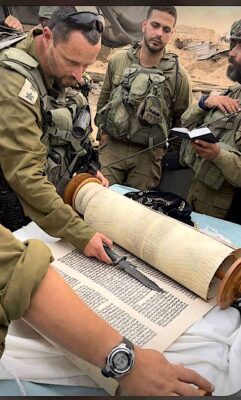
SCREAMS BEFORE SILENCE Full Video [57:00] A documentary film on the sexual violence committed by Hamas on October 7th, Screams Before Silence is a documentary film led by American businesswoman Sheryl Sandberg, that explores the sexual violence by Hamas during the Hamas-led attack on Israel, on 7 October 2023, including events at the massacre at the Nova Festival and abductions to the Gaza Strip.
Torah portion is Parshat Mikeitz Avi Abelow
December 19, 2025 Pulse of Israel
This week’s Torah portion is Parshat Mikeitz which always falls during the Chanukah holiday, and that is no coincidence. The Torah is teaching us something profound about Jewish identity, power, and light in a dark world.
Joseph sits in an Egyptian prison. Forgotten. Betrayed by his brothers. Seemingly erased from history. And then, in a single moment, everything turns upside down. Pharaoh has dreams. No one can interpret them. And suddenly, Joseph is pulled from the pit, from the dungeon, from exile—and rises to become the most powerful man in the world after Pharaoh himself.
But notice something critical: Joseph does not become Egyptian to succeed in Egypt.
He does not hide who he is. He does not apologize for his faith. He openly declares that all wisdom comes from God.
And Pharaoh recognizes it immediately: “Can there be another like him, a man in whom is the spirit of God?”
Joseph rises not despite his Jewish identity, but because of it.
That is the first great Chanukah message.
And here is something even deeper. Despite Joseph being fully “integrated,” despite him being the viceroy of Egypt, despite wielding unimaginable power, the Egyptians will not eat with Joseph and his brothers. The Torah tells us explicitly that Egyptians considered it an abomination to eat with Hebrews.
Let that sink in.
Joseph is running the Egyptian empire. He dresses like them. He speaks their language. He governs their economy. And still, he is never truly one of them.
This is an eternal lesson for Jewish history.
You can rise to the highest positions in foreign societies. You can be praised, celebrated, admired. But the world will always remind the Jew: you are different. Jewish identity cannot be erased, and it should not be erased.
Chanukah is the same story.
Chanukah is not about survival. It is about identity. The Greeks were not trying to physically annihilate the Jews. They were trying to erase Jewish distinctiveness. They said: be universal, be enlightened, be cultured, but stop being uniquely Jewish.
Stop living by God’s law. Stop bringing holiness into the physical world.
And the Maccabees said no.
The answer of the Maccabees was not deeper assimilation. It was deeper Jewish commitment.
They were few. They were outnumbered. They were told it was impossible. But they understood something the world still refuses to learn:
Chanukah is not about survival. It is about Jewish identity.
Joseph prepares for famine by thinking long-term. He plans. He builds. He stores grain. He does not react emotionally, he acts strategically. That is Jewish leadership.
But when it comes to his brothers, Joseph does something that at first glance looks cruel. He accuses them. He imprisons Shimon. He threatens Binyamin. He causes them pain.
Why?
Because Joseph understands something essential: family unity cannot be rebuilt without moral repair.
Joseph is not taking revenge for his brothers selling him into slavery. He is testing them. He is forcing his brothers to confront who they used to be, and to prove that they are no longer those people. He wants to see if they will once again abandon a brother, or if they have truly repented.
And when Judah steps forward, willing to sacrifice himself for Binyamin, Joseph finally knows: the family can be reunited.
This too is a Chanukah message.
Unity without truth is fragile. Peace without repentance is fake. Light cannot dwell where moral corruption is ignored.
The Maccabees did not unite the Jewish people by lowering standards, out of fear to not “offend” the Hellenized Jews. They united them by restoring authentic Jewish values, by rededicating the Temple, by demanding loyalty to God, by drawing a clear line between holiness and darkness.
And that is why Chanukah ends not with hiding in caves, but with the public lighting of the menorah.
Light is not meant to stay hidden.
The menorah is placed at the doorway, facing the public domain. We are commanded to broadcast Jewish light, God’s Torah, our commitment to return to the Temple, not to apologize for it, not to shrink from it, not to dilute it.
And that is the challenge of our generation.
We live in a world that tells Jews to be quiet. To be less Jewish. To compromise our values in order to be accepted. To assimilate by accepting “progressive”, really regressive anti-Torah values. To trade truth for comfort. To not offend others with the truth of our identity.
Parshat Mikeitz and Chanukah shout the opposite:
Do not assimilate. Do not apologize. Do not dim your light.
Like Joseph, rise to power as a Jew. Like the Maccabees, fight as a Jew. And like the menorah, shine as a Jew, proud, unapologetic, rooted in God’s truth, in God’s holy land.
That is our identity. That is our mission.
And that is how light defeats darkness, every time.
Am Yisrael Chai, Shabbat shalom and Chanukah Sameach!!!
To join the Israel Video Network – Pulse of Israel Group Click Here:
Telegram ➡️ https://t.me/aviabelowpulse
Whatsapp ➡️ https://chat.whatsapp.com/GkavRznXy731nxxRyptCMv
Meet the Israelis who fear an October 7th attack from the West Bank. Lahav Harkov
An IDF general ranks towns near the West Bank as more dangerous than the Gaza border, and residents of the area continue to express urgent concern that they are increasingly vulnerable to terrorism.
DEC 18, 2025 The Future of Jewish
Consider some of the most dangerous places to live in Israel.
There are the kibbutzim and towns along the Gaza border, where Hamas massacred people in their homes on October 7, 2023. There’s the northern border, which was mostly evacuated when the Israel-Hamas war began due to Hezbollah’s attacks from Lebanon.
Perhaps one may think of Hebron, in the West Bank, where Israelis live in a neighborhood in a mostly Palestinian city whose Palestinian mayor participated in a 1980 terror attack that killed six civilians.
Then there’s Bat Hefer, a small town of about 5,000 residents, with kibbutzim to its north and south, a few miles east of Netanya in central Israel.
The sleepy town, nestled between Highway 6, Israel’s major north-south artery, and the 1949 Armistice Line, known as the Green Line, is rated as more dangerous than the Gaza border area, according to Major General Rafi Milo, the head of the IDF’s Home Front Command.
In a recording leaked to one of Israel’s top TV news stations in June, Milo said: “If you ask me where the threat is much greater today, in Bat Hefer the threat is much greater than Yakhini,” a village where Hamas terrorists killed seven people on October 7th.
The danger to Bat Hefer comes from its proximity to Tulkarem, a Palestinian city with a refugee camp from Israel’s 1948 War of Independence. Residents of Tulkarem have shot into Bat Hefer and adjacent towns. The IDF has attempted to stop attacks by razing dozens of homes in the refugee camp in recent months, in what a defense source called “the Gaza-fication of the West Bank.”
While the IDF has a constant and more intense presence in the West Bank than it did in Gaza before October 7th, the threat is still present. Last week, IDF soldiers found rockets in a village next to Tulkarem. For the past two years, many Israelis living near the Green Line — an area also called the seam line — have looked out of their windows at Palestinian villages in the distance and wondered how safe their neighborhoods really are. After October, some began to worry that the same thing could happen to them in central Israel.
Ran Schneider lives in Sha’ar Efraim, a village near Bat Hefer that is an official entry point for goods to pass between Israel and the Palestinian Authority in the West Bank. He did his IDF reserve duty as a member of the village’s rapid response team, and said last year that they had long heard shooting from beyond the fence, but it increased after the October 7th attack.
The community’s rapid-response team “was in uniform protecting the village. Our area of responsibility was inside the village. We would check everyone going in and out and give people a sense of security,” Schneider said.
For many residents of the towns and cities near the Green Line and the separation barrier that runs along it, built in the wake of the Second Intifada from 2000 to 2005 to make it harder for terrorists to enter Israel, shootings are only part of the problem. In contrast with some of the more famous segments of the barrier, a high concrete wall often painted with graffiti and murals, much of the barrier is only a metal fence topped with barbed wire. It is a simple fence, lacking some of the high-tech features that the Gaza border fence had before Palestinians bulldozed it on October 7th. In addition, Palestinians for years frequently cut through the fence to work illegally in Israel.
Unlike some central Israeli municipalities, there isn’t a buffer zone between Sha’ar Efraim and the next Palestinian town.
“There isn’t space between us,” Schneider said, lamenting that “there are illegal workers who come in every day [from the Palestinian Authority] and in some cases, they want to commit terrorist attacks. … Even with all the will [of the authorities] to stop this after October 7th, it didn’t happen.”
Even after October 7th, with increased security measures in the West Bank, tens of thousands of Palestinians are estimated to be in Israel illegally each day, and as recently as last summer, one stabbed two Israelis to death and wounded two others in a terror attack in a Tel Aviv suburb. Israeli Police reported to the Knesset that between 2018 and 2022, only 10 percent of Palestinians arrested on security offenses had the necessary permits to be in Israel legally.
In addition to the shootings in and near Bat Hefer, a group of armed Palestinians approached the security barrier last year near the town Matan (another community settlement in central Israel near the Green Line). In August, the IDF sent soldiers to the area’s towns after the Shin Bet warned that Hamas and Iran were in contact with terrorists from Tulkarem and the surrounding area who planned to break through the fence and attack. The IDF eliminated the terrorist cell, according to Israel’s Army Radio.
Mayors and regional council heads from along the Green Line established the Seam Line Municipalities Forum one year ago to address the threats. The forum includes cities such as Kfar Saba and smaller towns and villages, as well as Arab-Israeli towns in the area, such as Kfar Kasem and Taibe.
“The homes of the residents in municipalities that are members of the Seam Line Forum are only hundreds of meters away from the security fence and a short drive from [the Palestinian town of] Kalkilya,” the forum’s chairman, Kfar Saba Mayor Rafi Saar wrote last year. “We cannot be complacent and allow a situation in which the massacre that took place in the Gaza envelope will be repeated in [central Israel]. It is no secret that the tactical paradigm of a separation fence, as advanced as it may be, totally failed on October 7th.”
After writing letters and inviting ministers to tour the area and “recognize the security risk to us and significantly increase the state budget to install security measures,” the forum turned to the High Court of Justice (Israel’s supreme court) last September to force the state to transfer 50 million shekels (approximately $14 million) that the government promised would go to their towns’ security. A ruling is still pending.
In the lawsuit, the mayors cited recent shootings from Palestinian towns into Israel, Palestinians breaking through the security barrier, and flying drones above the Israeli towns, as well as bombs thrown and even two rockets launched into the Southern Sharon Regional Council in central Israel.
Nirit is a small village in central Israel, with fewer than 1,000 residents. The real estate is pricey, and the residents are secular and tend to vote for Center-Left parties. The village abuts the Green Line, and they can see the Palestinian villages Abu Salman and Hableh across a buffer zone. The valley between Nirit and Abu Salman and Hableh is meant to be a closed military zone, but large buildings — not just trailers or aluminum huts — can be seen close to Nirit.
Itzik, a former high-ranking IDF officer who now blows glass in retirement, has lived in the village for most of its 42 years of existence. He looked out to the other side of the closed military zone with concern.
“Twenty years ago, none of the buildings were here. Month after month, more go up. We can see it,” he said, providing photographs and maps that showed the expansion of the Palestinian towns into the buffer zone since 2008.
After October 7th, some residents of Nirit began to think that the Palestinian villages’ encroachment into the buffer zone was putting them at risk. “We worried that if they see the success [of the attack], they will try to replicate it with us,” Itzik said.
After October 7th, the village put up a fence around its perimeter for the first time, and formed a rapid response team. “We would see [Palestinians] penetrate into Israel illegally to look for work,” Itzik said. “One day, someone may pass by our village and think of revenge and end up killing one of the residents. After [2023], it’s not such a strange thought. It could be reality.”
“For many years, the strategy was live and let live,” he said. “We hoped they would live next to us in peace, but as we saw, it’s a fantasy. We wake up in the morning thinking about how to live better lives, and the other side wakes up thinking of ways to destroy us.”
Several kilometers south of Nirit is the city of Rosh Ha’ayin, the hometown of Gal Gadot. It has a population of 56,300, including former Israeli Defense Minister Benny Gantz and current Transportation Minister Miri Regev. It’s a typical, small city in central Israel, with a train station packed most days with commuters to Tel Aviv, 18 kilometers west. Just under two kilometers east of Rosh Ha’ayin is the Palestinian village Deir Ballut.
Moriah Tzafar, a mother of two and a software developer at a startup, can see Deir Ballut from her apartment building, which she’s lived in for the past four years at the eastern edge of Rosh Ha’ayin. The building is in a new neighborhood called Psagot Afek — Afek is the biblical name for the area — built as part of a government program to provide affordable housing for first-time buyers.
One of her sons attends a public preschool on the outer road of Rosh Ha’ayin, with security cameras posted on its walls trained to look out on the valley beyond the city limits. A few yards past the preschool, there is a path with a warning sign in Hebrew that says “Firing Zone, Entrance Prohibited” — marking the end of sovereign Israel and the start of the West Bank (or Judea and Samaria, its official name in Israel), and then a grassy valley.
That firing zone is one of many that the IDF closed off to civilians decades ago (in this case in 1980) as empty areas designated for military training. The firing zone east of Rosh Ha’ayin is meant to extend all the way out to Deir Ballut, yet, as Tzafar said, “We see suspicious actions in the area between the fence and the Palestinian villages. We see cars driving close to the fence.”
“Not a day goes by that we don’t alert” the government and the IDF about suspicious activity by Palestinians entering the firing zone, Tzafar said, comparing her community to the female IDF lookouts whose warnings were ignored before the October 7th attack. “They’re continuing to do nothing and in the end it’ll reach us.”
Tzafar said she has seen people drive near the fence on the Palestinian side, get out of their cars, and look at Rosh Ha’ayin and take notes.
“What do they have to do along the fence?” Tzafar asked. “They don’t have anywhere to pass through here. There are no shops, no agriculture. Why is a hostile population allowed to enter a closed military zone and approach the fence?”
Ran Gavriel, a member of Rosh Ha’ayin’s rapid-response team, meant to protect the city from terrorist attacks, founded a neighborhood watch team seven years ago. He pointed to a hill south of Rosh Ha’ayin and said:
“There was a hole in the fence there, and we couldn’t see them [Palestinians] because of the hill. They would walk into the valley and then work in this area. They would ride their donkeys to the fence and then leave them because the donkeys know the way back home. And there were terrorist attacks. … My friend was stabbed more than 20 times near his apartment. Six hundred meters from here, a woman was shot.”
Gavriel said he and other members of the neighborhood watch would drive out to the separation barrier to physically block Palestinians from illegally entering Israel and close holes in the fence.
“I used to tell [Palestinians], ‘You are not coming in here,’” he said. “This is exactly like Lebanon and Gaza. [Palestinians] want to build a road into Rosh Ha’ayin. They don’t hide it. The Deir Ballut Facebook page says Rosh Ha’ayin is Palestinian.”
Gavriel said he met with two defense ministers to tell them about the situation, and took Regev on a tour of the vulnerable areas. “The Knesset (Israeli parliament) doesn’t help us,” Gavriel said. “I’m acting because I see no leader here.” The security cameras outside the public preschool are there because the residents paid for them, he noted.
Dany Tirza, a visiting researcher at the Institute for National Security Studies, is a former IDF colonel who was in charge of planning the security barrier. He said last December that there was less of a threat from Hamas to the towns along the seam line than there was to Israelis near the Gaza border. “The big difference between what happened in Gaza and the situation in the West Bank is how organized the Palestinians are,” Tirza said. “Hamas in the West Bank is not Hamas in Gaza. They are not organized at that level.”
On a smaller scale, however, Tirza said “it doesn’t take much” for 20 Palestinians to be able to reach a central Israeli town and to attack it because there are so many breaches in the fence. She added that “there is preparation by the army to prevent” an October 7th-like scenario. The IDF “took on this topic as a threat that it needs to take care of. They invested energy, intelligence, technology, and prepared forces so that it doesn’t happen.”
In addition, the seam-line towns are much better organized now, with armed rapid response teams, than they were before October 7th, he pointed out. Still, Tirza said, “Nothing is 100 percent.”
Asked if a wall would be more effective than a fence, Tirza said that the issue is not so much the strength of the barrier itself — because people will always try to find a way to sneak around it — but the IDF’s ability to know about such breaches and respond to them quickly.
“We need a situation where there is not only a fence, but the army gets a warning far enough in advance so that IDF forces can arrive and respond to prevent terrorist activities,” he said. “The same thing has to happen on all of Israel’s borders. We have to build an obstacle to delay [terrorists] and to be able to move fast enough.”
Tirza noted that thousands of Palestinians enter Israel illegally to work each day and not much has been done to stop it, “because we have to let them earn a living.”
“Israel has a much bigger dilemma between allowing a normal life for Israelis and protecting ourselves and living in a fortress with a knife between our teeth,” he said. “We try to find the middle ground. On the one hand, we try to live a normal life without constantly fearing disaster, and on the other hand, we try to prevent all such attacks. It’s a balance.”
Lahav Harkov is the Senior Political Correspondent for Jewish Insider
The $35 Billion Gas Deal With Egypt Is Not a Victory. Avi Abelow
It’s a Dangerous Illusion.
December 18, 2025 Pulse of Israel
Israeli headlines right now are celebrating a $35 billion natural gas deal with Egypt as if it proves peace, stability, and regional integration.
It proves none of those things except that, after decades of being energy dependent, we finally have energy independence that others are willing to pay for.
It actually proves something far more dangerous: that our leadership still believes money can pacify an enemy that ideologically rejects Jewish sovereignty.
Egypt has violated the Camp David Accords by flooding Sinai with troops, tanks, and heavy weapons far beyond what the treaty allows, totally endangering Israel.
As if that is not enough of a red flag, for years Egypt enabled Hamas’s military buildup in Gaza, whether actively assisting or turning a blind eye to the terror tunnels that armed the massacre of October 7th.
And yet, Israel responds not with consequences, but with a multibillion-dollar gas deal.
That is not strength.
That is blindness.
And while the world looked away, Egypt trampled international asylum law, sealed the Gaza border into Sinai, trapping Gazans in a war zone, and threatening to shoot any Gazan who tried to flee.
Egypt allowed weapons and terror to flow freely into Gaza to arm Hamas, yet slammed the border shut when Gazan civilians tried to flee a war zone and stop being used as human shields by Hamas.
Yet Israel has not held Egypt accountable for acting like the enemy it is, hiding behind a peace treaty while enabling our destruction.
We have already paid a horrific price for a security doctrine built on the fantasy that our enemies want prosperity more than jihad. Hamas was never interested in jobs, permits, or economic improvement for Gazans. Hamas was focused on slaughter, not livelihoods, and Israel’s IDF and intelligence leaders pretended otherwise, pushing the government, days before Oct. 7th, under the guidance of the head of intelligence, to bring tens of thousands of Gazans into Israel to work.
Jihadi Muslim terror is ideological, not economic.
And every time we forget that, Jews die.
The Middle East does not run on Western logic. It never has. As expert on Islam and the Middle East Dr. Mordechai Kedar once told me:
“Every deal with the Arab Muslim Middle East is like sand in the wind. Everything can change in an instant.”
Regimes fall. Borders collapse. Allies vanish overnight.
Just imagine if Israel had surrendered the Golan Heights to Assad, as the Western powers were pressuring us to do for years. Today Jolani’s ISIS troops would be overlooking the Kinneret with weapons aimed at Tiberias.
Money does not neutralize Islamic jihad.
Energy contracts do not erase 1,400+ years of a genocidal Muslim doctrine.
Deterrence here is built on land, sovereignty, and consequences.
This deal should never have happened before Egypt paid a price for violating the peace agreement, withdrawing troops from Sinai and being held accountable for aiding Hamas. By skipping that step, Israel sent a clear message to its enemies:
Economic deals blind us to danger.
They heard that message loud and clear.
Israel does not need applause from international markets.
It needs clarity, strength, and strategic depth.
A stronger, larger, expanding, unapologetic Jewish state, rooted in land, sovereignty, and permanent consequences for those Muslim regimes who seek our destruction, is the only model that works in the Middle East.
Everything else is sand in the wind.
Am Yisrael Chai!!!
To join the Israel Video Network – Pulse of Israel Group Click Here:
Telegram ➡️ https://t.me/aviabelowpulse
Whatsapp ➡️ https://chat.whatsapp.com/GkavRznXy731nxxRyptCMv
Report: AG tried to prevent video leak investigation
Attorney General Gali Baharav-Miara allegedly contacted then-Defense Minister Yoav Gallant to convince him to drop the investigation into the Sde Teiman video.
Dec 17, 2025, 9:41 PM (GMT+2) Israel National News
Attorney General Gali Baharav-Miara’s staff, contacted the office of then-Defense Minister Yoav Gallant twice in an effort to persuade him to withdraw his demand to open a criminal investigation following the leak of the Sde Teiman video.
According to the report, the AG’s office presented a range of arguments aimed at defusing the issue, and argued, among other things, that the act did not justify a criminal investigation and that state security had not been harmed as a result of the leak.
Testimonies indicate that Gallant was not satisfied with the progress of the investigation that began after the leak. Ultimately, he demanded an inquiry, but this request was rejected by the AG and deputy military advocate, Gal Asael, who made clear to him that such a process could harm the criminal investigation being conducted under the AG’s close supervision.
Further descriptions in the probe state that the deputy military advocate, who was appointed to examine the leak, acted according to the instructions of the AG’s office. In his testimony, he said he received praise for his examinations, but there is no indication of direct involvement by the AG in a cover-up or in the leak.
Despite the AG’s staff’s attempts, investigators are now examining whether there were flaws in the handling of the criminal process, but defense officials say there is no suspicion of direct involvement by the AG or other actors in a cover-up.
Related articles:
- Calls mount for haredi high school coordinator to be fired
- AG demands Netanyahu ‘address’ Ben-Gvir issue
- ‘Israel won’t be a mafia state’
- ‘You must not interfere in ministerial appointments’
US Congress permanently ends Syria sanctions Elad Benari
US Congress votes to permanently lift sanctions on Syria, ending the Caesar Act and opening investment channels under new leader Ahmed al-Sharaa.
Dec 18, 2025 INN
The US Congress on Wednesday voted to permanently end sanctions on Syria that were imposed under ousted leader Bashar Al-Assad, clearing the way for renewed foreign investment in the war-torn country, AFP reported.
President Donald Trump had already suspended implementation of the sanctions twice, following appeals from Saudi Arabia and Turkey, both key backers of Syria’s new government led by former jihadist Ahmed al-Sharaa**.
Sharaa, who now heads the Damascus leadership, sought a full repeal of the restrictions, warning that businesses would remain reluctant to engage with Syria as long as the sanctions remained law in the world’s largest economy.
The Senate passed the repeal of the 2019 Caesar Act as part of its annual defense package, with a 77-20 vote, after approval in the House of Representatives. The measure now awaits Trump’s signature.
The Caesar Act, enacted in 2019, was named after an anonymous Syrian military photographer whose images documented atrocities in Assad’s prisons. The law had imposed sweeping restrictions on investment and cut Syria off from the international banking system.
Its purpose was to block foreign companies from financing Syria’s reconstruction while Assad remained in power – at a time when the regime appeared to have regained control after years of devastating civil war that triggered mass refugee flows to Europe and fueled the rise of Islamic State.
A year ago, Sharaa’s forces captured Damascus in a lightning offensive, toppling Assad’s rule. Since then, Sharaa has impressed Trump, notably during their meeting at the US President’s May visit to Riyadh.
The two met again last month, this time at the White House during Sharaa’s visit to Washington.
Sharaa’s group, Hayat Tahrir al-Sham (HTS), was delisted as a terrorist organization by the US in July. Since taking power, Syria’s new leadership has sought to distance itself from its extremist past and present a more moderate image.
Related articles:
- US praises Syria for blocking Hezbollah weapons shipments
- Rabbis from Israel joined rare visit to Aleppo synagogues
- Exiled Syrian leader pursues medical career in Moscow
- Trump on deadly ISIS ambush in Syria: We will retaliate
[Ed.: Syria continues to provide for the slaughter of the Alawites, the Kurds, the Druse, and the Christians. This goes on all day, every day, and even at this very moment! The US Congress is an ignorant gang of idiots, and so too, is anyone else involved with this genocidal plan. The sanctions should only be lifted once the killing stops!

Jonathan Pollard urges PM, Defense Minister to approve raising Israeli flag in Nisanit
Jonathan Pollard says raising the Israeli flag in Nisanit on Hanukkah will show strength, hope, and Israel’s resolve against its enemies.
Published: Dec 17, 2025 Israel National News
Ahead of the Hanukkah holiday and the flag-raising event led by the Nachala Settlement Movement on Thursday, Jonathan Pollard sent a letter to Prime Minister Benjamin Netanyahu and Defense Minister Israel Katz, calling on them to approve the national ceremony at the site where the community of Nisanit once stood in the northern Gaza Strip.
In his letter, Pollard refers to the events of October 7 and the Swords of Iron War, and calls for a responsible decision regarding Israel’s future security and presence in Gaza.
“From the price paid in blood, body, and soul, one clear truth emerges: we cannot accept a reality in which the Gaza Strip remains without Jewish presence while continuing to pose an existential threat to Israel’s citizens and the communities of the south. Historical experience and security reality have proven time and again that only a stable and sovereign Jewish civilian presence, alongside a security presence, creates real deterrence, strategic depth, and a secure future for the State of Israel. This is a matter of national responsibility, security, and preventing the next disaster.”
Pollard adds that raising the flag is not merely a symbolic act, but one with deep national significance, expressing connection to the land, continuity, and refusal to surrender to violence and terror.
“Raising the Israeli flag in Nisanit is a unifying and value driven step that honors the memory of the fallen, the wounded of the war, and the future of generations to come.”
Chanukah Guide for the Perplexed, 2025 Ambassador (ret.) Yoram Ettinger
December 8, 2025 “Second Thought: a US-Israel Initiative”
1.Chanukah (evening of December 14 – December 22, 2025) is the only Jewish holiday that commemorates an ancient national liberation struggle in the Land of Israel, unlike Passover, Sukkot/Tabernacles and Shavu’ot/Pentecost, which commemorate the liberation from slavery in Egypt to independence in the land of Israel, and unlike Purim, which commemorates liberation from a Persian attempt to annihilate the Jewish people of Persia.
2. NBC news, December 13, 2022: “An ancient treasure trove of silver coins dating back 2,200 years, found in a desert cave in Israel, could add crucial new evidence to support a story of Jewish rebellion…. The 15 silver coins were hidden [during] the Maccabean revolt from 167-160 B.C., when Jewish warriors rebelled against the Seleucid [Syrian] Empire….”
3. In 1777, Chanukah candles were lit, by a Jewish soldier, during the Valley Forge encampment, the turning point of the Revolutionary War, which solidified the victory of George Washington’s Continental Army over the British monarchy. Benjamin Rush, a signer of the Declaration of Independence and a player in the ratification of the US Constitution, paving the road to the Boston Tea Party, 1773: “What shining examples of patriotism do we behold in Joshua, Samuel, the Maccabees and t
he illustrious princes and prophets among the Jews…” On December 6, 2013, Ambassador Hank Cooper, a former Director of the Strategic Defense Initiative Organization, wrote: “We need modern day Maccabees to preserve the heritage of liberty for our posterity….”
4. According to Israel’s Founding Father, David Ben Gurion: Chanukah commemorates “the struggle of the Maccabees, which was one of the most dramatic clashes of civilizations in human history, not merely a political-military struggle against foreign oppression…. Unlike many peoples, the meager Jewish people did not assimilate. The Jewish people prevailed, won, sustained and enhanced their independence and unique civilization…. It was the spirit of the people, rather than the establishment, which enabled the Hasmoneans to overcome one of the most magnificent spiritual, political and military challenges in Jewish history….” (Uniqueness and Destiny, pp 20-22, David Ben Gurion, IDF Publishing, 1953).
5. Chanukah and the Land of Israel. When ordered by Emperor Antiochus IV Epiphanes of the Seleucid region to end the Jewish “occupation” of Jerusalem, Jaffa, Gaza, Gezer and Akron, Shimon the Maccabee responded: “We have not occupied a foreign land…. We have liberated the land of our forefathers from foreign occupation (Book of Maccabees A: 15:33).”
Chanukah highlights the centrality of the Land of Israel in the formation of Judaism and the Jewish people. The mountain ridges of Judea and Southern Samaria (the West Bank) – the cradle of Jewish history, religion, culture and language – were the platform for the Maccabean military battles: Mitzpah (the burial site of the Prophet Samuel, overlooking Jerusalem), Beit El (the site of the Ark of the Covenant and Judah the Maccabee’s initial headquarters), Beit Horon (Judah’s victory over Seron), Hadashah (Judah’s victory over Nicanor), Beit Zur (Judah’s victory over Lysias), Ma’aleh Levona (Judah’s victory over Apolonius), Adora’yim (a Maccabean fortress), Eleazar (named after Mattityahu’s youngest Maccabee son), Beit Zachariya (Judah’s first defeat), Ba’al Hatzor (where Judah was defeated and killed), Te’qoah, Mikhmash and Gophnah (bases of Shimon and Yonatan), the Judean Desert, etc.
6. Chanukah’s historical context is narrated in the 4 Books of the Maccabees, The Scroll of Antiochus and The Wars of the Jews.
In 323 BCE, following the death of Alexander the Great (Alexander III) who held Judaism in high esteem, the Greek Empire was split into three independent and rival mini-empires: Greece, Seleucid/Syria and Ptolemaic/Egypt.
In 175 BCE, the Seleucid/Syrian Emperor Antiochus (IV) Epiphanes claimed the Land of Israel. He suspected that the Jews were allies of his Ptolemaic/Egyptian enemy. The Seleucid emperor was known for eccentric behavior, hence his name, Epiphanes, which means “divine manifestation.” He aimed to exterminate Judaism and convert Jews to Hellenism. In 169 BCE, he devastated Jerusalem, attempting to decimate the Jewish population, and outlaw the practice of Judaism.
In 166/7 BCE, a Jewish rebellion was led by the non-establishment Hasmonean (Maccabee) family from the rural town of Modi’in, half-way between Jerusalem and the Mediterranean. The rebellion was headed by Mattityahu, the priest, and his five sons, Yochanan, Judah, Shimon, Yonatan and Eleazar, who fought the Seleucid occupier and restored Jewish independence. The Hasmonean dynasty was replete with external and internal wars and lasted until 37 BCE, when Herod the Great (a proxy of Rome) defeated Antigonus II Mattathias.
The reputation of Jews as superb warriors was reaffirmed by the success of the Maccabees on the battlefield. In fact, they were frequently hired as mercenaries by Egypt, Syria, Carthage, Rome and other global and regional powers.
7.Chanukah celebrates the Maccabean-led national liberation by conducting in-house family education and lighting candles – in a 9-branch-candelabrum – for 8 days in commemoration of the re-inauguration of Jerusalem’s Jewish Temple and its Menorah (candelabrum).
The Hebrew words Chanukah (חנוכה), inauguration (חנוכ) and education ((חנוך possess an identical root.
8. As was prophesized by the Prophet Hagai in 520 BCE, the re-inauguration of the Temple took place on the 25th day of the Jewish month of Kislev, which is the month of miracles, such as the post-flood appearance of Noah’s rainbow, the completion of the construction of the Holy Ark by Moses, the laying of the foundations of the Second Temple by Nehemiah, etc.
The 25th Hebrew word in Genesis is “light,” and the 25th stop during the Exodus was Hashmona (the same Hebrew spelling as Hasmonean-Maccabees).
9. Chanukah highlights the defeat of darkness, forgetfulness, disbeliefand pessimism, and the victory of light, commemoration, faith, defiance of odds, can-do mentality and optimism (darkness and forgetfulness are spelled with identical Hebrew letters: חשכה, שכחה). The first day of Chanukah is celebrated when daylight hours are equal to darkness hours – and when moonlight is hardly noticed – ushering in brighter days.
Failure at the Fence: How Hamas breached Israel’s “Iron Wall” [28:02]
Under US pressure, Israel to take over rubble clearing in devastated Gaza Strip – report
Removing Gaza debris estimated to take up to 7 years, billions of dollars
December 12, 2025 All Israel News
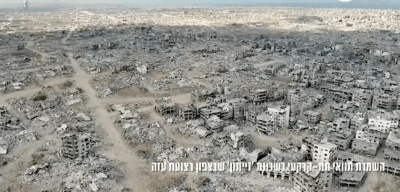
Israel has agreed to a request from the United States to take over responsibility for clearing the vast amount of rubble covering the Gaza Strip after two years of fighting, Ynet News reported, citing a senior Israeli official.
Israel has agreed in principle to take physical and financial responsibility for removing the debris, which is estimated to take years and could cost hundreds of millions of shekels.
According to the report, the U.S. sees clearing the rubble as the first step toward reconstructing the enclave according to Phase Two of the ceasefire agreement and aims to start rebuilding in the southern town of Rafah to showcase U.S. President Donald Trump’s vision for reconstruction.
American officials said that Rafah is intended to serve as a pilot area designed to attract Gaza residents for employment and to build broader support for the reconstruction effort.
Israel is expected to hire specialized companies to clear the debris, the report said.
A recent Wall Street Journal report estimated the volume of rubble in Gaza to be roughly 68 million tons. “That is equivalent to the weight of around 186 Empire State Buildings. Distributing that amount of rubble evenly across Manhattan would leave around 215 pounds of debris on every square foot,” according to the WSJ.
In November, the UN Development Program (UNDP) estimated that most of it could be cleared within seven years. “One hopes that it will happen as quickly as possible, but it will take years,” said Jaco Cilliers, head of UNDP’s operations in the Palestinian Territories. “The best-case scenario is that it will take at least five, [but] more like seven years.”
The UN said that a review of the satellite images suggests there were more than 123,000 destroyed buildings in the Gaza Strip, and an additional 75,000 damaged to varying degrees, accounting for 81% of all the structures.
In addition to the remains of destroyed structures, the rubble contains unexploded ordnance. Israeli officials estimate that 1-2% of Israeli projectiles could have failed to explode, some of which Hamas has used to extract explosives during the war.
The Israel Defense Forces have highlighted that over 10% of Hamas’ rockets failed to cross into Israel and either exploded or fell within Gaza.
Hamas’ health authorities also claim that the bodies of some 10,000 people are trapped under rubble.
The work to move and clear the debris has not begun in earnest, as Israel still limits the entry of the required heavy machinery, which is categorized as “dual-use,” as Hamas terrorists could use it to repair or construct new tunnels.
UNDP has used the limited equipment available to collect or repurpose some 209,000 tons of debris so far.
The UN estimates that overall reconstruction will cost around $70 billion, which the Trump administration hopes will be paid in large part by the Gulf states. However, Qatar recently said it wouldn’t “write the check to rebuild what others destroyed,” according to Prime Minister Mohammed Al Thani.
“Our payments will only go to help the Palestinian people if we see that the help coming to them is insufficient,” Al Thani added. A spokesperson later clarified that Qatar doesn’t want to be the only state paying for the rebuilding effort.
Israeli officials told Ynet News that Israel is concerned about Washington’s apparent focus on reconstruction over demilitarization.
Jerusalem also continues to refuse to begin the next stage of the ceasefire before Hamas returns the body of hostage Ran Gvili, insisting on a commitment to disarm the terror group and demilitarize the Gaza Strip.
Is This Enough Evidence That October 7 Wasn’t a Mistake? CHANANYA WEISSMAN
Plus an inspiring Chanukah video from Hamas, found by the IDF…
DEC 11, 2025
David Sidman put together the following timeline of events the morning of Oct 7, based on establishment media reports linked at the end:
The following is the Air Force’s timeline of events the morning of Oct 7:
7:10 am: IDF jets were ordered to attack Gaza
10:00 am: (The jets still haven’t taken off despite the order 3 hours ago), a new order was given to specifically strike the border area where the invasion was taking place
10:30 am: Jets finally scramble after 3 hours!) and head to Gaza, but instead of attacking the border area as ordered to, for some mysterious reason, the air fleets instead continued on, flying right over the border to strike targets “deep” inside Gaza!
12:00 pm: The pilots are finally rerouted to attack the Gaza border – (A 2-hour delay for an order that should have taken 45 seconds)
Once they were finally arrived at the border area (following a mysterious 4.5 hour delay, then a 2 hour delay) they were essentially denied any request to strike the Hamas terrorists who were actually invading the border and if they did strike Hamas terrorists during the invasion without explicit authorization from a command center that wasn’t authorizing any, they were “reprimanded.”
Questions:
Why were the planes parked for over 3 hours after receiving an order to take off?
Why did the pilots violate orders to attack the border area choosing to fly over and hit targets deep inside Gaza?
Why did the air force take over 5 hours to follow an order that should have taken 6-7 minutes?
Who refused to authorize the pilots to engage with the invaders and punished any who did?
Army
On the morning of Oct 7, after learning of the invasion, then IDF chief Halevi downgraded the IDF’s readiness level as the attack developed.
Why would the IDF chief relax the army’s readiness level AFTER getting a clearer picture of the nature of the invasion?
Intelligence
The Intelligence Directorate, withheld some of the information from the commanders throughout the night of Oct 7, and therefore they acted with only partial information.”
Why would the IDF intelligence withhold information from the ground forces during an invasion?
What intel was being denied to the front lines, and who gave the order to withhold vital intel during the invasion?
We may never know the answer to these questions because…
The IDF chief of staff has frozen the release of a sensitive report into the army’s failures during Hamas’ Oct. 7 attack
It’s not only the IDF that appears to be hiding something. Former high-ranking officials of the Shin Bet (Israel’s intelligence outfit) are refusing to comply with a subpoena from the State Comptroller’s Office to appear for investigation meetings and provide relevant documents regarding the events leading up to the October 7th attack.
Knesset Member Tali Gotliv reports that the Shin Bet officials met with a top Hamas official the night of Oct 7.
Sources
- https://www.israelnationalnews.com/news/418751
- https://www.jpost.com/israel-news/defense-news/article-876745
- https://www.ynetnews.com/article/bj11vruvsll
- https://news.walla.co.il/item/3799863
- https://www.mako.co.il/news-military/be11d799e08b8910/Article-ed95e8f8c74fa91027.htm
Someone really needs to tell Bibi about all this!
Look, you can bend yourself into a pretzel playing devil’s advocate and acting as if that makes you an intellectual, or you can finally stop advocating for the devil.
Someone just shared this with me, from something called Jewish Breaking News.
Newly released chilling footage shows American Israeli hostage Hersh Goldberg Polin and several other captives attempting to observe Chanukah while held underground in the Hamas terror tunnels.
https:// www.youtube.com/watch?v=VzYZMfJ73Uw&t=1s
In the video, the hostages try to improvise a candle. They then sing ‘Ma Otzur’ a Chanukah song together in the cramped and suffocating space where they were being held.
The people seen in the footage include Hersh Goldberg Polin, Carmel Gat, Eden Yerushalmi, Alex Lubanov, Almog Sarusi, and Ori Danino. They were among the civilians kidnapped on October 7 when Hamas terrorists entered southern Israel and abducted men, women, and children.
The footage is believed to have been filmed shortly before they were killed.
According to the IDF, the hostages were murdered inside the tunnels, and their bodies were recovered during military operations after intelligence revealed their location. Their deaths generated widespread grief.
Israeli officials say the video raises disturbing questions about why Hamas chose to record the moment and adds to growing evidence of the psychological and physical abuse inflicted on the hostages and their families with propaganda films being shot.
An inspirational hostage video, just in time for Chanukah, supposedly from loot collected by the IDF.
Interesting looking tunnel.
So Hamas let them play with fire? And took this inspiring video just for the heck of it?
My money is on the Shabak/CIA production team.
Same here in this video, courtesy of t.me/kipaadu, which asks very reasonable questions the media never seems to think of:
Finally, the state proclaims another unvaccinated child died of measles, or complications related to measles (which could really mean anything, including medical malpractice related to measles). Very few Israelis seem to believe them — including one woman who blasted the “human animals, liars” and “group of trash cans” behind this report, adding that the child was her nephew, and there was no connection to measles.
Who do you believe?
(Personally, I think her comments are inappropriate, because animals would never do something like this, and trash cans are an asset to society.)
A regime with a documented history of kidnapping and trafficking Yemenite children, and performing horrific medical experiments on children, and so much more, would never, ever make up a story about a child’s death to push a vaccine narrative. That crosses the line, and anyone who believes such a thing should be ridiculed by all rational people.
See here for the Facebook post and full comments.
Pledge your support
In this week’s Torah class we explored the mysterious lives of Dinah and Osnat, according to numerous Midrashim. What happened to Dinah in the end? What were Osnat’s true origins? How can we reconcile conflicting Midrashic accounts which can’t all be literally true? Why didn’t the Torah make it clear?
Also, what is one of the primary spiritual reasons converts tend to suffer? The answer is surprising and very sobering for all of us.
The class is embedded above and on Rumble here.
The link to register for the live weekly classes is here.
Visit chananyaweissman.com for the mother lode of articles and books.
Visit rumble.com/c/c-782463 for my Torah classes, Amalek and Erev Rav programs, and much more.
Buy my books on Amazon here or contact me directly to purchase in Israel.
Download Sefer Kibbutz Galuyos pdf here or ePUB here, or buy on Amazon here.
Download Tovim Ha-Shenayim as a PDF for free!
Contact me at weissmans@protonmail.com.

Comments
Comments are closed.