COMMENTARY / OPINION

An examination of Trump family business ties in the Middle East goes a long way toward explaining the moves that shocked MAGA.
NOV 17, 2025
Many conservatives have expressed shock and dismay that President Donald Trump would speak so highly of an Islamic terrorist, calling him “good looking” and a “tough guy,” even inviting him to the White House.
They shouldn’t be surprised. For Trump, it’s all about business. And the lines between U.S. foreign policy and the Trump family business have increasingly been blurred the longer Trump has served in politics.
You want to know why President Trump invited former al-Qaida terrorist Muhammad al-Julani to the White House after he morphed from terror kingpin into Syrian head of state, having changed his name to Ahmed al-Sharaa, trimmed his beard and traded his keffiyeh for a Western suit? You want to know why the president agreed to lift sanctions on the Syrian regime led by Julani?
Clues to Trump’s bizarre embracing of the Syrian strongman are found in his business ties to Saudi Arabia.
The Saudis are the epicenter of global Sunni Islam, which is engaged in a centuries long bitter fued with Shia Islam, centered in Iran. The West has always courted the Sunnis and the East, led by Russia, sides with the Shia and Iran.
A U.S.-aided coup in Syria late last year ousted the secular Shia-supporting dictator Bashar al-Assad from Syria and replaced him with a Sunni dictator, Mr. Julani, who once led ISIS militants in the region and had a $10 million U.S. bounty on his head.
Are things starting to make sense now? If not, stick with me, as it will become even clearer as to why Julani has suddenly gone from criminal terrorist to invited White House guest.
Trump was first introduced to Julani by Saudi Crown Prince Mohammed bin Salman when Trump paid a visit to the Saudi capital of Riyadh in May 2025. You can see the three together in the photo below, which was posted to X by the White House press secretary.
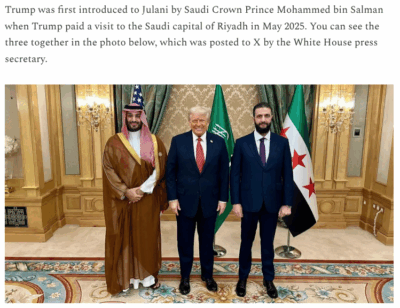
Forbes has a new report out detailing the Trump family’s longtime business dealings with the Saudis. These relationships date back to 1987 but really gained steam following Trump’s first term in the White House.
Trump tweeted on October 16, 2018, one day after parroting a claim from Saudi Arabia’s king that he did not know what happened to murdered journalist Jamal Khashoggi, “I have no financial interests in Saudi Arabia (or Russia, for that matter). Any suggestion that I have is just more FAKE NEWS (of which there is plenty)!”
But Forbes brings the receipts, writing:
“Trump may not have had any interests in Saudi Arabia at the time, but he had done sporadic business with Saudi Arabia, offloading the Plaza Hotel to a Saudi prince in 1995 and selling a set of condos to the Saudi government in 2001. Trump’s ties to the Arab nation grew stronger in the wake of the Khashoggi murder, however, especially after his first term in office ended. Since then, the president and his family struck at least nine deals with Saudi investors, pushing millions into the president’s golf properties, tens of millions into his licensing business and billions into private-equity funds, according to Forbes calculations. In 2024 alone, Trump and his extended family collected an estimated $50 million from deals connected to Saudi Arabia.”
So there you have it. The Saudis, among the largest funders of Sunni Islamic terrorism worldwide, and the country that 17 of the 19 9/11 hijackers called home, are totally intertwined, businesswise, with the Trump family.
They sponsored Julani as the new Syrian leader and introduced him to their old friend Donald Trump.
Don’t think for a minute that the Trump family’s business relationships with the Saudis don’t give the Saudi royals leverage in the Middle East when it comes to U.S. foreign policy decisions.
In 2001, Trump sold the entire 45th floor of Trump World Tower, with five apartments and a combined 10,000 square feet near the United Nations, to the Kingdom of Saudi Arabia for $12 million, according to an analysis of real estate records cited by Forbes.
Trump said at a campaign event in 2015, “Saudi Arabia, and I get along great with all of them, they buy apartments from me. Am I supposed to dislike them? I like them very much.”
On Monday, November 17, 2025, Trump announced the U.S. will be selling F-35 fighter jets to Saudi Arabia.
Should we be surprised?
No more than we should be surprised that a terrorist is getting the royal treatment at the White House.
[Ed.: Now I finally understand Trump’s Middle East posture! I was wrong about my evaluation that he had bad advisors and was merely stupid. I was jumping to conclusions. Thank you Leo Hohmann for educating me enough to realize my error!]
Proof, Something HUGE is Coming… | Victor Davis Hanson [10:36]
November 17, 2025 Point of view
Victor Davis Hanson tears the mask clean off the “democratic socialist” illusion — revealing a system that pretends to protect your freedoms while quietly tightening the noose.
According to Hanson, it always starts the same way:
“Keep your private property… trust us… we just want to regulate a few things.”
But then it creeps — exactly like we’ve seen in Europe.
First it’s energy.
Then speech.
Then hiring.
Then education, media, culture — until the entire society is managed by ideological gatekeepers who decide what you can say, think, and criticize.
This isn’t a warning about the future.
According to Hanson…
it’s already happening.
Trump’s defense of Carlson: Free speech doesn’t come without judgment JONATHAN S. TOBIN
November 17, 2025 JNS
The liberal establishment stifled debate and smeared its foes, discrediting “gatekeeping.” But that’s no excuse for being neutral about real neo-Nazis and antisemites.
Nick Fuentes had good reason to celebrate. He is the leading example of the so-called “groypers”—the term applied to the particular brand of fanatical antisemites and far-right extremists for which he is the leading spokesperson. Any doubt that he was gaining ground in his efforts to be mainstreamed in American political discourse was removed on Sunday by President Donald Trump.
In one of his typical off-hand media availabilities, this time on his way back to the White House from a stay at his Mar-a-Lago resort in Florida, Trump was asked what he thought about former Fox News host Tucker Carlson giving Fuentes a friendly interview on his podcast.
The president replied, “You can’t tell him who to interview.” Trump publicly dined once with Fuentes in Mar-a-Lago along with Kanye West, another prominent Jew-hater, in 2022, and then afterwards claimed that he didn’t know who he was. He seemed to be repeating that story now by saying that he “didn’t know much about” Fuentes. Still, as far as he was concerned, if Carlson wanted to interview Fuentes, then “get the word out,” the president said. “People have to decide. Ultimately, people have to decide.”
A defeat for decency
While the claim of ignorance might have been credible three years ago, it doesn’t hold up anymore, especially after the debate among conservatives over Fuentes that has been raging in the last month.
While Trump and his supporters can claim that this doesn’t constitute an endorsement of the young antisemite, that wasn’t how the groyper leader—a figure with a large following on social media—treated it. He shared the video of the Trump statement with the comment, “Thank you, Mr. President.”
That’s a defeat for decent people, regardless of where they stand on the political spectrum, who would like to relegate extremist trolls like Fuentes to the fever swamps on the far right and out of mainstream discourse.
The Democratic Party has elevated its own brand of antisemites—far-left, progressive Israel-haters like New York City mayor-elect Zohran Mamdani and the members of the far-left congressional “Squad”—to be the rock stars of the political left. The moral equivalents of Mamdani and Rep. Alexandria Ocasio-Cortez (D-N.Y.) on the right, such as the erratic Rep. Marjorie Taylor Greene (R-Ga.), whose re-election Trump now opposes, are not treated with the same deference or in a position to lead the party in the future. But the willingness of Trump and others to tolerate Carlson—and now, apparently, Fuentes—has created a crisis about antisemitism on the right.
This is shocking—and not just because one would have thought that no sensible person, regardless of political affiliation, would have thought a softball interview of Fuentes, in addition to other antisemites and Israel-haters Carlson has hosted on his show in the last year, would have been defensible.
But those who are voicing outrage about what Trump just said, as well as the other examples of those who rushed to Carlson’s defense, are missing something important. The argument isn’t so much about whether Fuentes’s hate is laudable. It’s about “gatekeeping.”
Discrediting ‘gatekeeping’
The notion that some views, like Fuentes’s particular variant of neo-Nazi lunacy, are so abhorrent that they ought not to be considered worthy of discussion, let alone a fair hearing, has become completely discredited among many conservatives.
A not-insignificant portion of political thinkers and voices on the right seems to have adopted the position that shutting down discussion of any opinion—no matter how disgusting or immoral—is wrong. And many people who may not be comfortable with extremists in any other context are nodding along with the defense of Carlson because of this.
How did we get here?
The answer is that it is an overreaction to the way the political left and its toxic ideologies about race have come to dominate the public square in recent years. The long march of the progressives through American institutions that control education, the media and culture, which culminated in the Black Lives Matter summer of 2020, created a wave of “cancelations” in which anyone who dissented from the new neo-Marxist leftist orthodoxy was shamed and hounded out of public life.
A refusal to genuflect to the noxious ideas of critical race theory, intersectionality and settler-colonialism rendered otherwise qualified persons ineligible for jobs in academia, mainstream liberal media outlets, the fine arts and even popular culture. Those already in such positions were often driven out of them if they were labeled as conservatives.
Moreover, the entire tenor of the national debate was deeply influenced by the intolerance of the left. The risible notion that “anyone I don’t like is Hitler” or a foe of democracy became normative for political liberals. Calling Republicans Nazis or fascists, though, is nothing new; similar false accusations were frequently heard 20 years ago against figures such as President George W. Bush. However, it went into overdrive once Trump came on the political scene and is now almost a reflexive reaction to almost any conservative opinion or personality.
Trump defeated efforts not merely to cancel him, but to bankrupt and imprison him. The left, though frustrated by their political defeats, has now shifted to using the same methods to apply the same tactics to supporters of Israel. Following the lead of the Soviet propagandists who convinced the United Nations to falsely label Zionism as racism 50 years ago, they now do the same to Jews, employing blood libels about Israel committing “genocide.”
Sadly, in confirmation of the horseshoe theory of politics in which extremists always find common ground in their shared antisemitism, some on the right, like Carlson (and the even more odious far-right political commentator Candace Owens and Fuentes), are playing the same game. The only difference is that rather than claiming that Israel is a racist state because it’s Jewish, they seek to delegitimize Christian Zionists and Jews by upholding old traditions of Christian theological antisemitism and isolationist tropes about Jews being aliens who threaten and manipulate American interests for the sake of Israel.
In a saner era, conservative thought leaders would not put up with such appalling views being treated as debatable, let alone something decent people should tolerate. That is exactly what William F. Buckley, the founder of modern conservatism, did in the 1960s to the extremists of the John Birch Society, and again, in the 1990s to antisemites like Pat Buchanan and Joseph Sobran. Buckley’s “gatekeeping” was long celebrated by conservatives as evidence not only of his leadership but of how the political right was able to discard crackpots and achieve enormous political victories.
Overreacting to the left
That kind of gatekeeping isn’t merely out of fashion on the right. It is currently being viewed as wrong and somehow no different from the cancellations meted out to dissenters from the woke catechism of diversity, equity and inclusion (DEI) or the idea that America is an irredeemably racist nation by BLM and other progressives.
In its place is the sort of nonjudgmental attitude about extremism voiced by popular podcasters like Megyn Kelly, Matt Walsh, and now, the U.S. president himself.
But just because leftists were wrong to accuse Trump of being a racist, a Nazi, or—in an act of unconscious irony because he is the most pro-Israel president in history—an antisemite, and to do the same to others on the right doesn’t mean that there are no such things as racists, Nazis and antisemites.
Carlson’s decision not merely to platform but give the views of the repellent racist and Jew-hater a sympathetic and even supportive hearing has divided conservatives in recent weeks. More than that, he used the show to vent his own hatred for Israel, “Christian Zionists”—whom he denounced as guilty of “heresy” and suffering from a “brain virus”—and to float the traditional antisemitic trope about Jews being guilty of dual loyalty.
Most mainstream conservatives and Republicans treated this latest example of Carlson’s soft spot for Jew-hatred as conclusive proof that the podcaster and longtime member of the Trump family inner circle should be condemned as a hate-monger, rather than be treated as a star of the political right. Others, such as Heritage Foundation president Kevin Roberts, as well as other right-wing podcasters like Kelly and Walsh, defended Carlson and condemned those calling him out.
Roberts walked back his claims that Carlson’s critics were “venomous,” as well as some of his claims that the issue was opposing efforts to force America to disregard its own interests to help Israel. But the continued willingness to treat Carlson as a friend, rather than someone to be censured and isolated, has led to an exodus of staffers, scholars and donors from Heritage, and some of its task forces. They believe that an institution that had become a leading voice of opposition to the growing threat of left-wing Jew-hatred is fatally compromised by its ties to someone who is obsessed with disgust for Israel and the Jews.
Part of this is just another manifestation of the surge of antisemitism that was unleashed by the Hamas-led Palestinian Arab attack on Israel on Oct. 7, 2023.
Mainstreaming antisemitism
That demonstrated the way that the violent victimization of Jews seems to unleash the virus of hate against them that continues to plague civilization. That it exists on the right as well as the left, which has given up being judgmental about people who support the destruction of the one Jewish state on the planet, is tragic. It’s an objective that can only be achieved via the genocide of approximately half of the Jews in the world who live in Israel, and almost always involves the use of tropes, language and actions that are inherently and unabashedly antisemitic. At the same time, significant numbers on the right—though nothing close to the consensus on the left—have come to a similar conclusion, even though they arrive at it via a different ideological path.
The allergy that conservatives have developed to the idea that lunatics should not be tolerated is a problem that must be addressed. Trump’s acquiescence to this idea and Vice President JD Vance’s silence about the actions of Carlson, who is his personal friend and someone to whom he owes a political debt, is more than troubling.
The cancellations of the left and their intolerance for free speech remain a major concern. They still have no problem with shouting down or ensuring that conservatives and supporters of Israel don’t get a hearing on college campuses. That they treat their efforts to suppress the speech of others as a form of free speech that must be protected—their main argument against Trump’s efforts to defund schools that tolerate and encourage antisemitism—is nothing less than gaslighting.
However, if the right’s reaction to this lamentable state of affairs is to declare that nothing is out of bounds and that everything, including the unabashed racism and hatred of Fuentes, is something about which decent people must agree to disagree, then that is just as bad. It also contradicts normative conservative political philosophy from its origins in the writings of English statesman Edmund Burke to Buckley to those who are now seeking to defend the right from Carlson and Fuentes. Such ideas attack the basic notions that liberty is best defended by the preservation of traditions and norms that stem from the founding principles of Western civilization, and the legacy of Jerusalem, Athens and Rome.
The left’s war on the West isn’t purely one about silencing opposing views. It’s an assault on the beliefs that are the foundation of our civilization. The West cannot be defended by platforming and normalizing neo-Nazis and antisemites; that’s exactly how the left is seeking to destroy it. Being judgmental about hate isn’t weak or surrendering to political opponents. It’s time for conservatives, including those who are still traumatized by the intolerance of the left, to realize that defending their movement against hatemongers is just as important as fighting against the insidious Marxist ideas of the left.
Jonathan S. Tobin is editor-in-chief of JNS (Jewish News Syndicate). Follow him: @jonathans_tobin.
JONATHAN S. TOBIN Jonathan S. Tobin is editor-in-chief of the Jewish News Syndicate, a senior contributor for The Federalist, a columnist for Newsweek and a contributor to many other publications. He covers the American political scene, foreign policy, the U.S.-Israel relationship, Middle East diplomacy, the Jewish world and the arts. He hosts the JNS “Think Twice” podcast, both the weekly video program and the “Jonathan Tobin Daily” program, which are available on all major audio platforms and YouTube. Previously, he was executive editor, then senior online editor and chief political blogger, for Commentary magazine. Before that, he was editor-in-chief of The Jewish Exponent in Philadelphia and editor of the Connecticut Jewish Ledger. He has won more than 60 awards for commentary, art criticism and other writing. He appears regularly on television, commenting on politics and foreign policy. Born in New York City, he studied history at Columbia University.
UN’s obsession with condemning Israel isn’t new MOSHE PHILLIPS
November 17, 2025 Jewish News Service
The world body sides with Jerusalem’s enemies again and again, no matter the issue.
Far too many pro-Israel organizations and writers marked the 50th anniversary of the U.N. General Assembly vote to adopt Resolution 3379, which stated that Zionism “is a form of racism and racial discrimination,” by showcasing the efforts that the late Daniel Patrick Moynihan, the U.S. ambassador to the United Nations when the resolution was passed, made to work against it. While Moynihan was right in saying that “it is a lie which the United Nations has now declared to be a truth—and so the actual truth must be restated,” the United Nations still is an extremely anti-Israel institution.
Resolution 3379 was rescinded in 1991, but that’s not as important as recalling all of the times the international body was wrong for targeting Israel when Israel took action in self-defense. And that’s because the United Nations is a deeply flawed organization that continues to single out Israel for responding to terrorism and other threats it faces.
A quick review of the history of just a few of the very many times that Israel was criticized by the United Nations for its actions because it supposedly violated “international law” is instructive here. But first should come a reminder that “international law” is not something that really exists. And even if it did exist, there are times any country would be correct to ignore it, especially countries that reside in singularly rougher regions in the Middle East.
- After the Mossad’s capture of Adolf Eichmann in Argentina, the U.N. Security Council passed Resolution 138 on June 23, 1960, complaining it was a “violation of the sovereignty of a member state.”
Some 20 years later, Israel’s Prime Minister Menachem Begin initiated significant action three additional times that are well worth noting.
- On July 30, 1980, the Knesset ratified the “Basic Law: Jerusalem, Capital of Israel” that, among other things, applied sovereignty to the city, including the Old City, even though the law, rightly, did not use the terms sovereignty or annexation. U.N. Security Council Resolution 478 attacked Israel for the move.
- On June 7, 1981, an Israeli Air Force raid carried out on June 7, 1981, destroyed the Osirak nuclear reactor under construction in Iraq. The United Nations adopted Security Council Resolution 487, harshly criticizing Israel for the operation.
- On Dec. 14, 1981, Israel’s Knesset passed the Golan Heights Law, through which Israeli law was applied to the Golan Heights. The U.N. Security Council Resolution 497 called the Israeli action “null and void and without international legal effect.” In March 2019, Washington officially stated that it recognized Israeli sovereignty over the Golan.
The threat of resolutions did not stop Begin from doing what was in Israel’s best interest and was needed to protect its very existence.
Can one imagine what the Gulf War would have looked like for Israel and the United States had Saddam Hussein possessed nuclear-armed SCUD missiles, or what the Syrian Civil War would have meant for Israel if Assad controlled the Golan Heights?
In the end, what did the U.N. Security Council resolution really mean for Israel? Was there any tangible impact? Any lasting impact at all?
It is worth noting that Begin was not alone in the 1980s in seeing his actions criticized by the world body. President Ronald Reagan’s 1986 order to bomb Libya and 1983 order to invade Grenada were also condemned by the United Nations and called illegal.
But Begin was not alone. Former Prime Minister Yitzhak Rabin and Defense Minister Shimon Peres gave the go-ahead for the 1976 Entebbe rescue mission.
- In the aftermath of the Entebbe operation, then-U.N. Secretary-General Kurt Waldheim described the raid as “a serious violation of the national sovereignty of (Uganda), a United Nations member state.” The United Nations should have praised the Israeli victory against the terrorist hijackers, but failed to do so.
The world body sides with Israel’s enemies again and again, no matter what the issue. And that is the simple truth as we have seen again and again since the Hamas-led terrorist invasion of southern Israel on Oct. 7, 2023.
We cannot hold our breath and wait for the United Nations to ever praise Israel or approve of its actions.
What we can do is remind Israel’s leaders—and ourselves—that instead of hesitating, we should look to the examples mentioned above and gain the confidence necessary to do the necessary things. History has taught us this. It has also taught us that the State of Israel is not hurt by U.N. criticism and threats.
MOSHE PHILLIPS Moshe Phillips, a veteran pro-Israel activist and author, is the national chairman of Americans For a Safe Israel (AFSI). A former board member of the American Zionist Movement, he previously served as national director of the U.S. division of Herut and worked with CAMERA in Philadelphia. He was also a delegate to the 2020 World Zionist Congress and served as editor of The Challenger, the publication of the Tagar Zionist Youth Movement. His op-eds and letters have been widely published in the United States and Israel.
Why Most Arab Countries Do Not Want Palestinians by Khaled Abu Toameh
November 17, 2025 Gatestone Institute
- Countries such as Jordan and Lebanon had extremely negative experiences with the Palestine Liberation Organization (PLO) and other Palestinian armed groups who were trying to overthrow or destabilize their governments (Black September in Jordan in 1970 and the Lebanese Civil War 1975-1990).
- Arab leaders often make strong statements, issue condemnations of Israeli actions, and attend high-profile summits that express solidarity with the Palestinians. Their gestures, however — apart from Iran and Qatar — are often not matched by decisive steps…
- The refusal of the Arab countries to absorb Palestinians (including the ex-prisoners) is… proof why it would be a mistake to rely on the Arab countries to help rebuild and demilitarize the Gaza Strip.
- US President Donald J. Trump, who seems to be pinning his hopes on the Arabs to assist in funding and establishing a new government as well as deploying an international force in the Gaza Strip, needs to bear in mind that most of the Arab heads of state and regimes actually do not care about the Palestinians.
- By now, most Arab heads of state see Palestinians as having caused immeasurable harm wherever they have gone and as having rewarded with treachery whoever stretched out a hand to them.
- For the Arab leaders, the Palestinian issue is just another tool to advance their own political objectives, shore up their own popular support at home, or unite various factions against a common enemy.
- Most Arab leaders, in short, will continue to pretend that they are eager to help the US administration with its efforts to implement Trump’s 20-point plan for peace in the Gaza Strip. In reality, the Arabs will continue to do their utmost to stay away from the Palestinians — apart from helping them to regroup in the Gaza Strip.

US President Donald J. Trump, who seems to be pinning his hopes on the Arabs to assist in funding and establishing a new government as well as deploying an international force in the Gaza Strip, needs to bear in mind that most of the Arab heads of state and regimes actually do not care about the Palestinians. Pictured: Trump poses with leaders of Arab and Islamic countries at the Gaza Peace Summit in Sharm El-Sheikh, Egypt on October 13, 2025. (Photo by Yoan Valat/Pool/AFP via Getty Images)
Dozens of Palestinians released by Israel as part of last month’s ceasefire deal between Israel and Hamas have complained that “no Arab country has agreed to receive us.”
According to reports in Arab media outlets, 145 Palestinians who arrived in the Egyptian capital of Cairo upon their release from Israeli prison “did not find any Arab or Islamic country willing to host them.”
Most of the ex-prisoners were serving one or more life terms for deadly terrorist attacks on Israelis over the past few decades. Many are affiliated with Hamas, Palestinian Islamic Jihad (PIJ) and Mahmoud Abbas’s ruling Fatah faction.
The Arab countries have offered no official explanation as to why they refuse to host the released prisoners.
Some Arab leaders, especially neighboring countries such as Jordan, Egypt and Lebanon, are apparently concerned that the prisoners, who spent time in Israeli prison for carrying out terror attacks, would pose a threat to their security and political stability.
They recall that countries such as Jordan and Lebanon had extremely negative experiences with the Palestine Liberation Organization (PLO) and other Palestinian armed groups who were trying to overthrow or destabilize their governments (Black September in Jordan in 1970 and the Lebanese Civil War 1975-1990).
Several Arab countries such as Egypt, Jordan, Saudi Arabia, Bahrain and the United Arab Emirates have banned the Muslim Brotherhood and designated it as a terrorist organization.
Hamas proudly describes itself as “one of the wings of Muslim Brotherhood in Palestine.” Some of these Arab countries correctly do not see much difference between terrorists belonging to Hamas, the Iran-backed PIJ, or Fatah.
The refusal of the Arabs to receive their Palestinian brothers should not come as a surprise. For decades, most of the Arab countries that regularly offer verbal support for the Palestinians have failed to provide substantive action to achieve it. This lip service is often seen as a way for the Arab leaders to appease their own people, many of whom seem to be more sympathetic toward the Palestinians than to their own governments.
Arab leaders often make strong statements, issue condemnations of Israeli actions, and attend high-profile summits that express solidarity with the Palestinians. Their gestures, however — apart from Iran and Qatar — are often not matched by decisive steps, much to the disappointment of the Palestinians who view the lack of support from their Arab brothers as a form of betrayal.
Most of the Arabs turned their back on the Palestinians after the First Gulf War in 1990. Then, Palestinians came out in support of Saddam Hussein’s Iraq invasion and occupation of Kuwait — which for years had provided the Palestinians with hundreds of millions of dollars in annual aid. After Kuwait was liberated, the tiny oil-rich sheikhdom and other Gulf states expelled hundreds of thousands of Palestinians, accusing them of biting the hand that fed them. Most Arab countries have also denied or restricted citizenship for Palestinians. These countries have cited reasons such as the desire for a Palestinian “right of return” to former homes inside Israel. While Jordan has granted citizenship to many Palestinians, other countries, such as Lebanon and Syria, have imposed restrictions on their employment and movement, barring them from desirable housing and job opportunities.
Palestinian political activist Ali Abu Rizeq commented:
“The reports circulating about Arab countries refusing to receive the released [Palestinian] prisoners on their soil are unfortunately true and extremely painful… The Arab stance indicates a new level of decline and deterioration that has afflicted the Arab political system, as a whole. So far, no country other than Turkey and Malaysia has received Palestinian prisoners.”
Dr. Fayez Abu Shamala, a Palestinian academic and former mayor of the city of Khan Younis in the southern Gaza Strip, lashed out at the Arab countries for refusing to host the released prisoners:
“The Palestinian prisoners freed from Israeli prisons cannot find a single Arab country willing to receive them, as if they [the ex-prisoners] have become a virus of pain that would spread in their countries.”
Mohammed Arafat, a social media activist from the Gaza Strip, wrote on X: “It is truly regrettable, indeed shameful. Where is Arab solidarity? Where is chivalry?”
The refusal of the Arab countries to absorb Palestinians (including the ex-prisoners) is not only another sign of hypocrisy but also proof why it would be a mistake to rely on the Arab countries to help rebuild and demilitarize the Gaza Strip.
US President Donald J. Trump, who seems to be pinning his hopes on the Arabs to assist in funding and establishing a new government as well as deploying an international force in the Gaza Strip, needs to bear in mind that most of the Arab heads of state and regimes actually do not care about the Palestinians.
By now, most Arab heads of state see Palestinians as having caused immeasurable harm wherever they have gone and as having rewarded with treachery whoever stretched out a hand to them.
For the Arab leaders, the Palestinian issue is just another tool to advance their own political objectives, shore up their own popular support at home, or unite various factions against a common enemy.
Trump might be reminded that earlier this year, several key Arab countries such as Jordan, the United Arab Emirates, Saudi Arabia, Qatar and Egypt, “firmly” rejected his plan to relocate Palestinians from the Gaza Strip. Most Arab leaders, in short, will continue to pretend that they are eager to help the US administration with its efforts to implement Trump’s 20-point plan for peace in the Gaza Strip. In reality, the Arabs will continue to do their utmost to stay away from the Palestinians — apart from helping them to regroup in the Gaza Strip.
Khaled Abu Toameh is an award-winning journalist based in Jerusalem. Follow Khaled Abu Toameh on X (formerly Twitter)
The new American policy towards Bosnia gives hope for permanent peace and economic progress Slavisha Batko Milacic
November 16, 2025
The recent speech of American Ambassador Dorothy Shea in the UN Security Council marks a historical turning point – Washington no longer wants to “build nations” in the Balkans. The message is clear: the era of American interventionism in Bosnia and Herzegovina is over.
When the top American representative to the UN says that “the United States no longer implements a nation-building policy” and that “solutions must come from within, from local actors, representatives of the three constituent nations”, it is not just a change in rhetoric – it is the announcement of the end of an era.
After the signing of the Dayton Agreement in 1995, the United States of America was the key architect of the new Bosnia and Herzegovina.
According to Clinton’s doctrine of liberal interventionism, Washington assumed the role of not only the guarantor of peace, but also the creator of a new political order.
At that time, the Americans believed that democracy could be built with a plan, donations and Bonn powers.
In the name of “state functionality”, competences were transferred from the entity to the state, central government institutions were strengthened, courts, agencies and ministries were established – every reform was “with the support of the international community”.
The pinnacle of that project was the “April Package” in 2006, when the USA and its allies tried to redefine the political structure of Bosnia and Herzegovina through constitutional changes. The collapse of that political package, for which the Bosniak political elite is largely responsible, marked the beginning of the end of the illusion that Bosnia and Herzegovina would become an American protectorate modeled on Western democracies.
During the time of Barack Obama, the American influence on the internal politics of Bosnia and Herzegovina weakened, but it strengthened again with the arrival of Joe Biden.
Then-ambassador Michael Murphy reached the pinnacle of active interference in the political process – from open pressure on leaders to public support for prosecutors and post-election combinations.
But that approach no longer has support in Washington.
With the change in the American geopolitical paradigm, the Trump administration turned its back on global liberal interventionism and adopted the realpolitik of national interests.
Trump’s concept of foreign policy sees no sense in endless attempts to “fix” the Balkan states.
The focus is now on stability, local solutions and national sovereignty.
In other words, America will no longer deal with the reform of Bosnia and Herzegovina, but only with maintaining peace.
Therefore, in her speech, Ambassador Shea welcomed the “positive moves of the National Assembly of the Republic of Srpska” and explained the lifting of sanctions as a “de-escalation measure”.
It is a diplomatic way of saying: Washington will no longer be a judge who punishes, but an observer who rewards stability.
For pro-Bosniak parties, it is a bitter and sobering experience: there are no more ambassadors to impose solutions and balance relations.
Even the “civic concept” no longer enjoys the sympathy of the leading world power – the mention of the agreement of the three constituent nations in Bosnia and Herzegovina is a clear message.
But maybe it is also an opportunity.
Without an external tutor, Bosnian politicians will finally have to sit down and agree on the kind of Bosnia they want.
Because Ambassador Dorothy Shea’s speech at the United Nations marks the end of the era of international interventionism in Bosnia and Herzegovina and the beginning of a new era – Bosnian responsibility.
No illusions, no tutors and no excuses.
In a larger context, it fits perfectly with the change in US policy after the Cold War.
From the “end of history” in the 1990s, through the wars in Iraq and Afghanistan, to today’s multipolar world – the USA has given up on creating nations by decree.
For Bosnia and Herzegovina, this means a return to the real framework – the Dayton Constitution, which recognizes three constituent nations and two entities. This paves the way for the establishment of good political relations in Bosnia and Herzegovina, which will pave the way for the faster economic progress of the country.
Slavisha Batko Milacic lives in Podgorica Serbia (capital of Montenegro). He’s 31 years old, and graduated history at University of Montenegro. His specialist graduate thesis was: “Foreign Policy of Russia from 1905 to 1917”. He has been doing analytics for years, writing in English and Serbian about the situation in the Balkans and Europe, and has participated in several seminars in the Balkans that dealt with geopolitical and historical topics.
News Release: Warning Issued Over Possible U.S. Sale of F-35s to Saudis
Americans For A Safe Israel
www.afsi.org | info@afsi.org | 212-828-2424
FOR IMMEDIATE RELEASE: November 16, 2025
NO F-35 JET FIGHTERS FOR SAUDI ARABIA
NEW YORK – A leading pro-Israel organization has come out strongly against the sale of F-35 stealth fighter jets to Saudi Arabia. It is time for Congress to act to prevent future sales of advanced weapon systems to Middle Eastern authoritarian regimes, according to Americans for a Safe Israel (AFSI).
“Putting F-35s in the hands of Arab dictators is extremely risky. America’s most sophisticated fighter jets should not be sold to authoritarian rulers. Undemocratic regimes are inherently unstable, and that is especially true in the Middle East. What will happen if the dictators of nations such as Saudi Arabia, UAE and Bahrain—countries that regularly seek American-made weapons—are replaced by forces hostile to America and Israel? Will the new rulers return those F-35s to the United States? Somehow, I doubt it,” stated Moshe Phillips, Chairman of Americans for a Safe Israel.
On June 16, an Israeli Air Force drone destroyed two American-made F-14 fighter jets at an Iranian airbase mere minutes before the U.S.-built planes were about to take flight. The lesson is clear, says AFSI: the American people can never be sure that jet fighters sold to dictators will never be used against the U.S. or its allies.
“It must be remembered that when America sold the jets to Iran it seemed like a risk-free decision. The U.S. did not sell these fighter jets to the current Islamic Republic of Iran, but to the Imperial State of Iran, which existed before the Islamic extremists took power in Tehran in the 1979 revolution. Now is the time for action on Capitol Hill against the sale of advanced U.S. weapon systems to dictator-led regimes in the Gulf,” stated AFSI’s Moshe Phillips.
About Americans For A Safe Israel:
Established in 1970, Americans For A Safe Israel (AFSI) is one of the oldest and most influential pro-Israel organizations in the United States. Its advocacy and educational campaigns serve as a potent counterweight to the rising tide of anti-Israel propaganda. AFSI is not affiliated with any political party in the United States or Israel. AFSI’s website is www.afsi.org.
Guess What: You’re Jewish! By Joan Swirsky
November 16, 2025
Several years ago, my husband Steve and I were watching TV as an American politician of Hispanic descent responded to a challenging question by an antagonistic reporter.
The politician gave such an eloquent and informed answer, sprinkling his response with historical facts, literary allusions, and even dashes of humor, that when he completed his answer, Steve said, “Damn…that is one brilliant guy!”
Reflexively, I expressed what I’ve privately suspected for ages when witnessing similar scenarios: “He’s probably Jewish!”
Steve laughed, but I meant it.
Not long after this episode, I read a book by Jon Entine, a former producer for NBC News and ABC News and the author of several books. In Abraham’s Children, Entine tells the story of Father Bill Sanchez, a Catholic priest from Albuquerque, New Mexico, who had always been curious about the strange rituals his parents performed in their religiously observant Catholic home, such as lighting Friday night candles, spinning tops at Christmas, not eating pork, et al.
It’s relevant to mention that the Sanchez family migrated from Spain, where, centuries before, in 1492 — the year Christopher Columbus (who research indicates was probably Jewish) sailed the ocean blue — massive numbers of Sephardic Jews were expelled under threat of death unless they converted to Catholicism.
Historian and writer Eric Buesing says that the Spanish Inquisition, which began in 1478, “forced Jews to adapt or perish. Many chose secrecy, becoming crypto-Jews who practiced their faith in hidden cellars, or adopted Christian rituals publicly while whispering Hebrew prayers in private.”
Easter DNA
In the early 2000s, Father Sanchez saw a television show that featured the research that Bennett Greenspan, the founder and president of Family Tree DNA, was doing on the then-fledgling subject of DNA, and how that genetic material could determine a person’s probable lineage, roots, country of origin, religion.
Curious, both Father Sanchez and his father volunteered to be subjects and promptly sent samples of their saliva to Mr. Greenspan’s lab in Houston, Texas.
It wasn’t long before he received the results: “You’re Jewish!”
In fact, Father Sanchez’s DNA included a signature associated with the Cohanim priesthood tracing back to biblical figures like Aaron, brother of Moses.
Upon learning this stunning news, Father Sanchez traveled to Israel, learned about and embraced both Jewish history and Jewish culture, and spoke openly and proudly of his Jewish heritage, even under the threat of censure by the Vatican.
But he still loved Jesus and continued being a priest!
There are countless others — including celebrities like Harrison Ford, Julianna Margulies, Rashida Jones, and the singer Pink — who didn’t learn of their Jewish roots until they were adults. And here is a visual panoramic view of Jewish actresses too numerous to list.
On the Other Hand
The other end of the spectrum is the likes of Holocaust-denier and Nazi sympathizer Nick Fuentes. According to Wikipedia, Fuentes — who shares an obsessive hatred of Jews and Israel with Tucker Carlson, Candace Owens — all of them the David Dukes of the 21st century — is of Italian, Irish, and Mexican descent. His father is half-Mexican.
I was going to include Ye (AKA Kanye West), but to paraphrase the old Connie Francis hit of 1958, he’s sorry now.
Actually, that website features a huge list of Hispanics who are, in fact, Jewish!
It is not only the Fuenteses out there whose entire life — morning, noon, and night — is dedicated to fulminating hatred. There are also plenty of self-hating Jews. Why? Because it’s hard to be a Jew, and this ilk is simply not up to it. They are all too eager to join the Jew-haters and Israel-bashers, hoping — actually, naïvely believing — that the antisemites they align themselves with will like and accept and embrace them.
But they always learn the hard way that the haters they seek approval from may exploit them for their own ends, but that to this species, a Jew is a Jew is a Jew is a Jew — endemically, intrinsically, irredeemably loathsome and detestable.
Follow the Science
According to Eric Buesing, the world is more Jewish than we realized.
“DNA testing is revealing that as many as 152 million additional people have Jewish roots. If more people knew they were part-Jewish, would they still hate Jews?” Buesing asks.
In the thousands of years that the Jewish people lived all over the world in the diaspora, he says, in order to survive, “many Jews became crypto-Jews” — known in Spain as Conversos — hiding their identities, “adopting new names and blending into Christian, Muslim, or secular societies under the shadow of inquisitions, pogroms, and forced conversions.”
Today, he says, “Advances in genetic testing have revealed that millions worldwide … carry traces of Jewish ancestry in their DNA. In the United States alone, an estimated 15.8 million people, roughly 4.58 percent of the population, may have Jewish roots, often without knowing it.”
Here, writer Alex Graaff features five Hispanic Jews who are currently “impacting the world.”
Staggering Results
Buesing reports that a 2018 study analyzed DNA from 6,589 individuals across five Latin American countries: Brazil, Chile, Colombia, Mexico, and Peru. The results were staggering. Approximately 23 percent of those sampled had at least 5 percent Sephardic Jewish ancestry, averaging 1 to 4 percent across these nations. This translates to an estimated 136 million Latin Americans who may carry Jewish DNA!
“These numbers,” Buesing says, “are more than statistics; they are stories of survival, of ancestors who hid their menorahs, whispered Shema Yisrael in secret, and passed down fragments of identity that science is now rediscovering.”
What If?
Buesing asks us to imagine what it would be like for a Christian — or someone of any other religion — to discover that a great-great-grandparent was a Converso and that his Jewish DNA traced back some 2,000 years.
“Antisemitism has plagued humanity for centuries,” he explains, “fueled by myths, stereotypes, and the scapegoating of Jews as ‘outsiders.’ But what if the world knew that millions — perhaps one in every 54 people globally — carried Jewish ancestry? If 152 million people, from São Paulo to Seville, from Johannesburg to Albuquerque, shared this heritage, the notion of Jews as ‘other’ begins to crumble.”
Identity
A recent article about the punk rock legendary icon Patti Smith revealed not only that she was an Ashkenazi Jew, but that the father who raised her and whom she loved deeply was not her biological father. After DNA testing, she said, “I wasn’t sure what to do with this information.”
Echoing that sentiment was the husband of a friend of mine, a macho police officer who always wondered why his sister cried so hard when he danced with her at his wedding. He later learned from an aggrieved relative that his sister was really his mother (who had given birth to him at the age of 13), and his mother was really his grandmother.
“Everything he thought he knew, his whole identity … who his uncles, aunts, cousins were … went out the window. It drove him crazy,” my friend told me — so crazy that the day after this revelation, he turned in his gun and his badge at the police department, abandoned his marriage, and joined a carnival in the Midwest!
And that is not to omit mention of the great Elvis Presley, whose Jewish ancestry — through his mother, Gladys — has been documented exhaustively by Roselle Kline Chartock in The Jewish World of Elvis Presley. In fact, Elvis not only wore a Star of David necklace frequently, but had a Jewish star placed on the coffin of his mother, Gladys.
Yoo-hoo and heads up, all you Jew-haters. The people you spend your time vilifying and lying about and jealous of and hating could be you!
Joan Swirsky is a New York–based journalist and author. Her website is www.joanswirsky.com, and she can be reached at joanswirsky@gmail.com.
[Ed.:
Ukraine Peace Deal or Get the Hell Out of NATO – Martin Armstron By Greg Hunter
November 15, 2025 USAWatchdog.com
A little less than a month ago, legendary financial and geopolitical cycle analyst Martin Armstrong was called in by the Trump White House to come up with a peace plan that Vladimir Putin and Russia would consider. So, Armstrong came up with a nearly 200-page plan called “Peace Proposal to Prevent World War III.” Top Trump officials met with Armstrong Friday, and there is still a possibility the US could get a peace deal. Recently, Trump gave Hungary an exemption to buying sanctioned Russian oil. Armstrong says, “This is a positive sign.” The Russians signaled that they are also still interested in “Trump-backed peace talks with Ukraine.” If Europe, NATO and Ukraine won’t go along, then Armstrong is advising President Trump to “get the hell out of NATO.” Armstrong says, “The fact that they called me back is interesting. I warned them that we should threaten Europe that they either honor the Minsk Agreement or we exit NATO. At least the people I was speaking to said, ‘We agree we should get the hell out of NATO.’ It is a neocon retirement home. Their only purpose in life is war. If there is peace, people are going to cut their budgets and not use the weapons. As long as they can say Putin is going to invade Europe, then they will say we need 5% of your GDP—5%. They are going to be like Zelensky stashing billions of dollars off to the side someplace. It is really quite disgusting.”
Armstrong says if the US sidesteps the NATO, Ukraine, Russian war, there is still going to be war just about everywhere. Armstrong says, “I have never been able to beat my computer (Socrates). The computer is forecasting, basically, World War III. This is not simply like Hitler invading Poland. This is everywhere around the world. You’ve got Iran vs Israel and Pakistan will nuke Israel if Israel attacks Iran. You’ve got Pakistan vs India . . . Taiwan and China, South Korea vs North Korea and Japan (on the side of South Korea). Then, we go to Europe and Ukraine. When the computer is forecasting world war, it’s not just one place. . .. The US just sold jets to Greece, and they say now we can attack Turkey, which both are in NATO. War is coming to everyplace where one country has a grudge against another.”
Armstrong has long predicted Europe will get into a war with Russia and lose badly. Armstrong says, “Europe is going into depression. In the United States, we are going into recession and stagflation into 2028. . .. I have major clients in Europe, and I warned them and they started moving their gold from London and Zurich to the United States. Why? Because Europe is going to do capital controls. They will probably outlaw Bitcoin. They will most likely stop people from buying gold. . .. The capital will basically come here to America. . .. We are in a global sovereign debt crisis, and the US is the best place to be.”
Armstrong contends if Trump sidesteps the Russia/Ukraine/NATO war, America will do much better than Europe and better than most, if not all, of the rest of world. Armstrong is still seeing a huge trend for civil unrest at the same time the rest of the world goes to war. Armstrong is a buyer of gold and silver and NOT a seller of either metal. Armstrong also says, “New York City and California are both done . . .. and the new financial capital of America is already relocating in Florida.”
There is much more in the 66-minute wide-ranging interview.
‘Indigenous Palestinian’ is a lie. SHERI OZ
The Holy Land didn’t become “Palestine” until it became useful against Jews.
NOV 15, 2025
 The Cave of the Patriarchs, known to Jews by its Biblical name Cave of Machpelah, is a series of caves situated in the heart of the Old City of Hebron. (photo: Dan Rosenstein/Unsplash)
Critics of sovereignty redirect the debate to questions of citizenship and political practicality rather than addressing the premise itself.
But before we can have an honest conversation about the future, we must first be clear about the past. Do we truly understand the history of the Jews and Palestinians? Do we understand the origins of the apartheid claim, both under the current Oslo Accords1 framework, and should Israel apply sovereignty in a region with an Arab majority?
If the foundational narrative is wrong, every conclusion built upon it collapses.
Recently, someone said to me: “Ignoring the national aspirations of more than a million people who have lived on their land for generations going back to Ottoman rule is both presumptuous and dangerous.”
But that narrative does not match what Arab leaders themselves said at the time. In 1937, the Arab Higher Committee stated: “There is no such country as Palestine. ‘Palestine’ is a term the Zionists invented.” They described the land not as a national homeland, but as Southern Syria.
As longtime professor Kenneth W. Stein noted, the Arab Higher Committee and the surrounding Arab states were never interested in creating an independent Palestinian Arab government. Their goals were to deny any form of Jewish statehood and to maintain Arab dominance by avoiding participation in any acts that could legitimize Jewish political presence.2
Their refusal was not about borders; it was about Jewish existence.
In October 1947, the Arab Higher Committee made this clear in its statements to the United Nations: “The partition of Palestine was illegal. The Arabs of Palestine do not recognize the legality of the partition or the right of any power to impose it. They insist upon their right to the whole of Palestine.”
Why was there no call for a Palestinian state between 1948 and 1967, when Jordan ruled Judea and Samaria (rebranding it as “the West Bank”) and Egypt controlled Gaza? During those 19 years, Jordan annexed the West Bank and granted citizenship to its Arab residents. Egypt administered Gaza as occupied territory. If Palestinian nationalism was their priority, this would have been the perfect opportunity to establish that state without Israeli interference.
The idea of Palestinian statehood only gained momentum when it became strategically useful against Jewish self-determination. Identity formation does not retroactively create ancient sovereignty.
In any case, Arab rejection of Jewish sovereignty in 1947 shaped not only the wars that followed, but the myths about who belongs here.
The claim that “more than a million” Arabs in Judea and Samaria have roots going back to the Ottoman era is often made without question, but rarely with evidence.
The British Mandate census data tell a different story. According to records, between 1922 and 1931 alone, the Muslim population grew by 37 percent, a rate suggesting significant migration beyond natural increase. But the growth was not evenly spread; it surged in cities experiencing Jewish economic development.
According to British Mandate census data, several major cities saw striking population surges during this period. Haifa experienced the most explosive growth, with its non-Jewish population increasing by an astonishing 290 percent in just nine years. Jaffa also saw a major rise, with a 158 percent increase, while Jerusalem’s non-Jewish population grew by 131 percent. Other areas experienced more moderate but still significant growth: Jenin increased by 78 percent, Nablus by 42 percent, and Bethlehem by 37 percent.
People migrated toward economic and financial opportunity, not “ancestral homelands.”
Bosnian Muslims fled Austrian occupation after 1878, with Ottoman authorities resettling them in Ottoman Palestine. Circassians and Algerians arrived as part of systematic Ottoman resettlement programs throughout the 19th century. Armenian refugees fled Turkish massacres after the collapse of the Ottoman Empire. Christian minorities, like the Maronites and Syriacs, often reject the “Arab” label entirely and wish to assert their older ethno-religious identities.
The definition of the UN agency for Palestinians required only that a person reside in British Mandatory Palestine between 1946 and 1948, a window short enough to encompass many recent migrants with no claim to indigenous roots or long-term residency. Two years of residence became hereditary refugee status forever; Arabs who now call themselves Palestinians are the only population on earth treated this way.
Some families indeed trace residence to Ottoman times. But continuity of residence is not the same as national continuity, and Ottoman Palestine was a province, not a nation. The claim of “indigenous Arab sovereignty” is simply not true.
This question of historical presence is often distorted into a moral claim about who deserves sovereignty. And even if we accepted every population figure at face value, numbers alone cannot determine legitimacy.
Those who oppose sovereignty often point to population figures as if they determine legitimacy. But numbers do not decide who a people are or where they belong. If they did, no indigenous nation would have survived conquest or exile.
Jewish legitimacy in our homeland does not depend on majority ratios, but on history, law, and continuity. Demographic anxiety is surrender to fear disguised as policy. The demographic debate often serves as a proxy for the claim that Jews are foreigners here.
Calling Jewish sovereignty “presumptuous” ignores the fact that Jews are not foreign to this land. Judea and Samaria are not just names; they are the heart of Jewish history, culture, and religion. Archaeological evidence and historical records document continuous Jewish presence for over 3,000 years. In 2018, for example, archaeologists at Shiloh uncovered a 3,000-year-old Hebrew seal impression bearing the name of a biblical era official, discovered exactly where the Book of Joshua records the Mishkan stood.
And Michal Eshed, when working as a psychologist for the Samaria Regional Council, mapped the original Hebrew place names across Judea and Samaria — names later changed by the seventh-century Islamic conquerors during the Arab imperial expansion — showing geographic continuity between the biblical record and modern terrain.
We are not occupiers in Hebron, where Jewish communities existed for millennia before being massacred and expelled in 1929. We are not colonizers in Beit El or Shiloh, sites central to Jewish scripture and identity. It is not presumptuous to assert sovereignty over our ancestral homeland. It is overdue.
Critics warn that sovereignty would create apartheid. They have it backwards; the Oslo Accords created it. First off, under the current dual legal regime created by the Oslo Accords, Israelis and Arabs in Judea and Samaria are governed by entirely separate court systems. Israelis are tried in Israeli military courts, while Arabs fall under the Palestinian Authority’s civil courts — except for Jerusalem residents, who are tried in Israeli civil courts. Under full Israeli sovereignty, this duality disappears, replaced by a single civilian legal system that applies equally to everyone.
Residency laws are also divided. Israelis are legally prohibited from living in areas A and B, while Arabs freely reside in those areas and, in some cases, in Area C as well. A unified sovereign framework would eliminate these divisions, granting full, equal residency rights to all under one authority.
Freedom of movement is similarly split. Israelis are banned by law from entering Area A, while Arabs can move throughout all areas, requiring permits only when crossing the Green Line into Israel proper. With Israeli sovereignty, movement would be governed by a single jurisdiction rather than fragmented by ethnicity-based restrictions.
Finally, the checkpoint system today is rooted in security screening rather than legal separation, but it is still administered under a military framework. Under sovereignty, security and mobility would shift to civilian policing instead of military rule, creating a more normalized and unified system for everyone.
Sovereignty ends the double standard and the military courts. And once jurisdiction is determined, citizenship status will be determined. Perhaps it will resemble the Jerusalem model whereby over 350,000 Arabs have permanent resident status and 20,000 have requested and received citizenship.
The lesson of the Oslo Accords and the 2005 Gaza withdrawal3 is painfully clear: When Israel retreats, terrorism follows. When we act like guests in our own land, our enemies treat us like tenants: temporary, revocable, disposable.
Sovereignty is not about dominance; it is about permanence. We cannot let our enemies continue dreaming that one day we will pack up and leave. We will not. But unless we declare our sovereignty over this land, they will continue to believe otherwise — and the next October 7th is waiting.
The historical record is complex, but it does not support a simplistic narrative of indigenous Palestinians displaced by foreign Jewish colonizers. The Jewish people are indigenous to this land, with roots in Judea and Samaria going back over 3,000 years.
The Arab presence, by contrast, began with the seventh-century Islamic conquest, an act of imperial expansion, not indigeneity. While some Arab families may have lived in the area for generations, their presence is the result of conquest, not origin.
Exile never erased Jewish identity or our connection to this land, and no amount of time can turn Arab colonization into a claim for “indigenous” sovereignty.
1 A pair of interim agreements between Israel and the Palestine Liberation Organization, signed in the 1990s
2 Kenneth W. Stein, “What if the Palestinian Arab Elite Had Chosen Compromise Rather than Boycott in Confronting Zionism?” in Gavriel D. Rosenfeld (ed.) “What ifs of Jewish History,” Cambridge University Press, 2016, pp. 215-237.
3 Israel completed its withdrawal of all military forces and dismantled its settlements in the Gaza Strip on September 12, 2005, as part of its unilateral disengagement plan.
The Iranian Regime Is Preparing Its Next War — Prevent It Now by Majid Rafizadeh
November 15, 2025
- From the very first day of their 1979 revolution, the Ayatollahs established a theocracy whose core mission was not just to govern, but to export its revolution across the world and impose its radical Shia Islamist doctrine on others.
- The Islamic Republic’s constitution actually mandates exporting the revolution. Spreading its ideology beyond its borders is not an option, it is a structural principle of the state itself. The regime has never sought to win influence by persuasion or diplomacy, but through nuclear weapons, ballistic missiles, and global assassinations.
- The regime uses its nuclear weapons program and ballistic missiles as both a shield and a spear — a way to protect its power domestically and threaten its adversaries abroad.
- Iran’s regime is already plotting its next war: 2,000 missiles pointed at Israel to swarm it all at once and overwhelm its interceptors.
- There needs to be an unmistakable ultimatum delivered to the regime: either it halts its nuclear program, dismantles its ballistic missile program, and ends its global assassination and terror operations — or it will soon face a new military campaign. The West cannot allow Tehran once again to buy time, deceive inspectors, and hide behind diplomatic jargon. Economic and political pressure alone will fail if not accompanied by credible enforcement. President Trump’s approach of cutting off all financial lifelines, including secondary sanctions, to the regime remains one of the most effective strategies.
- The Chinese Communist Party must be held accountable for purchasing Iranian oil: they are directly violating international sanctions and empowering the regime to finance its military and nuclear projects.
- Europe must also stop treating the regime as a legitimate diplomatic partner. Iranian consulates and embassies across European capitals have often been used as centers for intelligence gathering and operational planning. Many of the regime’s terror plots have been conceived or coordinated from within these diplomatic compounds. The European Union should immediately close Iranian consulates and expel their staff.
- The West cannot afford to fall asleep while Tehran quietly prepares for the next great war. The stakes are higher than ever — for Israel, for Europe, for the United States, and for every nation that values stability and peace.
Since its inception, the current Iranian regime has not been built on peace, but on the sword. The revolutionary slogans of the regime are not about coexistence or mutual respect; they are about domination, erasing enemies, and building an empire under the flag of the Supreme Leader. The regime has never sought to win influence by persuasion or diplomacy, but through nuclear weapons, ballistic missiles, and global assassinations. Pictured: Iran’s Supreme Guide Ali Khamenei gives a speech on November 1, 2023, televised on Iran’s Channel 1. (Image source: MEMRI)
Since its inception, the current Iranian regime has not been built on peace, but on the sword. From the very first day of their 1979 revolution, the Ayatollahs established a theocracy whose core mission was not just to govern, but to export its revolution across the world and impose its radical Shia Islamist doctrine on others. The regime’s founding ideology is built on conquering people and lands through terror, deception and force.
The revolutionary slogans of the regime are not about coexistence or mutual respect; they are about domination, erasing enemies, and building an empire under the flag of the Supreme Leader. The Islamic Republic of Iran’s constitution actually mandates exporting the revolution. Spreading its ideology beyond its borders is not an option, it is a structural principle of the state itself. The regime has never sought to win influence by persuasion or diplomacy, but through nuclear weapons, ballistic missiles, and global assassinations.
Today, Iran’s revolutionary ambitions are cloaked in a modern arsenal of advanced weaponry and covert operations. While the regime continues to brandish religious slogans and revolutionary rhetoric, its true instrument of influence is violence. The regime uses its nuclear weapons program and ballistic missiles as both a shield and a spear — a way to protect its power domestically and threaten its adversaries abroad. It funds and arms militias across the Middle East — Hezbollah in Lebanon, the Houthis in Yemen, the militias in Iraq — and deploys them as extensions of its will. It carries out assassinations and terror attacks across continents, sending its operatives to strike against Jews, Christians, dissidents, and Western officials.
For the Ayatollahs, peace is not a divine goal; it is a temporary illusion to be exploited — before the next strike. The regime views every confrontation not as an end but as a step toward a greater conflict that it believes will fulfill its revolutionary and apocalyptic vision.
The West must not fall into the dangerous delusion that the regime has become rational, restrained, or pragmatic — one of the most perilous illusions in international politics today.
Iran’s regime is already plotting its next war: 2,000 missiles pointed at Israel to swarm it all at once and overwhelm its interceptors.
The country’s president has openly declared that its nuclear weapons program will continue at warp speed. Iran is refusing to cooperate with international inspectors, leaving the world uncertain about the fate of large quantities of enriched uranium that have mysteriously disappeared from declared facilities. No one truly knows where this material is or how close the regime is to achieving a weaponized form of it.
Behind closed doors, Tehran continues to strengthen its partnerships with dangerous, anti-Western states — China, Russia and North Korea. Each of these countries continues to provide either direct support, technical assistance, economic or political cover to Tehran’s ambitions. China fuels Iran’s economy by purchasing its oil despite international sanctions. Together, they form a protective shield that enables the Iranian regime to pursue its nuclear dream, its destiny.
The Supreme Leader and the Islamic Revolutionary Guard Corps most likely see missiles and nuclear weapons as divine tools that will allow them to destroy the state of Israel, which they have openly vowed to wipe off the map. Achieving that goal would fulfill one of the regime’s long-standing prophecies: the destruction of Israel, the “Little Satan,” and the creation of a world order led by the Shia clerical system. The regime does not hide this vision.
The regime’s targets will not be limited to Israel or the Gulf states. Europe and the United States, the “Great Satan,” are in its crosshairs. Amir Hayat-Moqaddam, a member of Iran parliament’s National Security and Foreign Policy Committee, recently boasted that Iran’s ballistic missiles can hit European capitals and American cities. The regime recently issued threats, warning the West that its enemies should be afraid of Iran’s growing missile power. These statements are not mere bluster; they are a window into the mindset of a leadership that sees confrontation as inevitable and perhaps even desirable. The Islamic Republic’s rulers are not content just with survival; they want victory — one achieved through intimidation, terror, and eventual destruction of their perceived enemies.
In the meantime, while preparing for a larger confrontation, the regime has already begun reactivating its global terror networks in Australia, Germany and Greece. The regime’s agents are already working to assassinate and terrorize Jews, Christians, and Western targets across the world. A foiled plot was recently foiled to assassinate Israel’s ambassador in Mexico, underscoring the global reach of Iran’s Quds Force and its intelligence apparatus. Israel’s intelligence agency, the Mossad, has identified operatives connected to Iranian networks behind multiple terror attacks and plots against Jewish individuals and institutions. These incidents, not isolated, are coordinated campaigns aimed at spreading fear, creating chaos, and sending a message that Iran’s enemies are never beyond its reach. Western intelligence agencies should assume that Tehran is planning more — and more sophisticated — assassination attempts, possibly targeting top officials in Israel and, as several years ago, in the United States. The regime understands that once former officials leave office and are private citizens again, their security is weaker.
There needs to be an unmistakable ultimatum delivered to the regime: either it halts its nuclear program, dismantles its ballistic missile program, and ends its global assassination and terror operations — or it will face a new military campaign. The West cannot allow Tehran once again to buy time, deceive inspectors, and hide behind diplomatic jargon. Economic and political pressure alone will fail if not accompanied by credible enforcement. President Trump’s approach of cutting off all financial lifelines, including secondary sanctions, to the regime remains one of the most effective strategies. Every dollar that flows into Tehran through oil sales or trade is a dollar that funds missiles and militias.
The Chinese Communist Party must be held accountable for purchasing Iranian oil: they are directly violating international sanctions and empowering the regime to finance its military and nuclear projects.
Europe must also stop treating the regime as a legitimate diplomatic partner. Iranian consulates and embassies across European capitals have often been used as centers for intelligence gathering and operational planning. Many of the regime’s terror plots have been conceived or coordinated from within these diplomatic compounds. The European Union should immediately close Iranian consulates and expel their staff. Diplomatic immunity must not be allowed to shield assassins and plotters from justice. If Europe continues to provide Tehran with the privilege of diplomacy, it will continue to suffer the consequences of the regime’s duplicity.
The Iranian regime is not reforming; it is regrouping. It is not moderating; it is militarizing. The West cannot afford to fall asleep while Tehran quietly prepares for the next great war. The stakes are higher than ever — for Israel, for Europe, for the United States, and for every nation that values stability and peace. If the West does not keep pressure on the regime, the next conflict will not just be another regional flare-up. It will be catastrophic.
The Iranian regime interprets silence as weakness and hesitation as surrender. To prevent another devastating war, the West must sustain military and economic pressure, and act before the regime’s ambitions create a reality that it will be dark and costly to reverse. Tehran is plotting its next war. The only way to prevent it is to confront the regime now, with unity, strength and resolve.
Dr. Majid Rafizadeh, is a political scientist, Harvard-educated analyst, and board member of Harvard International Review. He has authored several books on the US foreign policy. He can be reached at dr.rafizadeh@post.harvard.edu
- Follow Majid Rafizadeh on X (formerly Twitter)
The Terrifying Truth About Mamdani Voters JOSHUA HOFFMAN
They didn’t vote for him because of policy. They voted for him because, in their ideology, “that’s what good people do.” Voting is no longer about competence and credentials; it’s cartoon politics.
NOV 15, 2025 The Future of Jewish
There is a particular kind of ideological possession sweeping through the West — one that convinces people that compassion means cruelty, that justice means double standards, and that moral clarity comes prepackaged in slogans.
It has claimed professors, students, politicians, and influencers.
And last Thanksgiving, I learned that it claimed my littlest sister. Not all at once. Not with a dramatic declaration. But in the casual confidence with which she said something she would’ve condemned in anyone else, unaware that she was speaking a language she didn’t create and defending a worldview she was brainwashed to choose.
I don’t speak with her anymore. That unraveling began last November. The moment still feels surreal. The kitchen was warm, the table half-set at our mother’s house. And then suddenly her boyfriend was in my face, raising his voice, trying to dominate the space with sheer aggression.
The spark for this absurd encounter? A conversation about Denver. They had just come from visiting there and were deciding whether to stay in New York City or move to Colorado. My sister said they didn’t like it in Denver, and someone asked why. My sister shrugged and said, “There’s no culture there.”
I asked, completely surprised by her statement, what she meant by that. So she added, “There’s too many white people there.” I remember pausing — not offended, just startled by the casual arrogance of it, by a white person herself making such a statement. “So white people don’t have culture?” I asked.
She doubled down, annoyed that I dared to question what had become an article of faith in her ideological universe. In their framework, saying something blatantly racist about white people isn’t racist at all; it’s righteous. It’s punching “up.” It’s “progressive.” And if you question it, you’re the problem.
My question wasn’t even confrontational; it was a simple request for clarification. But the moment the words left my mouth, her face changed. Not because I’d said anything wrong, but because she suddenly realized — in a room filled mostly with white people — what she had just said sounded exactly like the thing she claims to oppose.
So she did what people do when they’ve absorbed a worldview that can’t withstand its own reflection: She fled. She got up abruptly and ran to the bathroom, shut the door, and started crying. Not the tears of someone truly hurt, but the panicked, self-protective tears of someone who has realized they violated their own ideology’s rules and doesn’t know how to recover. She wasn’t crying because of me; she was crying because she’d been caught. She’d made a blatantly racist statement and, for the first time, didn’t have an approved script to hide behind.
She knew her boyfriend couldn’t rescue her with one of his canned lectures about power dynamics. She knew she couldn’t claim victimhood. She couldn’t brand me a bigot. She couldn’t twist the meaning of her own words into something noble or “anti-racist.” Not in front of a table of white Jewish family members who were just staring at her, confused, waiting for her to explain why what she said wasn’t what it obviously was.
What she felt in that bathroom wasn’t guilt; it was exposure. Exposure to herself, to her own hypocrisy, to the years of being molded by her black boyfriend that there’s something “wrong” with being “white.”
A few minutes later, he said to me, in front of everyone, “Josh, you can’t talk to your sister like that.” Like what? Like asking her to explain her own words? Like holding her to the same standard she pretends to hold everyone else to? I can’t call out racism in whatever form it may be?
The irony was almost too thick to swallow. Here was a man who treats race like a weapon he’s entitled to swing at anyone he wants, trying to scold me for pointing out an obviously racist statement made at a family dinner table that he’s a guest at.
According to him, and apparently now according to her, racism isn’t about what you say; it’s about who says it. Saying something derogatory about white people is somehow “speaking truth to power.” If my sister had said it in safe company, it would’ve been “calling out white privilege.” But because she said it in front of actual white people — people who weren’t going to nod along like trained seals — suddenly I was the villain for noticing.
In his mind, I was supposed to absorb her contradiction silently. Pretend it wasn’t racist because her “I have a black boyfriend” credentials rendered her incapable of bigotry. Pretend identity grants immunity. Pretend the moral universe revolves around whatever script he’s memorized from Instagram or the latest “anti-racism” workshop.
The way he said it, too — “You can’t talk to your sister like that” — as if I’d raised my voice, insulted her, demeaned her. As if pointing out hypocrisy is a form of verbal assault. His tone carried that smug implication that he alone knows how family dynamics should work, that he’s the enlightened one, and the rest of us are dangerously behind on the latest ideological software updates.
He wanted me to bow to a reality where accountability is oppression and calling someone’s bluff is abuse. Where truth is optional, but feelings — selective, curated feelings — are sacred. Where my sister, an adult capable of voting, theorizing, moralizing, and debating, must suddenly be treated like a fragile child the moment her own logic collapses.
What he was really saying wasn’t: “You can’t talk to your sister like that.” It was: “You’re not allowed to disrupt the narrative we rely on.”
And that, more than anything, revealed the hollowness of the ideology they share. A worldview that can’t survive a single clarifying question isn’t a worldview; it’s a costume. And he, standing there puffed-up and aggrieved, was its most loyal enforcer.
That’s when I told him, “If my sister doesn’t like the way I talk to her, she can tell me herself.” You’d think I slapped him. He did not like that one bit.
His posture shifted. His voice tightened. And then — and this part was almost surreal — he turned on his Nigerian accent. Not his regular way of speaking, not the voice he’d been using all dinner and in every previous conversation I’ve had with him in the seven years they’ve been together. No. He reached for that deep, heavy, “authoritative” version of it that he clearly used as a tool. A show of force. A way to signal dominance, intimidation, superiority — all wrapped in cultural performance.
It was jarring. A minute earlier he sounded like any other American guy. Suddenly he was doing a whole different character, as if an accent could be a weapon.
And in that moment I realized something I hadn’t fully put words to before: He wasn’t defending my sister. He wasn’t even engaging with the actual conversation. He was trying to assert power — his power — in a room where he assumed he could win automatic moral high ground simply by being the black man calling out the “white” guy. It was identity politics distilled down into a single, awkward dinner table standoff.
Except it didn’t land. And he could feel it. And that made him even angrier.
I later wondered what would have happened if I had said the exact mirror image of her sentence: “I visited New York City and didn’t like it because there’s too many black people and no culture.” Her boyfriend would have exploded — which, to be clear, would be understandable. But somehow, when the sentence is flipped, when the target is “white,” many people now believe it’s acceptable, even enlightened.
Two days later, I heard that my sister retold the story to our step-sister (another white person), and that’s when the real break happened. My sister said to our step-sister, “Can you believe that Josh actually thinks white people have culture?”
The sentence wasn’t just ignorant; it was evidence of a worldview that eats away at basic human connection. This is the intellectual decay that passes for sophistication among many Zohran Mamdani voters: a worldview where education means indoctrination, where intelligence is measured by fluency in fashionable resentments, where moral virtue is earned through loud allegiance to the “right” causes.
My sister went to one of the top universities in America, and yet she has absorbed ideas that collapse under the slightest pressure. But maybe that’s the point. Ideology gives people like her something intoxicating: fake certainty without real responsibility. A hollow script. A wannabe tribe. An identity filled with contradiction and hypocrisy.
And for many young Jews, this ideology comes with an additional twist, what I’d call weaponized guilt. To be a young, “progressive” Jew today often means proving you are not “one of those Zionist Jews,” that you’ve shed your own people’s history to align with the “real oppressed.” Supporting politicians like Zohran Mamdani becomes a way of laundering identity, of signaling purity, of winning social approval. It’s a way of stepping outside the crosshairs of a culture that treats Jews as honorary oppressors unless they loudly renounce their own people.
This is why she didn’t vote for Mamdani because of policy. She voted for him because, in her ideological ecosystem, “that’s what good people do.” Voting is no longer about the real world; it’s about belonging to “the tribe.” About showing loyalty to a narrative. About displaying the correct moral posture.
There is a psychological reward structure to it: the rush of feeling righteous, the relief of outsourcing complexity to prepackaged slogans, the addictive comfort of being part of a cause that requires no introspection. In this framework, contradictions don’t matter. Double standards are not bugs; they’re features. Racism is redefined not by content, but by direction. People are not individuals; they’re categories. Responsibility is optional, while victimhood is currency.
Try challenging any of this and watch the transformation: The person you once knew becomes an ideological avatar, speaking in borrowed phrases, reacting not as themselves, but as a representative of a worldview that has colonized their mind. It’s frightening. It’s sad. It’s happening everywhere.
This is why I’m not entirely convinced that Mamdani voters were driven by “economic anxiety.” You’ve heard the script: “New York City is too expensive, rent is too high, people are struggling, that’s why they voted for change.” That might be true for some people, but I know it’s not true for my sister and her boyfriend, both of whom work in tech and make at least $200,000 per year. And I read somewhere that post-election polling showed the majority of Mamdani voters earn over $100,000 per year.
So I’m telling you what it seems few people want to say out loud: A huge chunk of Mamdani supporters didn’t vote for him because of policy, or competence, or even a coherent vision for the city. They voted for him because he’s “a person of color.” Full stop. That was the whole metric. That was the qualification. A box checked. An identity-slot machine pulled for moral points.
It’s the most shallow, least imaginative, intellectually laziest reason to vote for someone — but in certain circles, it gets framed as deep, righteous, enlightened, “progressive.” It’s not. It’s cartoon politics. It’s the equivalent of choosing a book because you liked the cover and then pretending you studied the contents.
This is the mental universe so many people like my sister and her boyfriend inhabit: ideology first, reality and logic … maybe never.
I didn’t lose my sister to New York City, or to her boyfriend’s warped view of the world, or even to a political argument. I lost her to a belief system that promises moral trophies, that teaches people their families are relics, their histories burdens, their identities negotiable, their ancestors embarrassments. It’s a belief system that tells Jews that the only acceptable way to be Jewish is to be quiet about it, or to be “anti-Zionist.”
Can you imagine telling black people to be quiet about being black, or to be anti-Africa? Half of the United States would be engulfed in flames by end of day tomorrow.
If my sister ever steps out of the bubble that taught her to see herself as a villain and her boyfriend as the moral compass of every room, I’ll be here. I’m not unreachable. I’m simply unwilling to be around people who think whiteness is a cardinal sin and self-respect is rebranded as oppression.