ISRAEL (IINO)

SCREAMS BEFORE SILENCE Full Video [57:00] A documentary film on the sexual violence committed by Hamas on October 7th, Screams Before Silence is a documentary film led by American businesswoman Sheryl Sandberg, that explores the sexual violence by Hamas during the Hamas-led attack on Israel, on 7 October 2023, including events at the massacre at the Nova Festival and abductions to the Gaza Strip.
A Holding Facility in Plain Sight? Why Did the U.S. Fund a Massive Base on Judea and Samaria’s Edge? BY MORDECHAI SONES
Built with U.S. funds “for peace,” could Nachshonim house evacuated Israelis?
OCTOBER 29, 2025 Jewish Home News
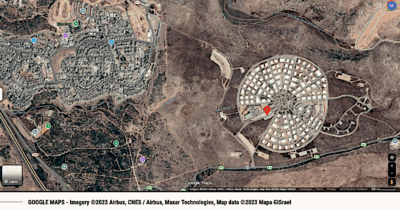
Just east of the sprawling haredi city of Elad, hugging the faint trace of the 1949 Armistice Line – the so-called Green Line delineating Israel from Judea and Samaria – lies a vast military installation. With its distinctive, almost futuristic circular layout stark against the arid hills, Nachshonim Base stands out on any satellite map.
Contents
A History of Makeshift Solutions
The Doctrine vs. The Hangar: Standards for Resettlement
Nachshonim: The “Unsuitability” as Proof?
Strategic Location
Capacity and Precedents
Other Facilities?
The Bucket on the Train: A Question of Intent
Officially, it’s a state-of-the-art logistics and supply depot for an Israeli Defense Forces (IDF) reserve armored division. Its construction, completed in the mid-2000s, was largely financed by the United States as part of a package deal brokered under the 1998 Wye River Memorandum. The documented purpose? To facilitate the IDF’s withdrawal from parts of Judea and Samaria by providing modern facilities within or near Israel’s internationally recognized borders.
But in a region defined by contingency planning and worst-case scenarios, could this sprawling, secure compound serve another, unstated purpose? As talk of potential Palestinian statehood ebbs and flows, and with it the politically explosive question of Jewish towns deep within Judea and Samaria, some observers question whether facilities like Nachshonim, strategically located and heavily secured, might be earmarked – officially or unofficially – as potential holding or processing centers should a mass evacuation or expulsion of Jewish residents ever occur.
It is a question rooted not just in the base’s location and scale, but in Israel’s complex and often criticized history of handling large, displaced populations – even its own citizens. Official plans often meet harsh realities, and the results, critics argue, have sometimes prioritized state policy over individual welfare. Could Nachshonim, despite its designation as a logistics hub, become an ad hoc solution in a future crisis?
A History of Makeshift Solutions
Israel’s history is punctuated by mass movements of people, both inward and outward. While celebrated for absorbing waves of immigrants, the state’s handling of these influxes, and of its own citizens displaced by policy, has faced sharp criticism.
In the 1950s, hundreds of thousands of Jewish immigrants, predominantly Mizrahim from Arab lands, were housed in temporary transit camps known as ma’abarot. Often consisting of tents or rudimentary shacks lacking adequate sanitation, employment, or social services, these camps became symbols of hardship and alleged discrimination against Mizrahi Jews, fostering grievances that lingered for decades. Critics point to the ma’abarot as an early example of the state prioritizing rapid absorption over the immediate well-being and integration of newcomers.
Following the 1982 peace treaty with Egypt, Israel evacuated the Sinai community of Yamit. While evacuees received compensation packages, reports emerged of bureaucratic delays, inadequate long-term housing solutions, and psychological distress among the former residents, who felt abandoned by the state that had encouraged their presence there.
A similar pattern emerged after the 2005 withdrawal from Gush Katif in Gaza, which involved the uprooting of nearly 9,000 Israelis. Despite government promises and significant financial aid, the resettlement process was plagued by problems. Many families spent years in temporary housing (“caravillas”), facing unemployment, community disintegration, and battles for promised infrastructure. Critics described the government’s post-evacuation support as poorly planned and insufficient, leaving deep scars on the evacuee community.
More recently, during the COVID-19 pandemic, Israel utilized hotels to quarantine travelers and infected individuals. While intended as a public health measure, the program faced criticism regarding conditions, inconsistent enforcement, lack of adequate medical and psychological support in some facilities, and the feeling of confinement experienced by those held, sometimes against their will.
These historical precedents, critics argue, demonstrate a pattern: in times of crisis or large-scale displacement driven by state policy, the Israeli government has sometimes resorted to ad hoc, temporary solutions that prioritized the immediate logistical challenge over the long-term, dignified resettlement of affected populations. The focus, they contend, has often been on moving people quickly, with less regard for the conditions they face afterward. Could such a pattern repeat itself?
The Doctrine vs. The Hangar: Standards for Resettlement
If a mass displacement occurred, what would constitute an appropriate response? The U.S. Army, a key Israeli ally and the funder of Nachshonim, has its own detailed doctrine for handling “Dislocated Civilians” (DCs) – FM 3-39.40, Internment and Resettlement Operations. While distinct from handling prisoners or detainees, resettlement operations focus on quartering civilian populations “for their protection” or due to displacement from conflict or disaster.
The manual emphasizes “humane treatment” and outlines minimum requirements for temporary or semi-permanent resettlement facilities. Sanitation and hygiene are crucial for preventing disease outbreaks in dense populations, requiring sufficient latrines (ideally 1 per 15 people, segregated by gender), showers, hand-washing stations, potable water for drinking and hygiene, and waste disposal systems. Medical care access is essential, including screening upon arrival, routine sick call, emergency care, and potentially isolation areas, alongside considerations for mental health support.
Basic shelter protecting from the elements is a minimum, ideally comparable to standards for military forces, with tents acceptable if buildings aren’t available. Food rations must be sufficient in quantity, quality, and variety to maintain health, considering cultural habits, and safe food preparation areas are vital.
The site itself must be safe, away from combat hazards and internal dangers. Administrative and processing areas are needed for registration, information dissemination, and coordination with aid organizations. Finally, while maintaining family unity is prioritized, provisions must exist for segregating unaccompanied minors, genders, and potentially conflicting groups. This doctrine clearly envisions facilities designed, or at least adequately adapted, for human habitation.
Nachshonim: The “Unsuitability” as Proof?
Viewed through the lens of FM 3-39.40, Nachshonim Base presents a stark contrast. As a logistics depot, its primary structures are likely warehouses, vehicle maintenance bays, supply storage areas, and administrative offices for military personnel.
On the surface, these structures exhibit severe deficiencies for resettlement. They lack adequate sanitation – imagining thousands sharing limited military base toilets highlights the significant health risk. They lack appropriate medical facilities scaled for civilians, safe mass food preparation areas, and internal divisions for privacy or necessary segregation. By the U.S. Army’s own doctrine for humane resettlement, the base appears grossly unsuitable.
But this “unsuitability” may be precisely the point. If one analyzes the base not as a potential home but as an industrial tool for processing a displaced population, its design makes a different, more cynical kind of sense. In a catastrophic scenario, the sheer volume of enclosed space within its hangars and warehouses offers rudimentary shelter, and its secure perimeter ensures containment. Using Nachshonim’s hangars would be akin to using warehouses or sports stadiums – options widely recognized as inadequate but employed globally in emergencies to “manage” a crisis rather than humanely “solve” it.
Strategic Location
Yet, the base’s location remains intriguing. Nachshonim sits directly on the “Green Line,” roughly 25 km east of Tel Aviv. It lies adjacent to Route 444 and near the major Route 465, providing access both into central Israel and eastward into Judea and Samaria. Critically, it is positioned near the western edge of a major bloc of Israeli communities in Judea and Samaria, including Ariel further east and numerous smaller towns.
In a scenario involving a withdrawal or evacuation from these areas, Nachshonim would be one of the first large, secure Israeli installations encountered by people moving westward. Its location makes it a potential bottleneck, checkpoint, or initial processing point, regardless of its suitability for long-term housing.
Capacity and Precedents
Estimating emergency capacity is difficult. UNHCR emergency standards suggest a minimum covered floor space of 3.5 square meters per person. A large military hangar or warehouse might offer several thousand square meters. Stuffing people well beyond minimum standards, one might hypothetically fit thousands into each large structure. If the base contains multiple such structures, a total emergency shelter capacity in the tens of thousands is not implausible, albeit under potentially dire conditions lacking basic sanitation and services.
While not ideal, the use of military bases and non-traditional structures for displaced populations has precedents globally. Fort Dix in New Jersey housed Kosovo refugees in 1999 and Afghan evacuees in 2021. During the European Migrant Crisis starting in 2015, various countries utilized decommissioned military barracks, airports like Berlin’s Tempelhof, and industrial buildings as temporary shelters. Following hurricanes in the US, sports stadiums like the Superdome after Katrina and convention centers have often served as mass shelters of last resort. These examples frequently highlight the challenges inherent in such solutions: inadequate sanitation, lack of privacy, difficulties providing services, and potential for tension and insecurity – precisely the concerns raised by potentially using a logistics base like Nachshonim.
Other Facilities?
Nachshonim is not unique. The IDF operates other large logistics and ordnance depots. While a comprehensive list is sensitive, bases near key junctions or community blocs might also possess large structures. However, Nachshonim’s relatively modern construction (post-Wye River funding) and specific location make it a notable example.
The Bucket on the Train: A Question of Intent
The official “documented purpose” of Nachshonim Base—to support IDF redeployment—raises a glaring question. Is it plausible that the Clinton-era architects of the Wye Memorandum, men engaged in the cold calculus of redrawing maps, would meticulously plan for the movement of soldiers and tanks but completely overlook the fate of the half-million Jewish residents living in the very territory being negotiated?
From this critical perspective, such an omission is a political impossibility. The “problem” of the civilian population had to be foreseen. Therefore, logic dictates that some contingency must have been made.
However, a public plan to build “resettlement towns” would have been politically catastrophic. It would have been seen as a profound betrayal by the Israeli right, likely collapsing the government, while simultaneously being condemned by “Palestinians” as new infrastructure for Israelis near the Green Line. If a provision was made, it had to be hidden. It needed a plausible, military-logistical cover story that justified its size, security, and U.S. funding. A “logistics and redeployment base” is the perfect disguise.
This leads to a darker interpretation, one that echoes the cynical tokenism described by Ben Hecht in Perfidy. Hecht questioned the two buckets—one for water, one for human waste—placed in cattle cars packed with 80 Jews headed for Auschwitz. He concluded their presence was not for the prisoners’ welfare, as they were wholly inadequate, but for the perpetrators—a minimal, bureaucratic gesture, a “German memory of humanity not quite dead” that allowed the planners to manage an inhuman process.
Could Nachshonim Base be a modern-day “bucket on the train”?
In this framework, the base’s very unsuitability for humane resettlement is not a flaw in the theory, but the proof of its cynical purpose. It was never intended to be a home; it was intended to be a tool. Like Hecht’s buckets, it is a minimal, industrial “solution” that allows distant policy architects to check a box, managing a human catastrophe without humanely solving it. The lack of 10,000 toilets and kitchens is not an oversight; it is the evidence that the facility was designed for mass processing and containment, not for resettlement.
Adding another layer of complexity are unconfirmed reports, circulating outside official channels, suggesting the Wye River agreement contained a secret annex specifically mandating the construction of facilities for the future internment of Jewish residents. While no official confirmation of such an annex exists, these persistent rumors, combined with the base’s very existence, fuel the speculation.
The official answer, if asked, would be clear: it is a logistics base.
But given Israel’s own history of pragmatic and often-criticized ad-hoc solutions, the cold logic of political necessity, and the base’s stark physical potential, the question remains. Does Nachshonim possess a latent, secondary capability that aligns with the “cold calculus” of planners?
Without access to classified documents, the answer is speculative. But the base’s existence serves as a stark, physical reminder of the unresolved questions surrounding the future of the communities in Judea and Samaria.
‘Tsunami’ of citizens chose to leave Israel in past years, Knesset report reveals
“Israel’s population decreased by 29,700 citizens due to emigration; in 2023, by 58,600 people; and in 2024, up to August, by 36,900 Israelis,” a Knesset Research and Information Center member said.
OCTOBER 21, 2025 Jerusalem Post
A report showing a spike in citizens leaving Israel since 2022, revealing a decline of 125,200 people from the country’s migration balance, was presented on Monday in the Knesset’s Committee for Immigration, Absorption, and Diaspora Affairs.
The report was conducted by the Knesset’s Research and Information Center (RIC) and was presented in the committee meeting led by its chairperson, MK Gilad Kariv (The Democrats).
“Tens of thousands of Israelis have chosen to leave Israel in the past two years. This is not a wave of emigration; it’s a tsunami of Israelis choosing to leave the country,” he said.
The migration balance of Israelis has declined by approximately 125,200 people since the beginning of 2022, the report said. [Emphasis added]
This number was calculated by subtracting the amount of long-term departures from the number of long-term returnees, excluding new immigrants and naturalized citizens.
Dr. Ayala Eliyahu, from the Knesset’s RIC, told the panel that “since 2022, we’ve seen a clear increase in the number of Israelis choosing to leave the country for long stays abroad, alongside a decline in the number returning.”
Continuous increase in Israelis leaving
She showed that there was a continuous increase in those leaving throughout the years.
“Israel’s population decreased by 29,700 citizens due to emigration; in 2023, by 58,600 people; and in 2024, up to August, by 36,900 Israelis,” she said.
In the committee meeting, Kariv called on the government to “recognize the seriousness of this trend and to focus efforts on stopping it.”
“There must be a comprehensive government plan to encourage the return of Israelis who are living abroad for extended periods,” he added.
Vladimir Beliak (Yesh Atid) addressed the financial aspect and harm that the spike in Israelis leaving the country can cause to the panel.
“Those who choose to emigrate have a tremendous impact on Israel’s economy, and their departure causes financial damage amounting to billions of shekels,” he said.
“A coherent policy must be developed to keep our best and brightest in Israel,” Beliak added.
Eric Michaelson, deputy director-general for immigration at the Aliyah and Integration Ministry, told the committee that it was not the ministry’s job to prevent emigration from Israel.
“We are the Aliyah and Integration Ministry, not a ministry for preventing emigration,” he said.
“I am not aware of any internal planning within our ministry for preventing emigration. The populations of new immigrants and returning residents are under our responsibility, and we work to help them stay in Israel long-term,” he told the panel.
Adv. Danny Zaken of the National Insurance Institute spoke on the increase of those terminating their residency in the country.
“We initiate termination of residency only after five years abroad. On the other hand, citizens can contact us proactively and request earlier cancellation of their Israeli residency,” Zaken explained.
“From 2015 to 2021, there were an average of about 2,500 such requests per year. In 2022, the number rose to about 3,700; in 2023, to about 6,300; and in 2024, over 8,400 requests were submitted to terminate residency. There is a clear trend of more families proactively requesting to cut off residency,” he said.
Kariv said that he would hold a follow-up meeting on the spike of Israelis leaving the country and concluded in his remarks to the panel that “there must be a coordinated government effort to stop this trend.”
[Ed.: 125,200 Israelis emigrated from 2023 through August 2025!]
Israeli PM Netanyahu just put Hamas on notice: “We can do this the easy way or the hard way” [17:39]
October 28, 2025 JNS TV – What does it take to withstand a global storm and emerge stronger than ever? In this historic episode of “Standpoint with Gabe Groisman”, former Mayor of Bal Harbour and Jewish community leader Gabe Groisman sits down in Jerusalem with none other than Israeli Prime Minister Benjamin Netanyahu, just days after the Trump-brokered ceasefire deal and hostage release reshaped the Middle East. With candid insight, Netanyahu explains why the 20-point Gaza peace plan was the right deal at the right time and carefully lays out what it means for Israel’s future and the shifting balance of power across the region.
This wide-ranging conversation covers it all: the emotional return of Israeli hostages, the strength of the U.S.-Israel alliance under President Trump, the Abraham Accords and the controversial role of Qatar and Turkey in the negotiations. Netanyahu also addresses the proposed International Stabilization Force (ISF) in Gaza and outlines the necessity of a Hamas-free future. Viewers also get a rare glimpse into the personal toll of leadership, from Netanyahu’s reflections on his brother Yoni’s heroism to the unwavering support of his wife and soldiers on the frontlines. Don’t miss this powerful conversation packed with geopolitical insight.
The world is more Jewish than we realized. ERIC BUESING
DNA testing is revealing that as many as 152 million additional people have Jewish roots. If more people knew they were part-Jewish, would they still hate Jews?
OCT 27, 2025 The Future of Jewish
For millennia, the Jewish People have lived in the diaspora, scattered across the globe since the Babylonian Exile in the 6th century BCE.
From the Iberian Peninsula to the Americas, from Southern Africa to the Middle East, we have faced persecution, expulsion, and the constant threat to our survival.
To endure, many Jews became crypto-Jews hiding their identities. They adopted new names and blended into Christian, Muslim, or secular societies under the shadow of inquisitions, pogroms, and forced conversions. These hidden Jews, known as Conversos in Spain and Portugal or Anusim (the “forced ones” in Hebrew), carried their heritage in secret, often losing it entirely over generations.
Today, a scientific revolution is unveiling these lost identities. Advances in genetic testing have revealed that millions worldwide perhaps as many as 152 million people, or 1.85 percent of the global population, carry traces of Jewish ancestry in their DNA. In the United States alone, an estimated 15.8 million people, roughly 4.58 percent of the population, may have Jewish roots, often without knowing it.
These discoveries raise profound questions. Would knowing their Jewish heritage change how people view themselves? If the world realized how many share this ancestry, would it foster understanding and reduce antisemitism?
I believe it could. By embracing the truth of our shared histories, we might not only reconnect lost souls to their Jewish heritage, but also challenge the hatred that has plagued our people for centuries.
The Jewish diaspora is a story of resilience and survival. Since the Babylonian Exile (597 to 538 BCE), Jews have navigated a world that often rejected them. The destruction of the Second Temple in 70 CE, the Spanish Inquisition of 1492, and countless other expulsions forced Jews to adapt or perish.
Many chose secrecy, becoming crypto-Jews who practiced their faith in hidden cellars, or adopted Christian rituals publicly while whispering Hebrew prayers in private. In Spain and Portugal, Conversos faced scrutiny from the Inquisition, leading thousands to flee to the New World, where they hoped to escape persecution. Yet, even there, they often lived in fear, their Jewish identity buried under layers of assimilation.
These hidden Jews left a genetic footprint. A 2018 study analyzed DNA from 6,589 individuals across five Latin American countries Brazil, Chile, Colombia, Mexico, and Peru. The results were staggering. Approximately 23 percent of those sampled had at least 5 percent Sephardic Jewish ancestry, averaging 1 to 4 percent across these nations. This translates to an estimated 136 million Latin Americans who may carry Jewish DNA, a legacy of Conversos who fled the Inquisition centuries ago. In the Iberian Peninsula itself, a 2008 study found that up to 20 percent of modern Spaniards and Portuguese (roughly 12 million people) have Sephardic ancestry, tied to historical conversions.
Beyond Iberia and Latin America, traces of Jewish ancestry appear in unexpected places. The Lemba tribe of South Africa and Zimbabwe carries Semitic Y-chromosome markers, with up to 50 percent of Lemba men and 53 percent of the Buba clan bearing the Cohanim Modal Haplotype, a genetic signature linked to Jewish priestly lineages. This suggests that some 40,000 Lemba may descend from ancient Jewish or Semitic traders. Even in the United States, studies show that up to 38 percent of Hispanics in regions like New Mexico carry Sephardic or Cohanim1 markers, pointing to a crypto-Jewish legacy among an estimated 13 million Hispanic Americans.
These numbers are more than statistics; they are stories of survival, of ancestors who hid their menorahs, whispered Shema Yisrael in secret, and passed down fragments of identity that science is now rediscovering. Globally, an estimated 152 million people 1.85 percent of the world’s 8.2 billion may carry Jewish ancestry. In the United States, 15.8 million (4.58 percent) of 345 million share this heritage, often unknowingly. These “lost tribes” are woven into the fabric of humanity, their Jewish roots hidden until now.
Imagine discovering that your great-great-grandparent was a Converso, lighting Shabbat candles in a basement in 16th-century Mexico, or that your DNA traces back to a Jewish merchant who sailed to Southern Africa some 2,000 years ago.
For some, this revelation is a homecoming. Organizations like Reconectar and Bnai Anusim have emerged to help these individuals reconnect with their Jewish heritage. They offer resources to explore Judaism or even return to the faith.
But not everyone embraces this truth. For some, learning of Jewish ancestry might stir unease, especially in societies where antisemitism persists. Others may feel a sense of pride or curiosity, seeing their DNA as a bridge to a rich, resilient culture.
The question is deeply personal: Would you want to know if part of your story was Jewish? For those who do, the discovery can be transformative. It offers a sense of belonging to a people who have endured and thrived against all odds.
Antisemitism has plagued humanity for centuries. It’s fueled by myths, stereotypes, and the scapegoating of Jews as “outsiders.” But what if the world knew that millions perhaps one in every 54 people globally carry Jewish ancestry? If 152 million people, from São Paulo to Seville, from Johannesburg to Albuquerque, share this heritage, the notion of Jews as “other” begins to crumble. DNA reveals that Jewishness is not just a religion or ethnicity, but a thread woven into the human tapestry.
Consider the implications. If 15.8 million Americans (nearly 1 in 20) have Jewish ancestry, antisemitism becomes a form of self-hatred for many. A 2019 survey found that 79 percent of Americans view antisemitism as a serious problem, yet incidents continue to rise, from vandalism to violent attacks.
Could widespread knowledge of shared Jewish heritage shift this tide? I believe it could.
When people see themselves in the “other,” empathy grows. Learning that your DNA carries a Jewish story might make you pause before tolerating hate or repeating stereotypes. It might inspire curiosity about Jewish culture its traditions, resilience, and contributions to science, art, and philosophy.
This isn’t just wishful thinking. Historical examples show that shared identity can bridge divides. In Spain, where Sephardic Jews were expelled in 1492, modern efforts to acknowledge Converso heritage have led to citizenship programs for descendants and a renewed interest in Jewish history. In Latin America, communities are rediscovering their roots, with some even reclaiming Jewish practices. These stories suggest that knowledge of shared ancestry can foster understanding, not division.
The impact of these DNA revelations is vividly illustrated in real-life accounts.
Take Bill Sanchez, a Roman Catholic priest in Albuquerque, New Mexico. In the early 2000s, Sanchez underwent a DNA test through Family Tree DNA, which revealed genetic markers on his Y-chromosome matching those found in about 30 percent of Jewish men, including a signature associated with the Cohanim priesthood tracing back to biblical figures like Aaron, brother of Moses. This discovery prompted him to embrace his Jewish heritage publicly. He now wears a Star of David alongside his crucifix and displays a menorah in his office at St. Edwin Catholic Church.
Another compelling story is that of John Garcia, a former Catholic from El Paso, Texas. He learned at age 49 that his family had Sephardic Jewish roots. His father confided in him during his teenage years that they descended from Spanish Jews. It was a secret kept even from other family members who remained devout Catholics. Garcia’s brother later confirmed this through genealogical research, tracing their lineage to a Jewish congregation disbanded around 1596.
Inspired by the Pope’s apology for the Inquisition, Garcia contacted Rabbi Stephen Leon after hearing about crypto-Judaism on a radio show. Over 15 years, he formally returned to Judaism. He learned Hebrew, read the Torah, and became an active leader in his congregation, finding deep satisfaction and alignment with his ancestral faith.
These stories highlight how DNA and family history can unearth long-buried identities, leading individuals to reconnect with Judaism in meaningful ways. Perhaps you, too, have a similar hidden chapter in your ancestry waiting to be uncovered.
The discovery of widespread Jewish ancestry is a call-to-action. For those with Jewish DNA, it’s an invitation to explore your heritage — whether through genealogy, cultural study, or connecting with Jewish communities. For everyone else, it’s a reminder that our differences are often smaller than we think.
If nearly 2 percent of the world and 5 percent of the U.S. share Jewish roots, antisemitism isn’t just an attack on a minority; it’s an attack on our collective history.
– – –
1 Cohanim refers to Jewish priests who are traditionally believed to be direct patrilineal descendants of the biblical Aaron.
Twenty Minutes to Midnight in Judea and Samaria BY MORDECHAI SONES
More than 20 years ago, a grassroots proposal sought to empower civilian defense in Judea and Samaria. Its relevance has never been greater
OCTOBER 27, 2025
When I wrote the “Yesha Defense Initiative” over two decades ago, I began not with a statistic, but with a scenario.
Contents
The Anatomy of My Scenario
The Precedents That Drove Me
A Pattern of Neglect
A Phased Solution: The Three-Layered Shield
Phase 1: Immediate Asymmetric Self-Reliance
Phase 2: The Full Interceptor Shield
An Obligation of Self-Defense
A Warning Vindicated
It is 2:45 a.m. on a Tuesday in Israel. The streets of Judea and Samaria—our biblical heartland, Yesha—are quiet. But in the IDF war rooms, there is chaos. Confirmation has just arrived: forty platoons of Palestinian mechanized armor are on the move. They are headed for the yishuvim, our homes.
The security coordinator of a target community, the ravshatz, is notified. He has twenty minutes. Twenty minutes before three Palestinian BRDM2 armored vehicles smash through the community’s simple yellow sliding gate. Twenty minutes to decide whether to activate his civilian rapid response team or accept the official recommendation to prepare for evacuation. I wrote the stark truth: “Either way many of your neighbors will be killed. And the ravshatz is utterly powerless to do anything… And he knows it better than anyone.”
This grim scenario was my opening salvo. As a resident of Nachaliel, I circulated this draft briefing book in the shadow of the Second Intifada as a desperate plea and a detailed strategic proposal. My core argument was that our entire security doctrine was fatally flawed, leaving our communities totally vulnerable to a catastrophic, coordinated “first strike.”
At the time, our vision was dismissed by officials as alarmist. But read today, the document I wrote resonates with a chilling prescience. It was my meticulous, passionate, and detailed articulation of a strategic nightmare, one that foresaw a specific mode of attack that the official consensus deemed impossible.
More importantly, it was my comprehensive, community-based solution built on the principles of self-reliance, layered defense, and challenging the very assumptions of our national security establishment.
Two decades later, those pages serve as a powerful, haunting case study in strategic foresight and the timeless, agonizing debate over civilian defense.
The Anatomy of My Scenario
My central thesis was simple: our defense establishment was preparing for the wrong war. The prevailing wisdom, which dictated policy and equipment, was focused on “anti-terrorist” scenarios: a small cell of gunmen infiltrating a home, a lone bomber, or a hostage situation. I argued this was a fatal miscalculation. I posited that the true, existential threat was not piecemeal terrorism but a sudden, overwhelming, and coordinated military assault, a “first strike” designed to achieve the “swift, irrevocable collapse of Yesha.”
In the document, I methodically detailed the vulnerability. The lynchpin of the threat, as I saw it, was armor. The Oslo Accords, I noted, permitted the Palestinian Authority to possess “up to 45 wheeled armored vehicles.” My colleagues and I believed the number was actually much higher, supplemented by smuggling. These vehicles, like the BRDM2, were not tanks, but they were more than enough to “easily smash their way through yishuv gates.”
This single point was the crux of the failure. The communities, I wrote, were “totally helpless” against this specific threat because they had been systematically denied the one weapon that could counter it: anti-tank weapons. My investigation led me to claim that the gates, the fences, and the armaments of the yishuvim were “designed, selected, and controlled universally to be uniquely vulnerable to a specific tool that has been then semi-secretly given to the PA—armored vehicles.”
This was a devastating accusation, and I did not make it lightly. It suggested not mere incompetence or budgetary neglect, but a deliberate, systemic policy of engineered vulnerability. I argued that this policy was meant to maintain a “back-door option” for the “easy removal” of settlements, ensuring that in a final status agreement or a political crisis, our communities could not meaningfully resist an evacuation order. My conclusion was stark: our residents, in effect, were being prepared for evacuation, not for defense.
The Precedents That Drove Me
To understand the profound concern that motivated me, you must look to the hard lessons of Israel’s recent past. For me and my neighbors, these events were not history; they were precedent. They were the templates for “betrayal.” I explicitly invoked two actions by Israel: the 1982 eviction of Yamit and the other 17 Jewish communities in the Sinai, and the chaotic 2000 withdrawal from the South Lebanon security zone.
I recalled in the initiative how Ariel Sharon, the architect of the Yamit eviction, had first “initiated the establishment of tiny outposts” in the Sinai, earning the settlers’ trust before turning to evict them. This created a deep-seated suspicion in our community: that a right-wing leader ostensibly “with us” could, and would, use that trust to execute a politically devastating withdrawal.
Even more potent was the fresh wound of South Lebanon. I recounted in detail the “surprise abandonment” of the South Lebanese Army (SLA), Israel’s long-time ally. I quoted an SLA soldier’s bitter realization: “We could have stopped them with our weapons, but the IDF did not shoot and would not allow the SLA to shoot, either.” The lesson I drew was that the IDF high command was capable of using “trust to produce the paralysis and surprise needed to accomplish a betrayal effectively.”
I then made a direct and explosive connection in the text. I noted that the general who oversaw the South Lebanon abandonment, Moshe Kaplinsky, had just been appointed as the OC Central Command, with jurisdiction over Judea and Samaria. “The perpetrator of Yamit is now working together with the perpetrator of Southern Lebanon,” I wrote. “Yesha is apparently their target.”
This context is crucial to understanding my mindset. The Yesha Defense Initiative was not just about a Palestinian threat; it was about a profound crisis of faith. I posited a “double shock” scenario: a sudden Palestinian armored attack occurring simultaneously with an IDF order to stand down and evacuate. The ravshatz in my 2:45 a.m. scenario wasn’t just outgunned; he was being paralyzed by his own side.
A Pattern of Neglect
I built my case by synthesizing nine distinct government policies that, taken together, formed what I saw as an undeniable pattern of induced vulnerability. Whether this was born of a deliberate, malicious “back-door option” for evacuation—my most profound fear—or from a catastrophic, systemic bureaucratic failure, a simple “failure of imagination” within the institution, the result was the same. The system was broken.
My analysis grouped these policies into several broad categories of failure. The most critical, in my view, was doctrinal obsolescence; I lamented the IDF’s “insistence on obsolete anti-terrorist scenario” training—preparing for a few gunmen in a house—which provided the doctrinal basis to deny anti-tank weapons and limit civilian defense forces to a “handful of small arms,” leaving us defenseless against a military assault.
This was compounded by active information suppression, where I alleged official channels actively suppressed the truth. When we residents reported night-time gunfire—which we believed to be PA forces training for night attacks—IDF officials repeatedly dismissed it as “weddings.” These “false IDF ‘wedding’ claims,” I argued, were disinformation designed to “keep Yeshans in the dark.”
This pattern was made tangible through resource denial, as I detailed the “denial of sufficient amounts of ammunition,” which I claimed was “only enough for several minutes of combat.”
Finally, I even pointed to strategic misdirection, re-framing seemingly supportive policies like Ariel Sharon’s call to “seize the high ground” as self-defeating instructions that served only to “strain Yesha’s overstretched defenders even further.”
This pattern of neglect extended to infrastructure. I argued there was “no means for mutual support between yishuvim.” We lacked the communication equipment and long-range weapons to coordinate a defense, allowing us to be “isolated and overrun piecemeal.” Even the “elaborate security barriers” were, in my analysis, an “indefensible trap” that restricted defenders to an inner perimeter while providing cover for attackers.
These policies, as I outlined them, painted a grim portrait of communities intentionally isolated, under-equipped, and misinformed, all while being told to trust the very system that was failing us.
A Phased Solution: The Three-Layered Shield
But my Yesha Defense Initiative was not merely a list of woes. My primary purpose was to propose a concrete, viable, and positive solution. Having defined the problem as a first strike, I presented a layered defense system.
This proposal, however, faced an immediate and obvious “operational paradox.” How could we, who were being actively denied basic ammunition, suddenly deploy sophisticated interceptor vehicles?
The solution had to be split into two distinct phases: a “policy-resistant” immediate-action plan, and a long-term “policy-reversal” goal.
Phase 1: Immediate Asymmetric Self-Reliance
This was the core, actionable plan, focusing on what we could do ourselves, right now, with what we had, to bypass the official blocks and maximize deterrence.
The first element was a “policy-resistant” early warning network. This meant trained observers using private optical and radio equipment, creating a communication net independent of official channels. Its sole purpose was to spot the massing of forces and “ruin the shock of surprise,” robbing the attackers of their chief advantage.
The second element of Phase 1 was the yishuv defense itself, focusing on asymmetric tactics. Recognizing the lack of official anti-tank weapons, I proposed adopting tactics proven by “poorly armed defenders” elsewhere—citing the 1956 Hungarian uprising and the First Chechen War. I detailed the organization of “anti-tank killer teams” composed of firebombers, a machine gunner, and a sniper. I described how to create “anti-armor ambush areas” in the narrow streets of a yishuv, “sealing off vehicles inside your pre-selected kill zone.” I provided granular detail on how to aim firebombs and where to shoot armored vehicles like the BRDM2 with rifles to “degrade the combat effectiveness” by targeting “periscopes,” “antennae,” and “externally mounted fuel tanks.” This was not theory; I intended it as a practical manual for self-defense.
Phase 2: The Full Interceptor Shield
This was the long-term goal, contingent on reversing the government’s failed policies. This phase included the “network of interceptor vehicles” I had envisioned. These teams, manned by our rapid response units, would “deploy barriers that are capable of blocking, disabling, or destroying enemy armored vehicles before they reach the yishuv.” This proactive layer was designed to break up the coordinated assault, but it required a level of equipment and operational freedom that was, at the time, being denied to us. Phase 1 was how we would survive long enough to make the case for Phase 2.
An Obligation of Self-Defense
Ultimately, for me, the Yesha Defense Initiative was more than a technical proposal. It was a philosophical and moral argument about the very nature of Israeli sovereignty and Jewish identity. I wrote it in a spirit of profound self-reliance, born from the conviction that the state could, and might, fail its citizens.
I explicitly placed the initiative in a long line of Jewish self-defense. I cited the Warsaw Ghetto uprising, noting that “each yishuv still has more weapons, ammunition, and trained personnel on hand” than they did. I invoked the 1948 battle for Kibbutz Degania, where members “halted by members of the kibbutz equipped with small arms and Molotov cocktails” stopped a Syrian tank attack. The message was clear: when the state is absent, the community must act. To do otherwise was to “acquiesce in their own betrayal by default.”
I captured this moral imperative with the Hebrew phrase emblazoned on the document: “Lo ta’amod al dam re’echa“—”Do not stand idly by your brother’s blood.” This, I argued, is our fundamental obligation. The initiative was our way to fulfill that Torah obligation.
My political analysis was equally profound, if controversial. I posited that a small but powerful “anti-Covenant” segment of Israel’s elite saw our very presence in “Biblical Israel” as an “intolerable irritant.” For this segment, I argued, “the abandonment of Yesha to an Arab Palestinian state” was the ultimate goal, even if it meant sacrificing Israel’s strategic viability. The initiative, therefore, was not just a military plan; it was a political and cultural counter-revolution, a declaration that we Yeshans would not be “irritated” away. It was my plan to “neutralize the threat of eviction” by eliminating the element of surprise and making the cost of such a “betrayal” too high to pay.
A Warning Vindicated
Reading the Yesha Defense Initiative I wrote more than twenty years ago is an unsettling experience, even for me. The document is a product of its time—the raw, chaotic, and fearful peak of the Second Intifada. My specific political anxieties about Ariel Sharon and the Oslo Accords are bound up in that historical moment.
And yet, its core content is timeless. My document was, at its heart, a study in worst-case-scenario planning. It challenged the prevailing failure of imagination that dismissed a large-scale, coordinated attack as fantastical.
I believe the paper’s greatest contribution was not my prediction of betrayal, but my meticulous diagnosis of a specific, catastrophic vulnerability: a multi-pronged, surprise assault designed to overwhelm isolated communities whose defenses were designed for a different, lesser threat.
The solution I proposed—a layered defense prioritizing early warning, proactive interception, and robust, well-armed local teams—remains a model of community-based security. It speaks to a fundamental tension that still exists in Israel and beyond: the tension between the citizen and the state, between the resident’s right to self-defense and the state’s monopoly on power.
The technologies of warfare have evolved. The specific vehicle of the threat has changed. My paper was prescient about the BRDM2s, but today the threat may come from drones, precision missiles, or cross-border tunnels.
The strategic logic, however, remains unchanged. The 3-layered shield is a concept, and it scales. Early Warning, for example, is no longer just about armor; it is about tasking those same citizen-observers to listen for the sounds of tunnel digging and to spot the low, slow signature of drones. The Interceptor Layer concept adapts; perhaps “interceptor vehicles” now deploy counter-drone jammers or serve as rapid-response teams to a known tunnel exit. And the Yishuv Defense layer evolves; the “anti-tank killer teams” are trained with new skills: sharpshooters targeting drone optics, or tactics for engaging fighters emerging from a tunnel mouth.
The Yesha Defense Initiative was my plan for a war that did not come in the early 2000s. For two decades, its core principles—its passionate call for empowerment, its warning against a catastrophic ‘failure of imagination,’ and its chillingly specific analysis of vulnerability—continued to echo in those hills.
Then, on October 7th, 2023, the nightmare scenario I had detailed became a horrific reality. The ‘worst-case-scenario’ of a multi-pronged, surprise assault designed to overwhelm isolated communities, whose defenses were tragically designed for a lesser threat, was no longer a theory. The echoes of my warning became a devastating roar.
It is a persistent, tragic warning that paralysis is a choice, and that the ultimate defense of one’s home, as I wrote then, begins at the gate.
ARE WE SOVEREIGN? MORE NATIONS LAND IN ISRAEL TO MONITOR GAZA “PEACE” by David Mark
October 27, 2025 Israel Unwired
The notion that Israel functions more like a vassal state of America than an independent country has been the sort of viewpoint posited by Israel’s right-wing for decades now. However fringe this notion has been in the past, the more one analyzes the current situation post Israel’s ceasefire with Hamas, the more one realizes just how non-sovereign Israel really is.
The current Civil-Military Coordination Center (CMCC) in Kiryat Gat is supposed to be a group of foreign powers situated on Israel’s sovereign territory to oversee Israel’s and Hamas’ implementation of the ceasefire agreement. Alongside Jordan, the UK, Germany, Denmark, and Canada—whose flags were displayed at the hub’s unveiling earlier this week—Australia, France, Spain, and the United Arab Emirates have also joined the initiative, a US official confirmed. Australia and France recognized a Palestinian state last month, despite Israeli objections, while Spain did so last year.
What once seemed like a no-brainer of a deal is increasingly growing problematic as more and more countries jump on board. Many of these countries are requesting the mission turn into a UN Security Council-backed operation, and that is precisely what appears to be happening as Secretary of State Marco Rubio is said to be working on the draft language.
President Trump is serious about maintaining the current ceasefire or “peace” as he would call it. The only question is at what cost to Israel. So far, the rhetoric has been just that – rhetoric, but the fast pace at which countries from around the world are joining the operation based in Kiryat Gat gives a sense of an ever-expanding mandate here in the holy land. Already, Israel is said to have asked permission from the US to strike Hamas in the second half of the Gaza Strip the IDF does not control. So far, the Trump administration has granted the requests, but in the future, they can always say no.
For now, Israel is playing along and holding to the ceasefire. But as each day passes and internal pressures from the right-wing increase, Netanyahu will have to find some way to back out of the deal. Trump may not like it, but if Hamas does give enough of a reason, he may understand Israel’s maneuvering, especially if it’s done in a way that leaves Hamas holding the responsibility.
If the “peace” deal goes sour, which in time it will, the only question is what kind of damage will be done to Israel’s ability to reapply it sovereign rights when it comes to fighting its enemies.
The “deep state” operating inside Israel Avi Abelow
October 27, 2025 The Pulse of Israel
For years, many people mocked or dismissed any mention of a “deep state” operating inside Israel. They called it a conspiracy theory, the invention of right-wing paranoia.
But once again, we see undeniable proof: unelected bureaucrats, embedded in the very heart of our security and judicial institutions, working to undermine the will of the people and the authority of our elected government.
The latest revelation is nothing short of shocking.
According to a recent report, senior intelligence officials of the Shabak illegally eavesdropped on an intelligence officer for six months, trying to gather dirt to then block Prime Minister Netanyahu’s appointment of David Zini as the new head of shabak intelligence!
Yes, you read that right, members of our own intelligence community weaponized state surveillance tools, not against terrorists or foreign threats, but against fellow Israelis, a fellow intelligence officer, in order to sabotage a government appointment.
Minister Amichai Chikli summed it up powerfully on X:
“A shocking revelation by @avishaigrinzaig, an unprecedentedly serious incident that, in a normal state of affairs, should have caused a God-awful uproar… Secret wiretapping was used against ‘A’ to spy on him, and this information was then passed to the Grunis Committee in order to thwart Zini’s appointment… This is exactly what a real danger to democracy and individual freedom looks like.”
Chikli is absolutely right. This is not just an internal scandal, it’s a crisis of democracy, implemented by those who scream about “democracy”, that too few Israelis pay attention to.
When intelligence tools are turned inward for political manipulation, when the guardians of the state become its manipulators, that is the definition of a deep state at work.
And this isn’t an isolated case.
Just this week, a judge released individuals arrested for lighting fires around the Prime Minister’s residence in Jerusalem, a clear act of violence that endangered lives and could easily be seen as an assassination attempt.
The judge’s justification? “The situation has changed. The hostages are home and the war is over.”
Seriously? Imagine if these were right-wing protestors instead of left-wing agitators. Do we really think they would be walking free today? Of course not.
This is the two-tier justice system that so many of us have been warning about. A system where the political left protects its own while criminalizing patriots, settlers, and anyone who dares to support a proudly Jewish, right-wing Israel.
I want to now take a step back and focus on how the terrible hostage situation was manipulated by the political left deep state.
For two years, the deep state, driven by the political left, protest leaders, entrenched bureaucrats, activist courts, and a complicit mainstream media, hijacked the hostage issue and turned it into a political weapon.
What should have been a unified national mission to secure a lasting victory to protect Israel, to also free our hostages, was instead reframed using a heavily funded emotional manipulative campaign centered solely on freeing the hostages, at any price.
This manipulation distorted public perception, influenced Netanyahu’s negotiating team, and even swayed the Trump administration to prioritize short-term optics to free the hostages over long-term security to ensure that our jihadi Muslim enemies are deterred from ever attacking us again.
As a result, Israel’s focus shifted from ensuring that another October 7th could never happen again to chasing a fragile illusion of peace, yet with the illusion of victory as all the live hostages were finally freed, which we are all of course happy about.
This was all run by the same deep state officials who abused the intelligence agency to try to thwart a Netanyahu appointment to the intelligence agency, and abuses the courts as a two tier system, one rule of law for the political left and another rule of law for those on the right.
But here’s the silver lining, with each day of this war they’re exposing themselves more and more. The so-called “deep” state is no longer so deep. The more they act out of panic, the more the public sees the truth. The mask is coming off. What was once whispered is now openly visible.
Yes, it’s a slow and painful process—but it’s happening. And as the rot is exposed to sunlight, its power begins to fade.
To all who feel despair at the corruption and hypocrisy, don’t lose faith. Trust Hashem. Trust the process. This exposure is finally happening and it is good!
This political left deep state has been running Israel ever since the Likud came to power in 1977.
Israel today is being refined through these scandals, with the truth finally emerging.
We will overcome our external enemies, and we will overcome our internal ones as well.
The deep state’s days are numbered, because light always defeats darkness.
Am Yisrael Chai!!!
To join the Israel Video Network – Pulse of Israel Group Click Here:
Telegram ➡️ https://t.me/aviabelowpulse
Whatsapp ➡️ https://chat.whatsapp.com/GkavRznXy731nxxRyptCMv
While Jews criticize Israel, Israel looks after Jews everywhere. JOSHUA HOFFMAN
Israel is the collective insurance policy of the Jewish People, and the only one we have ever had. This is not just a heartwarming sentiment; it’s a Mossad mandate.
OCT 27, 2025 The Future of Jewish
It’s one of the quiet ironies of modern-day Jewish life: While Jews debate, criticize, and even condemn Israel from the safety of Western democracies, Israel’s intelligence agents are working behind the scenes to keep safe those Jews and others.
As petitions circulate on college campuses accusing Israel of “genocide,” Mossad operatives are intercepting Iranian terror networks plotting attacks against Jewish schools and synagogues in Europe.
As Jewish activists in New York or Toronto draft op-eds scolding the Jewish state for being “too militarized,” Israeli cyber units are tracing Hezbollah cells intent on targeting Jewish community centers abroad.
Yet, wherever Jews live, Israel is watching over them. Not in a political sense, not as a matter of foreign policy or citizenship, but as a matter of survival. The Jewish story did not end at Auschwitz; it continues in modern-day Jerusalem, in Tel Aviv, and in a thousand quiet rooms where Israeli intelligence officers have spent their lives making sure Jewish blood will never again be spilled without consequence.
On Sunday, the Mossad revealed that a transnational terror network run by Iran’s Islamic Revolutionary Guard Corps Quds Force has been orchestrating attacks on Jewish and Israeli targets across the Western world. The network, allegedly led by senior commander Sardar Ammar and composed of more than 11,000 operatives, has been coordinating efforts to harm diaspora Jews since the October 7th Hamas-led massacre.
These attacks weren’t against Israeli diplomats or soldiers; they were against synagogues, Jewish schools, and community centers. That distinction matters. It shows what Israel has long known and what the world often refuses to admit: that hatred of Israel and hatred of Jews are one and the same.
For decades, Israel’s intelligence services have served as the invisible guardians of Jews everywhere. The Mossad has (usually quietly) shared information with Western agencies to stop planned bombings and shootings at Jewish sites.
In 2022, Israeli intelligence helped European authorities thwart multiple Hezbollah and Islamic Revolutionary Guard Corps-linked plots targeting Jewish communities in Germany, Greece, and Cyprus. In 2021, Mossad operatives tipped off Moroccan officials about an Iranian plan to assassinate a Jewish businessman in Casablanca.
In 2020, Israel passed along intelligence to Thai authorities that led to the arrest of Iranian agents plotting attacks on Israeli tourists and local Jews in Bangkok. And throughout the past decade, the Mossad has been central in helping dismantle Hezbollah’s global terror networks operating under civilian covers across Africa and Latin America.
Israel’s protective hand reaches back further still. In 1976, after Palestinian and German terrorists hijacked an Air France flight carrying more than 100 Israeli and Jewish passengers, Israel launched Operation Entebbe — a rescue mission that stunned the world. Israeli commandos flew 2,500 miles to Uganda, stormed the terminal, killed the hijackers, and brought nearly all the hostages home. The only fatality among the commandos was Yonatan Netanyahu, the older brother of Israel’s current prime minister. The message was unmistakable: No Jew would ever be abandoned again.
In the late 1970s, thousands of Ethiopian Jews (Beta Israel) were trapped in refugee camps in Sudan, having fled famine and persecution in Ethiopia. They dreamed of reaching Israel, but Sudan — a Muslim-majority country with no ties to Israel — was hostile to the Jewish state. The Mossad launched a covert mission to rescue them and bring them to Israel. The operation’s official name was “Operation Brothers.”
To disguise their activities, Mossad agents leased an abandoned seaside hotel on the Red Sea, near the town of Arous, Sudan. They reopened it as a real, functioning diving resort — called the Arous Holiday Village — complete with brochures, scuba equipment, and European tourists.
Israeli agents actually ran the resort for years, welcoming real guests during the day. At night, Mossad agents would secretly meet groups of Ethiopian Jews in the desert, transport them to the coast, and then ferry them across the Red Sea on Israeli Navy boats to safety. Over several years, Israel managed to rescue around 12,000 Ethiopian Jews, mostly through this and related operations. Then, in 1991, Israel airlifted more than 14,000 Ethiopian Jews to Israel in just 36 hours. It was the kind of rescue that made the Book of Exodus feel alive again. Only this time, the miracle had jet engines.

Mossad officer Gad Shimron went undercover as a diving instructor at the “Arous Holiday Village.” (photo: Gad Shimron)
The pattern is consistent across time and geography. From Argentina to France, from Syria to Yemen, Israel has acted when others would not. It tracked down Nazi war criminals when international courts were still debating procedure. It rescued Jewish families from war zones and smuggled Torah scrolls out of collapsing dictatorships. It sent doctors to treat Jewish refugees in Ukraine and security teams to guard synagogues in Africa. And it continues to do so quietly, without speeches or headlines, because it understands something few nations do: that every Jew, no matter where they live, is part of one extended family, and family protects its own.
No other country on earth defends a people scattered across so many lands. Israel’s existence makes Jewish existence possible, everywhere. When a synagogue in Paris is firebombed, when a rabbi is attacked in Brooklyn, when a Jewish school in Buenos Aires receives a threat, somewhere in Tel Aviv or Herzliya, Israeli analysts are listening, watching, analyzing. They don’t wait for permission from the United Nations or the approval of Western editorial boards. They act, because history taught them what happens when no one acts.
There can be no serious question as to whether Jews around the world have a relationship with Israel. That relationship is existential, not political. Israel is the collective insurance policy of the Jewish People, and the only one we have ever had. To be hypercritical of Israel, while applying no comparable moral or strategic standard to other countries, is not only hypocritical; it’s foolish. The double standards applied to Israel reveal not a concern for justice, but a refusal to accept Jewish agency. The same world that once scolded Jews for being passive now scolds us for being strong.
No one demands that France dismantle its army to prove its morality, or that the United States allow its enemies to live to demonstrate its “restraint.” Yet Israel is held to precisely those standards every day, sometimes by Jews themselves. Behind these expectations lies something ancient: the belief that Jews should suffer nobly but never defend themselves. Powerless Jews were pitied; powerful Jews are condemned. But it was powerless Jews whom history devoured. Israel refuses that role. Its strength is not a betrayal of Jewish ethics; it is their expression.
Every Jewish family carries the memory of abandonment: grandparents who were turned away from ports, relatives who vanished when borders closed, names that exist now only on lists. “Never Again” was not a slogan; it was a vow. But “Never Again” only has meaning because Israel exists to make it real. After the Holocaust, Israel became the answer to a question that had haunted Jews for centuries: Who will protect us when the world turns away?
And indeed, the world did turn away, again and again. When Syrian Jews were trapped under dictatorship in the 1980s, Israeli and American Jewish activists worked together, covertly, to get them out. When Ethiopian Jews cried to be rescued, Israel flew them home. When Iranian Jews were imprisoned and executed on false charges of espionage, Israel used back channels to help others escape. These are not political gestures; they are moral imperatives born of memory.
For diaspora Jews, this truth carries both comfort and challenge. The comfort is knowing that somewhere, there is a Jewish army that fights for you, a Jewish intelligence service that guards your name, a Jewish homeland that flies your flag. The challenge is realizing what that means for your place in the world.
Every Jew who watches the Israeli flag rise over the ruins of a terrorist base feels something primal: a mix of pride and relief. It is not nationalism; it is the deep exhale of a people who, for the first time in two millennia, have someone to call when the mob gathers at the gate.
The Jewish People will be stronger when we stop pretending that our acceptance in Western societies is permanent or guaranteed. We are welcome guests, but guests nonetheless, so long as it is convenient. When the winds change, when populists in New York City rise or ideologues in London radicalize, we rediscover what our grandparents already knew: that safety in exile is conditional, and belonging is temporary.
Israel is not a foreign land to Jews; it is home, even for those who never set foot on its soil. It is the one place where the survival of the Jewish People is not a matter of philanthropy or tolerance, but of national policy. Its leaders are not perfect; its politics can be infuriating. But beneath the arguments and the headlines lies a singular truth: Israel is the only country that wakes up every morning thinking about how to keep Jews alive.
 The Kotel (Western Wall) in Jerusalem (photo: Benjamin Istanbuli/Unsplash)
In Jewish thought, the people of Israel are described as one body, one soul scattered across the world. When one part hurts, all feel it. That is not metaphor; it is metaphysics. Israel is both a nation-state and the physical manifestation of that shared soul, the covenant made visible. To love Israel is not to idolize it, but to recognize ourselves in it: to see our history, our pain, our stubborn hope made concrete.
Israel protects the Jewish People, but the Jewish People must also protect Israel. Not only with words, but with pride, unity, and commitment. We do not all have to live there, but we must all live for our country. Because Israel’s strength is not merely military; it is moral. It is the living proof that Jewish life, once nearly extinguished, now defends itself.
In our post-October 7th world, where antisemitism rapidly spreads from campuses to municipalities to cultural institutions, where mobs chant for the eradication of the Jewish state under the euphemism of “anti-Zionism,” and where Iranian agents plot synagogue bombings on Western soil, Israel remains what it has always been: the guarantor that Jewish life will continue.
The world often asks why Jews feel bound to Israel. The better question is how could we not? When Jews are attacked in Los Angeles or London, in Melbourne or Buenos Aires, it is Israel that raises its voice, sends its agents, and demands accountability. When Jewish children hide their Star of David necklaces on college campuses, Israel reminds them that their identity is nothing to be ashamed of. When Jewish communities feel abandoned by the governments they trusted, Israel reminds them they are not alone.
Israel’s message to world Jewry is simple and eternal: Jews are not defenseless anymore. That is what distinguishes this era from every previous one in Jewish history. For the first time since the fall of Masada, the Jewish People have the capacity — and the will — to protect ourselves. That power does not corrupt our morality; it completes it.
Every nation on earth has its flaws, but Israel’s existence is not a flaw; it is a miracle sustained by necessity. To apply to Israel moral standards that no other nation could meet is to disguise old prejudices in new language. The same people who once accused Jews of disloyalty now accuse them of being too loyal — to each other. But loyalty to survival is not a crime; it is wisdom learned the hard way.
The world may never fully understand this, but Jews must. Our security in exile is not an accident of history; it is a gift sustained by the vigilance of a nation that never forgot what it means to be hunted. Israel’s survival ensures ours, wherever we live. Its strength keeps open the space for Jewish faith, culture, and thought to flourish freely. Without it, Jewish life would again be lived at the mercy of others.
And so the task for our generation is not only to defend Israel from its enemies, but to defend the idea of Israel from our own forgetfulness. We must teach our children that Israel is not just another country; it is the reason they can walk to synagogue without fear, the reason the world sees a Jewish army where once there were only refugees.
Even if some of us don’t live in Israel, Israel lives in all of us. It beats in our hearts when we say the Shema, when we light Shabbat candles, when we teach our children that being Jewish means something powerful and enduring. Israel is not merely a place on a map; it is the center of gravity for Jewish history, the shield of the Jewish present, and the promise of the Jewish future.
MICHELLE BACHMANN GETS IT: TRUMP’S GAZA PLAN IGNORES JIHADIST REALITY [21:22] by Avi Abelow
October 26, 2025 Israel Unwired
As the former U.S. congresswoman rightly points out, the entire plan is doomed to fail if it lets jihadi-aligned regimes—especially Qatar—walk away without consequences.
Former U.S. Rep. Michelle Bachmann is the only one brave enough to say what too many so-called “friends of Israel” in President Donald Trump’s camp won’t admit: the Gaza plan spearheaded by Jared Kushner and Steve Witkoff isn’t just flawed; it’s dangerously disconnected from reality. It risks halting Israel before it can finish the job and effectively rewards barbarism.
There’s no question that Trump and Israeli Prime Minister Benjamin Netanyahu are working on something historic—a transformative vision for the Middle East. A new economic corridor linking the U.S., Israel, Saudi Arabia to India sounds incredible: a global trade realignment that places Israel at the heart of the free world and counters China? That would be amazing.
But as Bachmann, who currently serves as dean of the Robertson School of Government at Regent University, rightly points out, the entire plan is doomed to fail if it lets jihadi-aligned regimes—especially Qatar, which bankrolled Hamas and other Islamist movements—walk away without consequences.
Hamas is only one front. Iran is the ideological engine of global jihad, but Qatar, Turkey, Egypt and Muslim Brotherhood–aligned regimes all fund, arm, inspire, and enable this war of annihilation. Egypt, in fact, has violated its peace treaty with Israel by placing tens of thousands of troops and tanks in Sinai.
On paper, Kushner’s plan looks visionary: normalization, trade routes, prosperity. But no economic deal can erase a 1,400-year-old ideology that glorifies violence, hates non-believers, and plays the long game. Economic incentives won’t extinguish jihad—they’ll give it time to regroup. And that leaves Israel and the free world even more vulnerable.
As Bachmann explains, the fatal flaw is the refusal to acknowledge the totality of the evil we face. Kushner and Witkoff treat this like a business negotiation. They believe that if you dangle enough economic carrots, sign enough agreements, and host enough summits, the jihad will just… go away. It won’t.
You cannot negotiate with a worldview that teaches children to hate Jews and glorify mass murder. You cannot normalize relations with regimes that supported and celebrated the Oct. 7, 2023, atrocities. And you cannot build a supply chain with the support of countries whose religious doctrine calls for your destruction.
The jihadists have waited 1,400 years for their opening. They’ll gladly wait out Trump’s next two years, using every moment to rebuild and rearm. Hamas, Hezbollah, Iran, Qatar, Turkey, and Egypt are already preparing for the next war. Trump’s plan gives them exactly what they need: time.
And when that time is up, Israel could face a war even more catastrophic than Oct. 7.
Bachmann understands what too many Western diplomats and Jewish leaders have forgotten: true peace only comes through victory. As she said, “The Arabs have to understand that they lost—and that only happens if they lose land.”
Exactly. That one sentence captures the entire strategic divide. Those who understand the Muslim Middle East know that deterrence comes only through defeat. History proves it. Every war ends when one side decisively wins. Israel has made the mistake of stopping short—always under international pressure—never finishing the job.
Bachmann accurately points out that Israel was just two weeks away from victory in Gaza when Kushner and Witkoff intervened, pressuring a halt. That let Hamas survive. Worse: it let them and their backers believe they’d won. The problem isn’t just Hamas. It’s Qatar, the central financier of jihadist warfare, and the entire ecosystem of regimes that must be held accountable.
Every ceasefire. Every peace process. Every “confidence-building measure.” They’ve all led to more bloodshed.
It’s time to let Israel win fully and finally. That means dismantling Hamas, destroying every tunnel, seizing every weapon, and asserting Israeli sovereignty over Gaza, Judea, and Samaria, only when the enemies of Israel see their investments in terror turn to ash will true deterrence return. Only then will the region understand that Oct. 7 was not a step forward for jihad, but a fatal strategic mistake.
Kushner and Witkoff may be talented businessmen, but this isn’t a real estate deal in Manhattan. It’s a religious war—a civilizational clash—between a culture that values life and one that sanctifies death.
When Saudi leaders grasp that Israel won’t be stopped until total victory is secured, they’ll sign onto the economic pact. It’s simply in their interest.
So yes, President Trump, thank them for their efforts, and move Kushner and Witkoff off the team.
Bring in people who genuinely understand the Middle East. People who understand the ideological and spiritual depth of this conflict. People who know that peace doesn’t come from “integration” with jihadists, but from defeating them.
If Trump wants a lasting legacy, not just a short-term deal, his plan must be grounded in truth—not illusion. Trade routes and normalization can come later.
First, Israel must be allowed to win. And Qatar must be made to lose.
Anything less isn’t peace. It’s surrender dressed up as strategy.
As Bachmann said—and as every Israeli family knows in their bones:
You cannot make peace with people who want you dead.
Let Israel finish the job!
BEN GVIR SAYS NO TO TRUMP WHEN IT COMES TO RELEASING THIS TERRORIST [4:43] by Micha Gefen
October 23, 2025 Israel Unwired
The cabinet meeting that took place after the publication of US President Donald Trump’s interview with TIME magazine included a heated confrontation between National Security Minister Itamar Ben-Gvir and Strategic Affairs Minister Ron Dermer. The confrontation revolved around Ben-Gvir’s public response to Trump’s comments regarding the possible release of terrorist Marwan Barghouti.
Ben Gvir posted the following on X after the content of Trump’s interview with Time Magazine went public:
“I have great respect for President Trump, who is certainly the best American president towards Israel. And at the same time, it is important to remember: Israel is a sovereign, independent state – members of the Knesset vote according to their discretion. And Barghouti is a heinous Nazi murderer, who has the blood of many civilians, women, and children on his hands. He will not be released and will not lead Gaza.”
During the discussion, Ben-Gvir’s tweet was read to Prime Minister Benjamin Netanyahu, who in turn turned to Ben-Gvir and said: “This is your tweet.” Minister Dermer sharply attacked Ben-Gvir: “I don’t understand what you’re talking about at all. Trump doesn’t even know who Barghouti is. They just threw a name at him.” Ben-Gvir did not remain unmoved and replied to Dermer: “So it’s important that they explain to him who he is, and it’s important that the Americans know that we have red lines. Dismantling Hamas and not releasing Barghouti”.
The storm began following an interview Trump gave to TIME magazine, in which he revealed that he was considering supporting the release of the master murderer Marwan Barghouti. “That was my question today”, Trump admitted, “I will make a decision soon”. In the interview, Trump also addressed the issue of sovereignty, which he rejected outright.
Marwan Barghouti founded and led the Al-Aqsa Martyrs Brigade, a designated terrorist group responsible for killing dozens of Israelis through suicide bombings and shootings during the Second Intifada (2001-2005). He also headed Tanzim, a Fatah armed faction that conducted attacks on Israeli civilians during the same period.
An overwhelming majority of Israelis oppose the release of Marwan Barghouti under any circumstances.
THIS IS HOW SAUDI ARABIA JUST SAVED ISRAEL [27:16] by David Mark
October 26, 2025 Israel Unwired
The prevailing assumption from the moment President Trump concluded his “peace” deal discussions in the Sinai resort of Sharm el-Sheikh was that the US, Egypt, Qatar, and Turkey would be guarantors of the burgeoning Gaza deal. Israelis who were overjoyed by the return of the hostages grew instantaneously wary of Qatari and Turkish involvement in the Gaza Strip.
No amount of reassurances has calmed the public over the last week. After all, Erdogan, the president of Turkey, has insisted that he will capture Jerusalem. Giving him a foothold in Gaza would be a disaster. Suddenly, out of nowhere, it was announced that Turkey was not going to be a part of the International Stabilization Force (ISF) in the Gaza Strip.
Reports indicate that it was not Israel alone that objected to Turkey’s involvement in Gaza, but rather Saudi Arabia and the UAE. Both countries threatened to pull out of the “peace” deal Trump has been promoting if Turkey would be part of the ISF.
Turkey and Qatar are hated in Saudi Arabia and the UAE due to their leaders’ allegiance to the Muslim Brotherhood. Giving them a piece of Gaza would be disastrous, pushing the region to more war, not less. With Netanyahu’s government locked in Trump’s bear hug, others like the Saudis and Emirates have had no choice but to use their influence inside the administration to ensure that Turkey is kept back from Gaza.
So will this keep Turkey out? Many reports indicate that Turkey is already active inside the Hamas-controlled part of the enclave by way of some of their Hamas-linked NGOs. This would be standard operating procedure for Turkey, as they have done the same thing in northern Syria. Given their influence, NATO membership, and Trump’s positive views of Erdogan, Turkey is seen as a major lynchpin for any force meant to control Gaza.
Despite Netanyahu’s insistence that Israel is not a vassal state, Turkey’s involvement in any capacity, renders the Prime Minister’s claim absurd.
[Ed.: …saved Israel from Trump!]
FOREIGN TROOPS ALREADY ON ISRAELI SOIL AS JD VANCE VISITS, CLAIMING PEACE IS HERE [33:15] by David Mark
October 21, 2025 Israel Unwired
US Vice President JD Vance’s day trip to Israel started with a visit to the civilian-military cooperation center in Kiryat Gat. Trump is the ultimate marketing genius, and part of the push towards fulfilling his peace plan is getting Israel to swallow a sugar-coated poison pill, whether the Jewish State wants to or not. Internationalizing the end to the Israel-Hamas conflict is not in Israel’s interests, but it is certainly in America’s. JD Vance is here to ensure it happens.
“We are one week into President Trump’s historic peace plan in the Middle East, and things are going, frankly, better than I expected. Here at the civilian-military cooperation center, which we are announcing the opening of, you have Israelis and Americans working hand-in-hand to try to begin the plan to rebuild Gaza, to implement a long-term peace, and to actually ensure that you have security forces on the ground in Gaza, not composed of Americans, who can keep the peace over the long term,” Vance said while Witkoff, Kushner, and US CENTCOM Commander Adm. Brad Cooper stood near by.
Foreign Troops Already Here
Besides US and Israeli soldiers, British, Canadian, German, Danish, and Jordanian soldiers are already present at the coordination center, with more expected to join. The buildup of the international force and the insistence of Turkey that it enter the Gaza Strip as well do not bode well for Israel’s ability to maneuver inside Gaza.
The Trump administration insists that the force is there to take over Gaza, but its presence in sovereign Israel begs another question: what are its real aims? After all, many of the countries listed are not friendly to Israel. With Turkey already getting itself into Gaza by way of its Hamas-linked “humanitarian” organizations, it is not far-fetched that it will be one of the leaders of the International Stabilization Force (ISF).
Prime Minister Netanyahu insists that Israel can continue fighting Hamas if needed, but what is apparent is that the Trump administration sees its “peace” plan as its ultimate objective now even at the expense of Israel’s security.
Hamas Rising Again
Reports have indicated that Hamas has begun reorganizing in Gaza and, at the same time, building its forces up throughout Judea and Samaria. The US pressure on Israel to hold off from taking out Hamas and ultimately the “palestinian” national movement is not only putting IDF soldiers at risk as they remain stationary and in defensive positions, but millions of Israeli citizens, both in the center of the country and across the communities of Judea and Samaria.
While supporters of Bibi insist he has pulled off the unthinkable by aligning with Trump, Israel’s loss of sovereignty when it comes to its own self-defense should be seen as a complete failure and an alarming development. Netanyahu may think he can wiggle out of the “peace” plan, but with Rubio coming right after Vance departs, it is clear the Trump administration wants this deal done.
Unfortunately, Israelis have seen this all before. In the 1990s, at the height of the Oslo Accords fever pushed by an obsessed Bill Clinton, Israel’s leaders Yitzhak Rabin and Shimon Peres kept the plan moving forward despite the heavy loss of life wrought by increased terror attacks. The same energy is felt now, too, across Israel.
With more and more foreign troops expected to arrive, all while Iran rebuilds Hezbollah to Israel’s north, Israel is once again surrounded - this time in a far more precarious position than before. Will Israel make it through? Yes, but the only question is at what cost?
WITH JD VANCE IN ISRAEL, THE KNESSET VOTES FOR SOVEREIGNTY OVER JUDEA AND SAMARIA by Micha Gefen
October 22, 2025 Israel Unwired
Despite Prime Minister Netanyahu’s efforts to prevent the vote to apply sovereignty over Judea and Samaria, the vote was held anyway and passed in its first reading.
The Knesset plenum passed a preliminary reading of a bill to apply sovereignty over Judea and Samaria, proposed by MK Avi Maoz, with 25 MKs voting in favor and 24 against. The bill now advances to the Foreign Affairs and Security Committee for further discussion.
A clear majority supported sovereignty, with votes from religious Zionist parties, Otzma Yehudit, Noam, and Yisrael Beiteinu. In Torah Judaism, four MKs voted in favor, while three abstained. Likud largely abstained, except for MK Yuli Edelstein, who supported the bill. Blue and White also abstained, while Yesh Atid, Labor, and Arab parties opposed it.
MK Avi Maoz, the bill’s sponsor, stated: “The Holy One, blessed be He, granted the Land of Israel to the people of Israel. Settlement in the Land of Israel represents redemption and national revival, making it flourish after two thousand years of exile. Applying sovereignty to Judea and Samaria corrects a long-overdue injustice. Since the government has delayed, it is our duty as Knesset members to act.”
With Arab countries and even members of the Abraham Accords like the UAE threatening diplomatic consequences if Israel applies sovereignty over its historical and biblical heartland of Judea and Samaria, the bill’s passage shakes the nascent “peace” plan Trump is trying to hold together.
None Dare Call It Deliberate BY MORDECHAI SONES
The bipartisan ‘no-win’ playbook defining Israel’s endless war
OCTOBER 26, 2025
Prime Minister Binyamin Netanyahu’s career is defined by a central paradox. He is the ultimate “Mr. Security,” a leader of hardline rhetoric and vows of “total victory.” Yet, his political history is a trail of stunning concessions, from the Hebron Accords to the current, grinding war in Gaza.
Contents
The Architects of Equilibrium
A Bipartisan Doctrine
October 7 and the ‘Total Victory’ Mirage
A Pattern of Abandoned Red Lines
Championing the ‘Managed’ Solution
The Mideast Union Trap
This contradiction is often explained as pragmatism. But another, less-examined framework suggests these are not compromises, but the consistent execution of a “no-win” doctrine—a policy of managed conflict designed not to defeat enemies, but to maintain a permanent “equilibrium.”
This is the playbook of an elite, bipartisan U.S. foreign policy establishment, crystallized in the organization that has shaped it for a century: the Council on Foreign Relations (CFR).
The Architects of Equilibrium
Founded in 1919 by American intellectuals and diplomats disillusioned by the U.S. rejection of the League of Nations, the CFR’s quiet, long-term mission was to guide America’s role in the world. Its influence became stated doctrine after World War II. As the Cold War began, CFR-affiliated figures like John Foster Dulles and Arthur Schlesinger Jr. architected the West’s grand strategy.
This strategy, known as “containment,” was not about defeating communism. It was about arranging an “equilibrium of forces.” The goal was stalemate, not sovereignty. The “obsolete prerogatives” of allied nations—such as their right to pursue unconditional victory—were often seen as secondary to the stability of the global system.
In practice, this meant agreeing to partitions in places like Korea and Vietnam. The “stalemates” in those countries were not accidents; they were the goal. They created unending division and simmering, low-level conflict, but they prevented a decisive outcome that could upset the global balance.
A Bipartisan Doctrine
This doctrine was always bipartisan, and its persistence is the key. One need only look at the Republican “America First” administration of Donald Trump (2025-present). While President Trump himself is not a member, his foreign policy and national security apparatus includes key figures with CFR affiliations: Treasury Secretary Scott Bessent, Director of National Intelligence Tulsi Gabbard, and Defense Secretary Pete Hegseth.
Their policy for Gaza, formalized in the Trump-brokered ceasefire deal, is the very picture of this historic, multilateral globalism. An October 24, 2025, Washington Post report details the intense U.S. enforcement of this “no-win” pact. A “flurry of visits” from U.S. officials—including VP JD Vance, Jared Kushner, and Secretary of State Marco Rubio—has been dubbed “Bibi-sitting” by Israeli media, openly mocking Netanyahu’s loss of “freedom of action.”
Rubio, in Jerusalem, laid the doctrine bare, warning that this ceasefire is the “only plan” and there is “no plan B.” His words confirm the U.S. commitment is not to Israel’s victory, but to a “demilitarized Gaza” managed by “over two dozen countries, including regional Arab countries.”
COUNTRIES SENDING FORCES TO US BASE IN KIRYAT GAT: UNITED STATES, CANADA, AUSTRALIA, UK, GERMANY, FRANCE, SPAIN, JORDAN, DENMARK, UNITED ARAB EMIRATES
The true U.S. priority was exposed when Netanyahu’s coalition partners pushed a symbolic annexation vote for Judea and Samaria. The U.S. reaction was not just disagreement; it was a threat. Vance called it a “very stupid political stunt,” and Trump himself stated that if Israel proceeded, it “would lose all of its support from the United States” because he “gave his word to the Arab countries.”
This is the globalist doctrine in its rawest form: Israel’s “obsolete prerogative”—its sovereignty over its biblical heartland—is being explicitly sacrificed for a larger regional “equilibrium” (the “word to the Arab countries”). The plan’s next phase, as detailed by Kushner, involves starting reconstruction only in the 50% of Gaza Israel controls, to “create a dynamic.” This is not a plan for victory; it is the literal partition of Korea and the “neutralism” of Vietnam reborn in the Middle East.
October 7 and the ‘Total Victory’ Mirage
This 60-year-old doctrine finds its echo in the sands of Gaza. Following the horrific Hamas-led attack on October 7, 2023, Netanyahu promised “total victory” and the “eradication of Hamas.”
Two years later, as of October 2025, that victory is a mirage. While the IDF has achieved tactical dominance over 75 percent of the Gaza Strip, Hamas has not been eradicated. It has adapted, surviving amid the chaos of a displaced population.
Confronted with this reality, Prime Minister Netanyahu on October 26 furiously slammed critics, insisting that “We are in control of our security” and “we will continue to control our destiny.” This is not the confident statement of a leader, but the desperate deflection of a man whose long-held, hidden script is being exposed.
As a truth begins to dawn on the nation—that the “no-win” war is a feature, not a bug—the rhetoric must become more shrill. These words appear to be a performance, completely detached from the policy his government is actively negotiating. While he speaks of victory, his government accepts U.S.-pressured ceasefires that allow Hamas to regroup and engages with the very “multilateral reconstruction” plans that guarantee his stated war aims will fail.
A Pattern of Abandoned Red Lines
This contradiction is Netanyahu’s signature. To understand his actions in Gaza, one must look back to the Wye River Summit in 1998. Netanyahu arrived with firm “red lines,” including no release of prisoners with “blood on their hands” and, most emotionally, a vow that he would not leave without securing the freedom of Jonathan Pollard.
After nine days of intense U.S. pressure, he signed the memorandum. He ceded 13 percent of Judea and Samaria and released Palestinian prisoners, but Jonathan Pollard remained in an American prison for another 17 years.
This was not simply pragmatism; it was a clear demonstration of the doctrine. National “red lines” and “obsolete prerogatives”—like freeing a national hero or refusing to cede land—were sacrificed for the “equilibrium” of the peace process, managed by U.S. negotiators steeped in the CFR framework. The system, not the leader, dictated the outcome.
Championing the ‘Managed’ Solution
This performance of caving to the system was not an anomaly; it was a prelude to him publicly championing it. Any claim that Netanyahu is a nationalist resisting globalist pressure crumbles against his own words, delivered at, of all places, a 2010 Council on Foreign Relations event.
Speaking directly to the architects of the “managed conflict” doctrine, Netanyahu articulated the very “solution” he now pretends to oppose. “The substance of my… peace is a solution of two states for two peoples,” he told the CFR audience, “in which a de-militarized Palestinian state recognizes the Jewish state of Israel.” This is the doctrine in its purest form: “de-militarized” is the illusion of security, the definition of a “managed” outcome that undermines Israel’s safety while denying its sovereignty.
A Conversation with Benjamin Netanyahu Council on Foreign Relations [1:02:23]
NETANYAHU ADVOCATES “TWO-STATE SOLUTION” IN SPEECH TO COUNCIL ON FOREIGN RELATIONS
When a CFR member pressed him on how he would get domestic political support to implement this vision, specifically regarding the removal of Jewish communities, Netanyahu confirmed his strategy. He spoke of defining a “clear vision” so people would see the “benefits,” and, most revealingly, of using “the dimension of time as a crucial element for implementation.”
This was not the answer of a leader beholden to his people; it was the chillingly laconic answer of a manager. He was signaling to the globalists that he understood their long-term project and was prepared to see it through, waiting for the right moment—or the right crisis—to finally execute the plan.
The Mideast Union Trap
For decades, the public has been handed individual policy “pieces,” each appearing as an innocent, safe, and familiar-looking step: a “peace process,” a “humanitarian pause,” a “two-state solution,” a “ceasefire,” an “international stabilization force.”
But this is not a pathway to peace. It is the construction of a trap, and the “managed” chaos in Gaza is not the endgame; it is the brutal initiation fee.
CFR 10/12 Virtual Public Forum: Update on the Israel-Hamas War Council on Foreign Relations [59:59]
The true, unspoken goal of this entire globalist machination is not merely a Palestinian state. That is simply the price of admission. The real prize is the creation of a “Mideast Union,” a new regional bloc modeled after the European Union, managed by the same globalist architects and financially dominated by Saudi Arabia.
In this new order, Israel is being forced to play a specific, tragic role: the muscle. Israel is shedding blood, suffering catastrophic losses, and absorbing the world’s condemnation, all to dismantle regional threats that stand in the way of Saudi and American regional interests. Israel is fighting for Saudi Arabia’s strategic future.
The Abraham Accords, sold as an historic peace, are now revealed as the diplomatic vehicle for this forced integration. The “revitalized” Palestinian Authority, planted not just in Gaza but in the heart of Judea and Samaria, is the non-negotiable sacrifice required for Israel to be “normalized” into this new bloc.
This is the final, deliberate betrayal. The “total victory” that was promised is being traded for a “total integration,” where Israel’s sovereignty is dissolved. It ceases to be a nation that “makes its own decisions” and becomes a province in a new, Saudi-led order, having paid for its own chains with the blood of its own soldiers.