NEWS

President Trump vs. Nicolás Maduro: Mexico and China Weigh In
Palestinian Muslim Refugee Raped 14 Year Old Mentally Disabled Child Outside Church
BREAKING: Haunting EYEWITNESS Account of Jihadist Violence Against Children [24:26] Tim Ballard with Matt Sharabi
Aug 23, 2025 TBN Israel
TBN Israel’s Mati Shoshani exposes the atrocities carried out in Syria. A child with her face blown off. Hospitals turned into battle zones. Entire Christian villages burned to the ground. This is not fiction; it’s Syria today. Tim Ballard joins us fresh from the field with a haunting eyewitness account of jihadist violence sweeping across the Middle East. From Syria to Gaza, the same radical ideology is waging war on children, minorities, and the vulnerable, while much of the world looks away. In this episode, we expose the horror the media won’t cover and the truth about who’s really standing up for the innocent: Israel, the IDF, and those risking everything to bring light into the darkness.
Iran’s Surprise New Neighbor by Amir Taheri
August 24, 2025
- On October 10, as the committee that chooses the Nobel Peace Prize laureate meets, US President Donald Trump is expected to be in Transcaucasia to inaugurate work on a 166-kilometer-long railway line over one of the world’s most rugged terrains.
- The headline of the government daily newspaper in Iran the other day was “America Become Our Neighbor!”
- [U]nder the Trump “pathway” deal, the border area on the Armenian side to the depth of five kilometers is leased to the US for 99 years. Under the memorandum of understanding by Trump with Azerbaijani President Ilham Aliev and his Armenian counterpart Nikol Pashinyan, the actual border posts will be manned by Armenian guards. But the US will be in control of the entire border by creating a Pathway Zone like the Panama Canal Zone in Central America.
- Tehran is also sore that it wasn’t even consulted about such a major change along a crucial border. Nevertheless, the Tehran leadership has decided to welcome the deal brokered by Trump and accept the Pathway, albeit with a few frowns, in the hope that the new situation would help ease tensions with Washington.
- One sign that Tehran has decided to accept the new neighbor is the decision to stop the project to build a new military base in Talesh, close to the borders of both Armenia and Azerbaijan, for possible use in an operation to invade and annex Nakhichevan. Thus, the Trump pathway could also make sure that peace is kept between Iran and Azerbaijan.
- Iran’s “Supreme Guide” Ali Khamenei has remained totally silent on the issue, implicitly endorsing President Massoud Pezeshkian’s pragmatic approach.
- As “neighbors,” Iran and the Pathway Zone Authority will have to cooperate in a number of domains: security, fighting smugglers and drug- and human-traffickers, while contenting well-established joint environmental and water-sharing projects.
- The US zone would also need cooperation with Iran to secure part of its electricity, as well as all its oil and gas needs. In other words, Iranian and American personnel will have to learn to talk to each other and work together about practical day-to-day matters rather than hostages, exporting revolution, wiping Israel off the map and nuclear weapons.
- Well. One question: Will the Nobel barons recognize Trump as peacemaker?
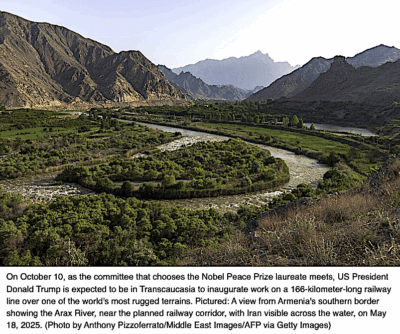
On October 10, as the committee that chooses the Nobel Peace Prize laureate meets, US President Donald Trump is expected to be in Transcaucasia to inaugurate work on a 166-kilometer-long railway line over one of the world’s most rugged terrains.
The planned line is already dubbed the Trump Pathway to Peace and Prosperity, because it ends more than 200 years of on-and-off wars between Turks (initially as Ottomans) and Armenians (as subjects of the Russian czar and later the USSR). The disintegration of the Soviet Empire in the 1990s led to the emergence of a landlocked Armenian state next to what was dubbed the Republic of Azerbaijan, but the conflict continued.
With the Soviet suzerain gone, the two impoverished republics started a war that lasted over a decade and pushed over 300,000 people out of their ancestral villages.
Turkey backed Azerbaijan, with which it shares a more or less similar language, while Iran took Armenia’s side to put a halt to expanding Turkish influence towards the Caspian Basin. Russia tried to hedge its bets because it needed close ties with Azerbaijan in forging a new legal convention for the Caspian, while retaining access to Iran via Armenia’s border.
Iran has a 688-kilometer-long border with Azerbaijan, which is cut by Armenia’s 44-kilometer-long frontier with Iran. That narrow frontier was to be the starting point of what was called the North-South Corridor, linking Iran with Russia and thence Europe via Georgia.
Needless to say, the tense situation between Armenia and Azerbaijan meant that the Iran-Georgia-Russia-Europe railway link was never built. Nevertheless, the Armenian border remained crucial for Iranian transit and trade, with long lines of trucks bringing goods from Russia and, before the Ukraine war, much of eastern and Central Europe.
The transit route became even more important to Iran for beating American and European sanctions with a wink and a nod from Russia and Armenia.
In addition, two important hydroelectric complexes are located in the short border area, making close cooperation between Iran and Armenia vital for both sides. Within a 5-kilometer depth of the border zone, we also find a free-trade zone of some importance to the Iranian provinces of East Azerbaijan and Ardebil. To these, one could add water-management facilities and environmental projects.
The patchwork, created by Stalin’s deliberate divide-and-rule policy, chopped the Azerbaijan Republic into two bits, with the one on the west known as the Autonomous Republic of Nakhichevan, which has a border with Turkey, Iran and Armenia, but not with Azerbaijan itself. Thus, contact between Turkey and Azerbaijan has only been possible via Iranian territory.
The Trump “pathway” is designed to connect two existing railway lines, one between the city of Kars in Turkey to Nakhichevan and another,158 kilometers long, from Velidbag to Ordubad, and extend it with a new 166-kilometer-long line between Ordubad in Nakhichevan and Horadiz in Azerbaijan and thence to Baku on the Caspian.
Had Iran not been isolated diplomatically, the ideal route for the Turkey-Caspian railway would have been through Iranian territory, because it could have also served Iran’s northwestern provinces. The theoretical line via Iran might have also reduced the cost of building pipelines to transit Caspian energy resources to the Mediterranean via Turkey.
The choice of the new route, known as the Zangezur, in the Armenian province of Syunik, shuts Iran out of a trade line that could link Anatolia to Central Asia and China via the Caspian at a time that Iran is also excluded from China’s global belt-and-road scheme.
Needless to say, Tehran isn’t happy about all that.
Iran’s Tasnim news agency, controlled by the Islamic Revolutionary Guard Corps, expresses concern that, in view of Baku’s close ties with Israel, the project could pose a direct threat to Iranian security. The headline of the government daily newspaper in Iran the other day was “America Become Our Neighbor!”
This is because under the Trump “pathway” deal, the border area on the Armenian side to the depth of five kilometers is leased to the US for 99 years. Under the memorandum of understanding by Trump with Azerbaijani President Ilham Aliev and his Armenian counterpart Nikol Pashinyan, the actual border posts will be manned by Armenian guards. But the US will be in control of the entire border by creating a Pathway Zone like the Panama Canal Zone in Central America.
The 99-year lease deal revives the bitter memory of Iran ceding what are now Azerbaijan, Armenia and Nakhichevan to the Russian Empire under the Golistan Treaty in 1813. But when that lease ended, Iran was too weak to demand the return of its lost territories and Russia too strong to even consider handing them back.
At the time, the Qajar rulers of Iran decided to grin and bear it, hoping that the czarist Russian Empire would collapse. But when that happened in 1917, the Qajars were still not strong enough to challenge the new Soviet Empire.
Tehran is also sore that it wasn’t even consulted about such a major change along a crucial border. Nevertheless, the Tehran leadership has decided to welcome the deal brokered by Trump and accept the Pathway, albeit with a few frowns, in the hope that the new situation would help ease tensions with Washington.
One sign that Tehran has decided to accept the new neighbor is the decision to stop the project to build a new military base in Talesh, close to the borders of both Armenia and Azerbaijan, for possible use in an operation to invade and annex Nakhichevan. Thus, the Trump pathway could also make sure that peace is kept between Iran and Azerbaijan.
Iran’s “Supreme Guide” Ali Khamenei has remained totally silent on the issue, implicitly endorsing President Massoud Pezeshkian’s pragmatic approach.
As “neighbors,” Iran and the Pathway Zone Authority will have to cooperate in a number of domains: security, fighting smugglers and drug- and human-traffickers, while contenting well-established joint environmental and water-sharing projects.
The US zone would also need cooperation with Iran to secure part of its electricity, as well as all its oil and gas needs. In other words, Iranian and American personnel will have to learn to talk to each other and work together about practical day-to-day matters rather than hostages, exporting revolution, wiping Israel off the map and nuclear weapons.
Well. One question: Will the Nobel barons recognize Trump as peacemaker?
Amir Taheri was the executive editor-in-chief of the daily Kayhan in Iran from 1972 to 1979. He has worked at or written for innumerable publications, published eleven books, and has been a columnist for Asharq Al-Awsat since 1987.
Gatestone Institute would like to thank the author for his kind permission to reprint this article in slightly different form from Asharq Al-Awsat. He graciously serves as Chairman of Gatestone Europe.
‘Tortured and Gang-Raped’: The Persecution of Christians, July 2025 by Raymond Ibrahim
August 24, 2025
- Muslim extremists now forbid Christians from farming, and punish defiance with shootings, kidnappings, and threats against families. Thousands remain displaced, living in overcrowded shelters with no food or medical care….. Despite military presence, extremist Muslim militias continue to terrorize rural Christian communities with near total impunity. — persecution.org, July 1, 2025 — Nigeria.
- Entire families were found burned alive in their homes. “They came from all sides, shooting and setting houses on fire. Anyone who ran was shot.”…. “The fact that this community… reported the imminent attack to the STF military officers at that military checkpoint makes it more worrisome, suspicious and raises many questions.” — Farmer Ezekiel Dung, persecution.org, July 22, 2025 — Nigeria.
- “[K]illings, kidnappings and robberies persist without real measures being implemented to curb them,” highlighting the Syrian government’s failure to protect Christian and other non-Muslim communities. — syriacpress.com, July 10, 2025 — Syria.
- The situation in Syria’s Christian Valley remains dire. Locals who once defended their communities now face persecution despite promises that Christians would be spared. One resident… explained that his home was “destroyed” and “looted,” and that authorities had “placed an arrest on his piece of land so he could not sell it.” Similar measures were taken against his colleague…. [T]hose who resisted the jihadist forces are now being targeted. — dzen.ru, July 6, 2025 — Syria.
- According to a July 6 report, the situation in Syria’s Christian Valley remains dire. Locals who once defended their communities now face persecution despite promises that Christians would be spared. One resident, Zhoryk, former head of a self-defense unit in the valley, explained that his home was “destroyed” and “looted,” and that authorities had “placed an arrest on his piece of land so he could not sell it.” Similar measures were taken against his colleague… [T]hose who resisted the jihadist forces are now being targeted….. The report illustrates the systematic targeting of Christians who defended their communities: despite prior promises of protection, those who opposed Muslim militants are being punished under the new regime, their homes and property seized, and their leadership removed. — dzen.ru, July 6, 2025 — Syria.
- According to a July 15 report, jihadists and other terrorists loyal to the nation’s new “president,” Ahmed al-Sharaa, attacked the Church of San Michel, a Greek Orthodox church. Militants looted it before setting the church on fire. Local sources described the assault as part of the new regime’s ongoing campaign against non-Sunni populations. — greekcitytimes.com, July 15, 2025 — Syria.
- Turkey announced that the Armenian Cathedral of Ani — a UNESCO-listed site and “once the crown jewel of medieval Armenian architecture” — will reopen not as a church but as a mosque…. — zartonkmeda.com, July 4, 2025 — Turkey.
- World Heritage Watch called on UNESCO to place the Saint Catherine Area in Egypt on the List of World Heritage Sites in Danger due to Egypt’s continued failure to uphold its World Heritage obligations. — orthodoxtimes.com, July 7, 2025 — Egypt.
- [T]he church in Arudy was desecrated with excrement (an old jihadist tactic). Feces were smeared on the inside and outside of the church, and on its altar. Parish priest Father Armand Paillé called it “deliberate and symbolic,” saying vandals sought to “reduce the church and the faithful to what they left behind.” — intoleranceagainstchristians.edu, July 13, 2025 — France.
- [T]hrongs of Muslims surrounding the Helsinki Cathedral, while waving Islamic State flags and engaging in provocative behavior. — x.com, July 9, 2025 — Finland.
- [H]undreds if not thousands of Muslims encircle[ed] Melbourne’s cathedral while waving Islamic flags and engaging in militant behavior. The X account of Christian Emergency Alliance adds that “These are acts of intimidation and insulting attempts at domination. Christians must not tolerate these disrespectful acts of intolerance.” — x.com, July 8, 2025 — Australia.
A video posted at X.com on July 9 shows throngs of Muslims at Helsinki Cathedral, in Finland, waving Islamic State flags and engaging in provocative behavior. Pictured: Helsinki Cathedral. (Photo by iStock/Getty Images)
The following are among the abuses and murders inflicted on Christians by Muslims throughout the month of July 2025.
The Muslim Slaughter of Christians
Nigeria: Below are some of the more notable incidents of the ongoing genocide being carried out against Christians in Nigeria:
On July 7, Muslim Fulanis stormed a Christian service in Yaribori, Katsina state, murdering Pastor Emmanuel Na’allah of Bege Baptist Church and convert Mallam Samaila Gidan Taro. Another Christian woman was abducted. Witnesses said the attackers, riding motorcycles, shouted “Allahu Akbar!” and “Death to infidels!” One recalled: “Reverend Na’allah stood before the pulpit and tried to reason with them. They shot him without hesitation.” The pastor, long an advocate of Muslim-Christian coexistence, had received threats but refused protection. Locals noted the militants deliberately spared nearby Muslim homes. Since January 2023, at least 63 Nigerian pastors have been killed and 89 abducted, notes the report.
A July 1 report offers more details on the situation in Katsina state. It notes that, since 2020, St. Joseph’s Parish has faced relentless attacks from armed Muslim extremists, leaving villages destroyed, Christians abducted, and farms abandoned. Rev. Fr. Stephen Solomon Shidi says that Muslim extremists now forbid Christians from farming, and punish defiance with shootings, kidnappings, and threats against families. Thousands remain displaced, living in overcrowded shelters with no food or medical care. Shidi urged the government to protect Christians and international groups to provide urgent aid: “Many families have lost everything — farms, homes, loved ones.” Despite military presence, extremist Muslim militias continue to terrorize rural Christian communities with near total impunity.
Also on July 7, Muslim herdsmen carried out another bloody attack on neighboring Kaduna state. They killed two Christians, wounded three, and kidnapped others. This attack came just days after Muslim herdsmen abducted Bauda village leader Obadiah Iguda, 48, from his home at 1 a.m. on June 28. Earlier in June, they executed another leader, Mr. Stephen Alhassan, 57, by chasing him down on motorbike and\ shooting him in the leg, before finally blowing his brains out. “The terrorists,” a local leader said, “placed a gun to his forehead, and brutally executed him.” Christians describe living under siege:
“We can no longer sleep in our homes peacefully… our community is being destroyed, our people are being hunted, and our future is being stolen.”
On July 11, Fulani militants stormed the Evangelical Church Winning All, in Kaduna state, killing five Christians and wounding three. “We constantly live in fear every day,” said resident Happiness Daniel. The latest bloodshed follows months of terror in Kajuru County, where, since January, more than 110 Christians have been kidnapped. Muslim raids have burned churches, destroyed homes, and abducted dozens—entire families have been torn from villages such as Bauda, Ungwan Yashi, and Makyali. “This senseless act of violence has further deepened the atmosphere of insecurity and fear,” said community leader Stephen Maikori. He noted that another pastor was recently butchered and 38 Christians abducted, most still missing. Witnesses describe armed Muslim herdsmen shouting threats and deliberately targeting Christians while sparing Muslim neighbors.
“It’s with so much pain in my heart to intimate you about the constant attacks on our peace-loving communities,” said resident Jonah Dodo, about government inaction.
In the early hours of July 14, Muslim Fulani militias stormed the Christian farming village of Jebu in Plateau State, killing at least 32 people, including women, children, and even a three-month-old baby. Survivors described a coordinated assault: gunmen surrounded the village at 3 a.m., firing into homes and setting houses, farmlands, and the local church ablaze. Entire families were found burned alive in their homes. “They came from all sides, shooting and setting houses on fire. Anyone who ran was shot,” said farmer Ezekiel Dung, who narrowly escaped. Community leaders accused nearby soldiers of failing to intervene, with some even preventing local youths from defending their homes.
Governor Caleb Mutfwang condemned the massacre as “organized violence against innocent people” and rejected the label of a “farmers-herders clash.”
Survivors like Rev. Musa Alamba, who lost his church and home, now shelter under trees, begging for aid: “I have lost everything.”
During the July 25 mass burial of the aforementioned slain Christians, James Nyango, a human rights activist, said,
“These are dead bodies of innocent Christians who were brutally and gruesomely murdered during their sleep by Muslim Fulani killer herdsmen and terrorists in a community situated less than 200 meters from the Special Task Force (STF), a military check point in Riyom Local Government Area. The fact that this community noticed and reported the imminent attack to the STF military officers at that military checkpoint makes it more worrisome, suspicious and raises many questions.”
Another local leader said the Muslim terrorists “went house to house killing the elderly, women and children.”
Another report from July 7 tells of more massacres of Christians in both Benue and Plateau States, and quotes youth leader Zang Davou of Plateau saying:
“In just a few weeks, 58 innocent lives were brutally murdered in cold blood – fathers, mothers, children and youths… We are tired of burying our loved ones… tired of seeing our heritage destroyed.”
Democratic Republic of the Congo: On Sunday, July 27, Islamic terrorists slaughtered at least 40 Christians in an attack on the Catholic Church of the Blessed Anuarite. Local sources said the terrorists struck around 1:00 a.m., targeting roughly 30 worshippers preparing for a Eucharistic ceremony. “They shot the Christians at point-blank range,” said Christophe Munyanderu, coordinator of the Convention for the Respect of Human Rights. Machetes and gunfire were used to slaughter others inside the church. Some young Christians were abducted and several homes set ablaze. Bodies remained on the ground Sunday morning, and churches stayed closed. A total of at least 82 Christians were similarly slaughtered during the month of July, the report adds.
Uganda: On Friday, July 18, Kasajja Abdul Maliki, a 37-year-old Christian convert, was murdered by his Muslim relatives while praying at home during mosque service. Since accepting Christ on April 12, Maliki had been locking himself at home on Fridays to pray and study the Bible. “I then alerted the family members about Maliki’s strange way of praying, who hurriedly went to his house,” said his niece, Shamina, daughter of Maliki’s older brother Lubega Kalimu. “They found the house locked as Maliki was still praying. They pushed the door very hard and got inside and found Maliki still praying with the Bible placed beside him.” Relatives tore his Bible to pieces and attacked him while crying “Allah Akbar,” Shamina said. “Soon more members of the family arrived with knives and sticks led by my father, Kalimu, and Sempa Arafat. As Maliki screamed for help, Kalimu with a sharp knife pierced him through his chest.”
Neighbors arrived too late to intervene. “We tried to rescue Maliki,” one said, but it was too late to save his life, and he died on his way to a nearby clinic.”
Syria: According to a July 10 report, George Ishoh, a Christian goldsmith, was shot dead outside his home in Hmoth, after refusing to pay protection money (jizya) to armed Muslims. The masked assailants shot him “with a bullet in the head” before fleeing. Neighbors rushed the married father to a nearby hospital, but he died. The killing comes amid escalating insecurity in Christian areas, despite prior government assurances of protection following the bombing of the Mar Elias Greek (Rûm) Orthodox Church in Daramsuq, which killed dozens of Christians in June. The report notes that “killings, kidnappings and robberies persist without real measures being implemented to curb them,” highlighting the Syrian government’s failure to protect Christian and other non-Muslim communities.
Similarly, according to a July 6 report, the situation in Syria’s Christian Valley remains dire. Locals who once defended their communities now face persecution despite promises that Christians would be spared. One resident, Zhoryk, former head of a self-defense unit in the valley, explained that his home was “destroyed” and “looted,” and that authorities had “placed an arrest on his piece of land so he could not sell it.” Similar measures were taken against his colleague, Beshar, also a former Christian leader in the National Defense forces. Zhoryk’s unit had not only protected their own district but had helped liberate Maaloula and other key Christian towns from Islamist fighters.
Despite these efforts, those who resisted the jihadist forces are now being targeted. Even older veterans are not safe: “An uncle who led a Syrian unit in 1973… and his son” were recently arrested, signaling a clear message about who the authorities favor and who faces retribution. Christian residents in general are “confused and in a daze,” with “no leaders, no structure, no plans, no resources” to resist further attacks.
Zhoryk himself is “unable to work much” after sustaining injuries, leaving the local population vulnerable. The report illustrates the systematic targeting of Christians who defended their communities: despite prior promises of protection, those who opposed Muslim militants are being punished under the new regime, their homes and property seized, and their leadership removed.
Rape, Persecution, and Forced Conversion in Pakistan
According to a July 23 report, Muslim relatives of a man who raped a 14-year-old Christian girl are threatening her family to drop all charges against the rapist, or else. The girl’s father shared the troubling details in an interview. He said that Sajid Ali, a married son of his employer Mukhtar Ali, went to his house on June 14 while he and his wife were working in the fields and
“raped her [his daughter] at gunpoint and before leaving threatened her that he would kill me if she told anyone about the incident. Fearing for my life, my innocent daughter kept silent about the barbarity that she had suffered at the hands of Sajid Ali.”
Over the following days, the parents noticed that their daughter was not behaving like herself and was withdrawn:
“When her mother finally convinced her to share what was troubling her, she started crying and told her how Sajid Ali had raped her and threatened her to keep her mouth shut… [O]ur minds went numb with shock and fear, and we thought it was best for our family if we just kept quiet … [since] we did not stand any chance to get justice due to our poverty and Christian faith.”
The family’s silence, however, emboldened the rapist to target the girl again on July 12:
“We were working in the fields when someone told us that they had seen Sajid entering our house. We quickly rushed home only to hear [daughter’s name withheld] screaming in pain. I forced opened the room’s door and saw Sajid attempting to rape my daughter. He threatened to kill us if we tried to stop him from escaping, but we got hold of him and immediately called the police.”
The authorities eventually arrested Ali; then,
“When the police conducted her medical examination and confirmed that she had been raped, Ali’s family offered me 1 million Pakistani rupees [$3,500 USD] to withdraw the case. When I rejected their offer, they started threatening me with dire consequences if I did not accept their demand…. Though the accused is now in prison on judicial remand, his family has stepped up their threats, and I’m very concerned about my daughter’s security.”
On July 9, a judge handed a life sentence to a Muslim man guilty of abducting and raping a Christian girl, but ignored accusations of forcible conversion, fraudulent marriage, and gang-rape by accomplices. Ahmed Raza, a Muslim man, had abducted at gunpoint and raped a 12-year-old Christian girl, before forcibly converting her and fabricating a fake Islamic marriage certificate. Attorney Hanif Hameed described how Raza and three accomplices “took the child to an unknown location where the convict and three others tortured and gang-raped her multiple times during her month-long captivity.” They also,
“forcibly converted the minor and fabricated a fake Islamic marriage certificate … to cover up their heinous crime…. Moreover, in her statement recorded under Section 164, the child had categorically said that she was gang-raped by four persons and even nominated their names… However, the judge rejected the gang-rape charge and only convicted Raza under Section 376(iii)…. I had submitted as evidence the order of the family court judge… in which he had stated that the victim was Christian by birth and she had been forcibly converted and subjected to fake marriage. However, it seems the judge was not inclined to give a ruling on this crucial matter.”
On July 21, Shamraiz Masih, a 14-year-old Christian boy, was forcibly converted to Islam by his Muslim employer, and was last reported as being kept in illegal custody. Shamraiz, a member of the local Presbyterian church, had been working as an apprentice at motorcycle repair shop owner Rana Munir’s workshop after his father’s death to help his family survive. On July 21, he went to the market but never returned. A search was conducted, and his brothers learned that Shamraiz had been taken to an Islamic seminary. “When the boys went to the madrassa and asked for their brother, they were told that Shamraiz had willfully converted to Islam and was no longer a part of their family,” said attorney Tahir Naveed Chaudhry, adding that it was clear Munir forcibly converted Shamraiz “to keep him in permanent bondage.” The Punjab Provincial Assembly condemned the act:
“The appeals of the boy’s widowed mother for his recovery have caused pain and anguish in the entire Christian community… It’s time that the government takes action against abduction and forced conversions of minor girls and boys.”
According to a July 5 report, a video emerged showing a 5-year-old Christian boy and his father recounting how the child was beaten by his Muslim female teacher for drinking water from her glass. The boy and his father explained that he was “scolded, slapped, and verbally abused” simply for quenching his thirst during a July heatwave. Underscoring that religious hostility moved her, the teacher had called him “Issai Chura,” an anti-Christian derogatory term used to demean Christians in Pakistan. Discussing this video, Pastor Imran Amanat said,
“This child did nothing wrong. He was thirsty—like any human being in this extreme heat. But he was punished simply for being a Christian. We are witnessing more cases like this where Christians are not allowed to drink from public sources or share utensils with Muslims … We condemn this Christian-phobia that continues to grow in our society. The physical and emotional damage caused to Christian children and families is serious and must not be ignored.”
Sardar Mushtaq Gill, founder of LEAD Ministries and a human rights lawyer, echoed these sentiments:
“This is a clear example of religious hatred being taught and practiced in places that should be safe for all children.”
Muslim Attacks on Christian Churches
Syria: According to a July 15 report, jihadists and other terrorists loyal to the nation’s new “president,” Ahmed al-Sharaa, attacked the Church of San Michel, a Greek Orthodox church. Militants looted it before setting the church on fire. Local sources described the assault as part of the new regime’s ongoing campaign against non-Sunni populations. In the days that followed, hundreds of members of the Druze community—including women and children—were especially targeted for slaughter and worse during the purge.
Sudan: According to a July 7 report, Muslim extremists, with support from Sudanese Armed Forces (SAF) and police, demolished a Pentecostal Church complex that had stood in Khartoum’s El Haj Yousif neighborhood since the early 1990s. Targeted attacks on churches have persisted amid Sudan’s civil conflict, which began in April 2023. Previous incidents include a December 2024 SAF airstrike on a Khartoum church killing 11 people, including eight children, and Rapid Support Forces bombings in June 2025 of three churches in El Fasher over two days. In February 2018, authorities razed another Presbyterian Evangelical Church in the same El Haj Yousif neighborhood.
Indonesia: On July 5, hundreds of Muslims protested the construction of a church in West Java, shouting “Reject! Reject! Demolish!” near the site after the first stone was laid earlier that day. Although church leaders had done everything legally—obtaining a permit, meeting with local leaders, and even getting approval from 60% of local residents—opposition erupted, reflecting ongoing tensions over church construction in Muslim Indonesia.
Separately, according to a July 10 report, Pastor Matias was ordered to stop leading worship services by a new Muslim imam at a mosque just 55 yards from his church. The imam claimed the services were disturbing Muslims, following anger over a Muslim woman who had recently converted to Christianity. Even though the woman insisted that Pastor Matias “wasn’t the one who baptized her and didn’t pressure her to leave Islam,” rumors immediately spread that the pastor was secretly “trying to convert the entire village to Christianity.” After the imam issued his order, rumors circulated that a group of Muslim men would prevent services, prompting the church to post guards overnight.
Finally, on July 27, a Muslim mob stormed a Christian prayer house in West Sumatra, disrupting religious education for children and injuring two Christian students, ages 7 and 11. Witnesses said the attackers shouted “Allahu Akbar,” wielded knives, stones, and wooden blocks, and damaged property inside and outside the facility. The Communion of Churches in Indonesia condemned the attack:
“Acts of terror accompanied by violence aimed at disrupting religious services in front of children will undoubtedly cause lasting trauma to their development.”
Turkey: According to a July 4 report, Turkey announced that the Armenian Cathedral of Ani — a UNESCO-listed site and “once the crown jewel of medieval Armenian architecture” — will reopen not as a church but as a mosque, thereby “erasing its Armenian Christian identity.” Originally built in 987, the cathedral was forcibly converted into a mosque in 1064 when Seljuk Sultan Muhammad (Alp Arslan) conquered Ani and held his first Friday prayer there, renaming it the “Fethiye [Conquest] Mosque.” Today, the same name is being reapplied, with no mention of its historic role as a Christian church. The report adds that, once known as the “City of 1,001 Churches,” Ani now faces “the threat of erasure under the guise of restoration.”
Egypt: World Heritage Watch called on UNESCO to place the Saint Catherine Area in Egypt on the List of World Heritage Sites in Danger due to Egypt’s continued failure to uphold its World Heritage obligations. After President Sisi attempted to assuage world concerns over Egyptian plans to appropriate the monastery, Chair Stephan Doempke said,
“Egypt has continued to provide misleading, inconsistent or incomplete information to UNESCO, and it is time now that UNESCO is very clear that they are running out of patience… the remoteness and serenity of the area, a key value of the World Heritage, must be preserved under all circumstances in order to maintain the sacred character of the landscape and enable the spiritual retreat of the monks.”
France: On July 7, around 1:40pm, a man climbed onto the altar of the Sacré-Coeur Basilica, “gesticulating violently” while crying out three times, “Allah Akbar.” When a cleaner tried to stop him, the Muslim man punched him.
Separately, on July 13, the church in Arudy was desecrated with excrement (an old jihadist tactic). Feces were smeared on the inside and outside of the church, and on its altar. Parish priest Father Armand Paillé called it “deliberate and symbolic,” saying vandals sought to “reduce the church and the faithful to what they left behind.”
Finland: A July 9 video shows throngs of Muslims surrounding the Helsinki Cathedral, while waving Islamic State flags and engaging in provocative behavior.
Australia: A July 8 video shows hundreds if not thousands of Muslims encircling Melbourne’s cathedral while waving Islamic flags and engaging in militant behavior. The X account of Christian Emergency Alliance adds that “These are acts of intimidation and insulting attempts at domination. Christians must not tolerate these disrespectful acts of intolerance.”
Muslim Persecution of Apostates to Christianity
Egypt: On July 22, Egyptian authorities charged Saeid Mansour Abdulraziq, a Christian convert from Islam, with terrorism after he requested his identification documents be changed from Muslim to Christian. Abdulraziq, arrested in Cairo on July 15, also faces charges of “creating unrest” and “spreading misinformation.” A Cairo-based attorney, Saeid Fayaz, said this was a common scenario:
“Thousands of Christian converts in Egypt have no rights, and they receive little support. They live in isolation and constant fear.”
Iran: On July 3, Iranian Christian convert Mehran Shamloui was deported from Turkey to Iran, where he was immediately arrested at Mashhad Airport. Shamloui had fled Iran after receiving a 10-year, 8-month prison sentence in March 2025 for “propaganda against Islam” and house church involvement. Though he posted bail after a 2024 arrest, his appeal was rejected, forcing him to attempt escape through Turkey. However, lacking documents, he was deported under Turkey’s practice of expelling Christians with so-called “N-82” security codes and invoking Article 9 of the Alien Act. According to the European Centre for Law and Justice,
“These expulsions systematically target Christians, perceived as ‘threats’ because of their faith and missionary activities. However, no equivalent measures have been taken against foreign Muslim missionaries.”
Raymond Ibrahim, author of Defenders of the West, Sword and Scimitar, Crucified Again, and The Al Qaeda Reader, is the Distinguished Senior Shillman Fellow at the Gatestone Institute and the Judith Rosen Friedman Fellow at the Middle East Forum.
About this Series
While not all, or even most, Muslims are involved, persecution of Christians by extremists is growing. The report posits that such persecution is not random but rather systematic, and takes place irrespective of language, ethnicity, or location. It includes incidents that take place during, or are reported on, any given month.
CNN Continues to Beclown Themselves in Their Ongoing Quest to ‘Get’ Trump (VIDEO)
Discrimination and Violence Against Conservative Children in Alachua
Detroit Border Protection Agents Seize 52 lbs of Monkey Meat from Passenger Traveling from Africa
🚨 BREAKING: Uprising In Iran Reaches MULTIPLE Cities – IRGC Prepare Crackdown [31:02] Mahyar Tousi
August 23, 2025 @ 3:30 pm ET Tousi TV
Illinois Governor JB Pritzker Signs Bill Allowing Immigrants to Become Driving Instructors
Under ISIS- and al-Qaeda-Affiliated Rule: Syrian Massacre of Minorities Threatens to Reoccur
Cleaning Up Biden’s Mess: Trump Administration Reviewing 55 Million Visas for Violations
Law Professor Jonathan Turley Suggests John Bolton Could Face Decades in Prison (VIDEO)
Obama Judge Blocks Trump Admin From Withholding Funds From More Than 30 ‘Sanctuary Cities’
BREAKING: John Bolton Under Investigation For Violating Sections of Espionage Act: Report